
In a Δ PQR, PS is the bisector of ∠P, meeting side QR at S. If PQ = 7.2 cm, QR = 7 cm, and QS = 3.6 cm, find PR.
6.8 cm
The angle bisector theorem says that the bisector of an angle of a triangle divides the opposite side in the ratio of the other two sides. Here the bisector from P meets QR at S, so \( \frac{PQ}{PR} = \frac{QS}{SR} \).
First find the other part of the base: \( SR = QR - QS = 7 - 3.6 = 3.4 \) cm. Substituting the values: \( \frac{7.2}{PR} = \frac{3.6}{3.4} \).
Cross multiplying: \( PR = \frac{7.2 \times 3.4}{3.6} = 2 \times 3.4 = 6.8 \) cm. Check: \( \frac{7.2}{6.8} = \frac{3.6}{3.4} \) since both ratios simplify to \( \frac{18}{17} \).
Hence, 6.8 cm.
Similar Questions
In Δ ABC, AB = 12 cm. ∠A is bisected internally to intersect BC at D. BD = 7 cm and DC = 8.75 cm. What is the length of CA?
- If the ratio of the corresponding sides of two similar triangles is 2 ∶ 3, then the ratio of their corresponding altitudes is
Which of the following is Pythagorean triplet?
If ΔABC ≅ ΔXYZ and ∠BAC = 55°, then ∠ZXY = ?
ΔDEF is similar to ΔPQR. If the ratio of semi-perimeter of ΔDEF and ΔPQR is 4 : 5 and if PQ = 15cm, then the length of DE is:
In △ABC, DE ∥ AC, where D and E are the points on sides AB and BC, respectively. If BD = 10 cm and AD = 13 cm, then what is the ratio of the area of △BDE to the trapezium ADEC?
ΔABC is similar to ΔRST. If the ratio of altitudes of ΔABC : ΔRST is 1 : 4 and if RS = 6 cm, then find the length of AB.
In ΔABC, AB = 8 cm. ∠A is bisected internally to intersect BC at D. BD = 6 cm and DC = 7.5 cm. What is the length of CA?
Important Questions from Triangles, Congruence and Similarity
In a $\Delta ABC$, $\angle C = (9/4) \angle B = (3/2) (\angle A+\angle B)$. Find the measure of the angles.
- The areas of two similar triangles $\Delta$XYZ and $\Delta$LMN are 49 cm$^2$ and 9 cm$^2$, respectively. If LM = 9 cm, then the length of XY is:
Triangles \(PQR\) and \(ABC\) are similar triangles. Triangle \(ABC\) have the following sides
\(AB = 12 \text{ cm}\),
\(AC = 15 \text{ cm}\),
\(CB = 21 \text{ cm}\).
Triangle \(PQR\) have the following sides:
\(PQ = 4 \text{ cm}\),
\(RQ = 7 \text{ cm}\).
What is the length of side \(PR\)?
For a pair of similar triangles, the angles made at \(Q\) is same in both the triangles \(PQR\) and \(LQJ\).
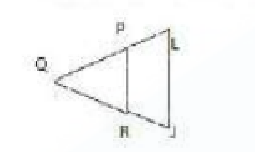
If the length of side \(QJ\) is 10 cm and \(QR\) is 5 cm, what is the ratio of their total areas?- In $\Delta ABC$ $\overline{PQ} \parallel \overline{AB}$. P and Q are on BC and CA respectively. If CQ : QA = 1 : 3 and CP = 4, then what is the value of BC?



