
ΔABC is similar to ΔRST. If the ratio of altitudes of ΔABC : ΔRST is 1 : 4 and if RS = 6 cm, then find the length of AB.
1.5 cm
Understanding Similar Triangles and Altitudes
The problem involves two similar triangles, ΔABC and ΔRST. We are given information about the ratio of their corresponding altitudes and the length of one side in ΔRST. We need to find the length of the corresponding side in ΔABC.
When two triangles are similar, their corresponding angles are equal, and the ratio of their corresponding sides is constant. A crucial property of similar triangles is that the ratio of their corresponding altitudes, medians, and angle bisectors is equal to the ratio of their corresponding sides.
Applying the Ratio of Altitudes and Sides in Similar Triangles
Given that ΔABC is similar to ΔRST, let \(h_1\) be the altitude of ΔABC corresponding to side AB, and \(h_2\) be the altitude of ΔRST corresponding to side RS. The problem states that the ratio of altitudes of ΔABC to ΔRST is 1 : 4.
So, we have:
\(\frac{\text{Altitude of } \Delta\text{ABC}}{\text{Altitude of } \Delta\text{RST}} = \frac{h_1}{h_2} = \frac{1}{4}\)
According to the property of similar triangles, the ratio of corresponding sides is equal to the ratio of corresponding altitudes. Side AB in ΔABC corresponds to side RS in ΔRST because the triangles are similar (ΔABC ~ ΔRST) in that specific order of vertices.
Therefore, we can write the proportion:
\(\frac{\text{Length of AB}}{\text{Length of RS}} = \frac{\text{Altitude of } \Delta\text{ABC}}{\text{Altitude of } \Delta\text{RST}}\)
Substituting the given values:
\(\frac{\text{AB}}{6 \text{ cm}} = \frac{1}{4}\)
Calculating the Length of Side AB
Now we can solve the equation for AB:
\(\text{AB} = 6 \text{ cm} \times \frac{1}{4}\)
\(\text{AB} = \frac{6}{4} \text{ cm}\)
\(\text{AB} = \frac{3}{2} \text{ cm}\)
\(\text{AB} = 1.5 \text{ cm}\)
Thus, the length of side AB is 1.5 cm.
Summary of Steps
Here's a breakdown of the process:
- Identified the given information: Similar triangles, ratio of altitudes, length of corresponding side RS.
- Recalled the property that the ratio of corresponding altitudes in similar triangles equals the ratio of corresponding sides.
- Set up a proportion: \(\frac{\text{AB}}{\text{RS}} = \frac{\text{Altitude ratio}}{1}\).
- Substituted the known values into the proportion.
- Solved the equation for the unknown side length AB.
| Property of Similar Triangles | Ratio |
|---|---|
| Ratio of Corresponding Sides | \(\frac{\text{AB}}{\text{RS}} = \frac{\text{BC}}{\text{ST}} = \frac{\text{AC}}{\text{RT}}\) |
| Ratio of Corresponding Altitudes | \(\frac{h_{ABC}}{h_{RST}} = \frac{1}{4}\) |
| Relationship | \(\frac{\text{AB}}{\text{RS}} = \frac{h_{ABC}}{h_{RST}}\) |
Revision Table: Similar Triangle Properties
Understanding the properties of similar triangles is key to solving geometry problems like this one.
| Property | Description |
|---|---|
| Corresponding Angles | All pairs of corresponding angles are equal. (\(\angle A = \angle R\), \(\angle B = \angle S\), \(\angle C = \angle T\)) |
| Corresponding Sides | The ratio of all pairs of corresponding sides is constant. This constant ratio is called the scale factor. |
| Altitudes, Medians, Angle Bisectors | The ratio of corresponding altitudes, medians, and angle bisectors is equal to the ratio of corresponding sides (the scale factor). |
| Perimeters | The ratio of the perimeters is equal to the ratio of corresponding sides (the scale factor). |
| Areas | The ratio of the areas is equal to the square of the ratio of corresponding sides (the square of the scale factor). |
Additional Information: Scale Factor in Similar Triangles
The scale factor is a very important concept when dealing with similar figures, including similar triangles. It is the constant ratio by which all linear dimensions of a figure are scaled to produce a similar figure.
- If the scale factor is greater than 1, the similar figure is an enlargement.
- If the scale factor is between 0 and 1, the similar figure is a reduction.
- In this problem, the ratio of altitudes from ΔABC to ΔRST is 1:4. This implies that ΔABC is a reduction of ΔRST, or ΔRST is an enlargement of ΔABC with a scale factor of 4 relative to ΔABC.
- The ratio of corresponding sides (AB/RS) is also the scale factor if we are going from the smaller triangle to the larger one, or its reciprocal if going from larger to smaller. Here, the ratio \(\frac{\text{AB}}{\text{RS}} = \frac{1}{4}\), meaning the scale factor from ΔRST to ΔABC is \(\frac{1}{4}\).
Understanding the scale factor helps relate not just sides and altitudes, but also perimeters, medians, and angle bisectors.
Similar Questions
In Δ ABC, AB = 12 cm. ∠A is bisected internally to intersect BC at D. BD = 7 cm and DC = 8.75 cm. What is the length of CA?
- If the ratio of the corresponding sides of two similar triangles is 2 ∶ 3, then the ratio of their corresponding altitudes is
Which of the following is Pythagorean triplet?
If ΔABC ≅ ΔXYZ and ∠BAC = 55°, then ∠ZXY = ?
ΔDEF is similar to ΔPQR. If the ratio of semi-perimeter of ΔDEF and ΔPQR is 4 : 5 and if PQ = 15cm, then the length of DE is:
In △ABC, DE ∥ AC, where D and E are the points on sides AB and BC, respectively. If BD = 10 cm and AD = 13 cm, then what is the ratio of the area of △BDE to the trapezium ADEC?
In a Δ PQR, PS is the bisector of ∠P, meeting side QR at S. If PQ = 7.2 cm, QR = 7 cm, and QS = 3.6 cm, find PR.
In ΔABC, AB = 8 cm. ∠A is bisected internally to intersect BC at D. BD = 6 cm and DC = 7.5 cm. What is the length of CA?
Important Questions from Triangles, Congruence and Similarity
In a $\Delta ABC$, $\angle C = (9/4) \angle B = (3/2) (\angle A+\angle B)$. Find the measure of the angles.
- The areas of two similar triangles $\Delta$XYZ and $\Delta$LMN are 49 cm$^2$ and 9 cm$^2$, respectively. If LM = 9 cm, then the length of XY is:
Triangles \(PQR\) and \(ABC\) are similar triangles. Triangle \(ABC\) have the following sides
\(AB = 12 \text{ cm}\),
\(AC = 15 \text{ cm}\),
\(CB = 21 \text{ cm}\).
Triangle \(PQR\) have the following sides:
\(PQ = 4 \text{ cm}\),
\(RQ = 7 \text{ cm}\).
What is the length of side \(PR\)?
For a pair of similar triangles, the angles made at \(Q\) is same in both the triangles \(PQR\) and \(LQJ\).
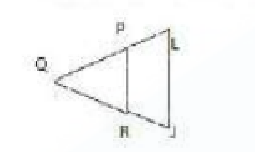
If the length of side \(QJ\) is 10 cm and \(QR\) is 5 cm, what is the ratio of their total areas?- In $\Delta ABC$ $\overline{PQ} \parallel \overline{AB}$. P and Q are on BC and CA respectively. If CQ : QA = 1 : 3 and CP = 4, then what is the value of BC?



