
If angles of a triangle are in the ration of 2 : 3 : 4, then the measure of the smallest angle is:
40°
Solving for Triangle Angles Given Ratio
The question provides the ratio of the angles of a triangle as \(2 : 3 : 4\). We need to find the measure of the smallest angle.
Understanding Triangle Angle Properties
A fundamental property of any triangle is that the sum of its interior angles is always \(180^\circ\). This property is key to solving this problem.
Representing the Angles
Since the angles are in the ratio \(2 : 3 : 4\), we can represent the angles as \(2x\), \(3x\), and \(4x\), where \(x\) is a common multiplier.
Setting Up the Equation
Using the property that the sum of angles in a triangle is \(180^\circ\), we can write the equation:
\[2x + 3x + 4x = 180^\circ\]
Solving for x
Combine the terms on the left side of the equation:
\[(2 + 3 + 4)x = 180^\circ\]
\[9x = 180^\circ\]
Now, divide both sides by 9 to find the value of \(x\):
\[x = \frac{180^\circ}{9}\]
\[x = 20^\circ\]
Calculating the Measure of Each Angle
Now that we have the value of \(x\), we can find the measure of each angle:
- First angle = \(2x = 2 \times 20^\circ = 40^\circ\)
- Second angle = \(3x = 3 \times 20^\circ = 60^\circ\)
- Third angle = \(4x = 4 \times 20^\circ = 80^\circ\)
Identifying the Smallest Angle
Comparing the three angle measures \(40^\circ\), \(60^\circ\), and \(80^\circ\), the smallest angle is \(40^\circ\).
Summary of Angles
| Ratio Part | Expression | Angle Measure |
|---|---|---|
| 2 | \(2x\) | \(40^\circ\) |
| 3 | \(3x\) | \(60^\circ\) |
| 4 | \(4x\) | \(80^\circ\) |
The sum of these angles is \(40^\circ + 60^\circ + 80^\circ = 180^\circ\), which confirms our calculation is correct.
Conclusion
The measure of the smallest angle in the triangle is \(40^\circ\).
Revision Table: Triangle Angles Ratio
| Concept | Key Idea | Application in Problem |
|---|---|---|
| Sum of angles in a triangle | Always \(180^\circ\) | Used to form the equation \(2x + 3x + 4x = 180^\circ\) |
| Angles in ratio | Represent angles as multiples of a variable (e.g., \(2x, 3x, 4x\)) | Used to set up terms for the equation |
| Solving linear equation | Find the value of the unknown variable \(x\) | Calculated \(x = 20^\circ\) |
| Finding angle measures | Substitute the value of \(x\) back into angle expressions | Calculated angles as \(40^\circ, 60^\circ, 80^\circ\) |
Additional Information: Types of Triangles by Angles
Triangles can be classified based on their angle measures:
- Acute Triangle: All three angles are less than \(90^\circ\). The triangle in this problem (angles \(40^\circ, 60^\circ, 80^\circ\)) is an acute triangle.
- Right Triangle: One angle is exactly \(90^\circ\). The other two angles must be acute.
- Obtuse Triangle: One angle is greater than \(90^\circ\). The other two angles must be acute.
Understanding the sum of angles and how to work with ratios is fundamental in solving various geometry problems related to triangles.
Similar Questions
The distance between the points (4, 8) and (k, -4) is 13. What is the value of k?
What is the reflection of the point (-0.5, 6) in the x-axis?
In the triangle, if AB = AC and ∠ABC = 72°, then ∠BAC is:
In a ΔABC, the bisectors of ∠B and ∠C meet at point O, inside the triangle. If ∠BOC = 122°, then the measure of ∠A is:
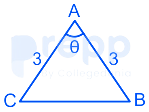
In the given figure ΔABC, if θ = 80°, the measure of each of the other two angles will be:
The angles of a triangle are (8x - 15)°,(6x - 11)° and ( 4x – 10)°. What is the value of x ?
Point A divides segment BC in the ratio 1 : 3. The co-ordinates of B are (4, -4) and that of C are (0, 6). What are the co-ordinates of point A?
What is the equation of a line having a slope -1/3 and y-intercept equal to 6?
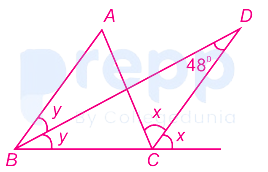
In the given figure, ABC is a triangle. The bisectors of internal DB and external DC interest at D. If ∠BDC = 48°, then what is the value (in degrees) of ∠A?
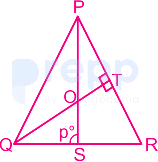
In ΔPQR, QT ⊥ PR and S is a point on QR such that ∠PSQ = p°. If ∠TQR = 46° and ∠SPR = 32°, then the value of p is∶
Important Questions from Lines and Angles
Two parallel lines are intersected by a transversal, the corresponding angles are:
If l, m, n are lines such that, l is parallel to n and m is parallel to n, then, ______
There are three points P, Q and R on a straight line such that PQ : QR = 3 : 5. If n is the number of possible values of PQ : PR, then what is n equal to ?
Two cars start from a point at the same time and travel on two different roads at right angles to each other. Their speed is 18 km/h and 72 km/h respectively. What will be the distance between them after 6 seconds?
If the angles of a triangle are in the ratio of 2 : 3 : 5, then find the ratio of the greatest angle to the smallest angle.
A. 7 : 2
B. 5 : 2
C. 5 : 3
D. 3 : 5



