
Host A (on TCP/IPv4 Networks) send an IP Datagram D to host B (also on TCP/IPv4 network). Assume that no error occured during transmission of D, when D reaches B. Which of following header field may differ from that of original datagram D ? (A) TTL (B) Checksum (C) Fragment offset (D) Source IP (E) Destination IP Choose the correct answer from the options given below :
(A), (B) and (C) Only
As an IPv4 datagram crosses routers, some header fields are legitimately rewritten at each hop even when no transmission error occurs, while the addressing fields stay fixed end to end (ignoring NAT, which the question does not involve).
(A) TTL may differ: every router decrements Time To Live by 1 before forwarding.
(B) Checksum may differ: the header checksum covers the header, so it is recomputed at every router after TTL (and possibly other fields) change.
(C) Fragment offset may differ: if a link's MTU is smaller than the datagram, a router fragments it, and the fragments that reach B carry new offset values (and flags and total length).
(D) Source IP and (E) Destination IP do not change in ordinary IP forwarding; routers deliver the datagram from the original source address to the original destination address.
So the fields that may differ are TTL, checksum and fragment offset; choices adding the source or destination address are wrong, and the choice with only TTL and checksum misses fragmentation.
(A), (B) and (C) Only option is correct.
Similar Questions
In a classful addressing, first four bits in Class D IP address is
In a classful addressing, the IP addresses with 0 (zero) as network number :
Which of the following fields in IPv 4 datagram is not related to fragmentation ?
Which of the following is/are restriction(s) in classless addressing ?
What is the size of the ‘total length’ field in IPv 4 datagram ?
A network on the Internet has a subnet mask of 255.255.240.0. What is the maximum number of hosts it can handle ?
Which of the following is used in the options field of IPv4 ?
Match List - I with List - II.
List - I (IP Address) List - II (Class) (A) 10.20.30.40 (I) Class E (B) 210.20.30.3 (II) Class B (C) 180.30.100.10 (III) Class A (D) 252.5.15.11 (IV) Class C Choose the correct answer from the options given below :
(A) In IPv4 addressing, a block of address can be define as x.y.z.t/n in which x.y.z.t define one of the address and /n define the mask
(B) The first address in the block can be found by setting the rightmost 32-n bits to 0s
(C) Address of class C is used for multicast communication
(D) There are five classes in IPv4 address
(E) Supernetting combine several networks into one large network
Choose the correct answer from the options given below :
Consider two hosts P and Q are connected through a router R. The maximum transfer unit (MTU) value of the link between P and R is 1500 bytes and between R and Q is 820 bytes. A TCP segment of size of 1400 bytes is transferred from P to Q through R with IP identification value of 0x12334. Assume that IP header size is 20 bytes. Further the packet is allowed to be fragmented that is Don’t Fragment (DF) flag in the IP Header is not set by P.
Which of the following statement is/are not true?
A. Two fragments are created at R and IP datagram size carrying the second fragment is 620 bytes
B. If the second fragment is lost then R resend the fragment with IP Identification value of 0x1234
C. If the second fragment lost then P required to resend the entire TCP segment
D. TCP destination port can be determined by analyzing the second fragment only
Choose the correct answer from the options given below:
Important Questions from IPv4
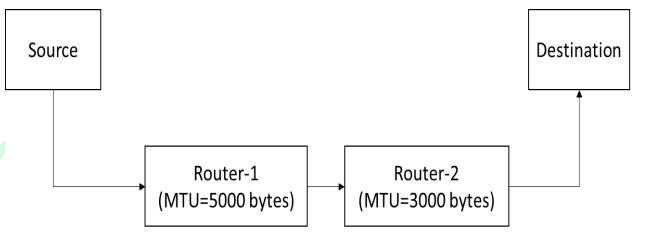
Suppose a message of size 15000 bytes is transmitted from a source to a destination using IPv4 protocol via two routers as shown in the figure. Each router has a defined maximum transmission unit (MTU) as shown in the figure, including IP header. The number of fragments that will be delivered to the destination is ________ . (Answer in integer)
- A machine receives an IPv4 datagram. The protocol field of the IPv4 header has the protocol number of a protocol X.
Which ONE of the following is NOT a possible candidate for X? - Consider a network that uses Ethernet and IPv4. Assume that IPv4 headers do not use any options field. Each Ethernet frame can carry a maximum of 1500 bytes in its data field. A UDP segment is transmitted. The payload (data) in the UDP segment is 7488 bytes.
Which ONE of the following choices has the CORRECT total number of fragments transmitted and the size of the last fragment including IPv4 header? Which class of IPv4 addresses supports the largest number of host addresses in a computer network?
- What is the maximum value that can be assigned to one quad (octet) of an address in an IPv4 addressing system?



