
Which ONE of the following choices has the CORRECT total number of fragments transmitted and the size of the last fragment including IPv4 header?
Ethernet IPv4 UDP Scenario Details
This question involves understanding how data is transmitted over a network using Ethernet and IPv4 protocols when a large UDP segment needs to be sent. We are given the following key pieces of information:
- Network Protocols: Ethernet for the link layer and IPv4 for the network layer.
- Ethernet Frame Constraint: Each Ethernet frame can carry a maximum of 1500 bytes in its data field. This is known as the Maximum Transmission Unit (MTU) for Ethernet.
- IPv4 Header: The IPv4 headers do not use the options field, meaning they have a standard size of 20 bytes.
- UDP Segment Payload: The actual data being sent within the UDP segment is 7488 bytes.
Maximum IP Packet Payload Calculation
When an IPv4 packet is sent over Ethernet, the entire IPv4 packet (which includes the IPv4 header and its payload) must fit within the Ethernet frame's data field (the MTU). Therefore, the maximum size of the IPv4 packet itself is limited by the Ethernet MTU.
The maximum size of data that an IPv4 packet can carry as its payload is calculated as:
$Max IP Packet Payload = Ethernet MTU - IPv4 Header Size$
Substituting the given values:
$Max IP Packet Payload = 1500 bytes - 20 bytes = 1480 bytes$
This means that each individual IPv4 packet, carrying a part of the UDP segment, can contain at most 1480 bytes of UDP data.
IPv4 Fragments Determination
Since the total UDP payload (7488 bytes) is larger than the maximum payload an IPv4 packet can carry (1480 bytes), the UDP segment must be fragmented into multiple IPv4 packets. IPv4 fragmentation breaks the large UDP payload into smaller pieces, each encapsulated in its own IPv4 packet.
The number of fragments required is calculated by dividing the total UDP payload by the maximum payload size per IPv4 packet and rounding up to the nearest whole number. We use the ceiling function ($ceil$) for this, which rounds up any fractional result.
$Number of Fragments = \lceil \frac{\text{Total UDP Payload}}{\text{Max IP Packet Payload}} \rceil$
Plugging in the values:
$Number of Fragments = \lceil \frac{7488 \text{ bytes}}{1480 \text{ bytes}} \rceil$
$Number of Fragments = \lceil 5.06... \rceil$
$Number of Fragments = 6$
Therefore, 6 IPv4 fragments will be transmitted.
Last Fragment Size Calculation
Out of the 6 fragments, the first 5 fragments will be as large as possible to carry the maximum amount of data. The last fragment will carry the remaining data.
First, let's calculate the total amount of UDP data carried by the first 5 full fragments:
$Data in Full Fragments = (Number of Fragments - 1) \times \text{Max IP Packet Payload}$
$Data in Full Fragments = (6 - 1) \times 1480 \text{ bytes}$
$Data in Full Fragments = 5 \times 1480 \text{ bytes} = 7400 \text{ bytes}$
Next, we find the amount of UDP data that remains for the last fragment:
$Remaining UDP Payload = Total UDP Payload - Data in Full Fragments$
$Remaining UDP Payload = 7488 \text{ bytes} - 7400 \text{ bytes} = 88 \text{ bytes}$
The last fragment consists of this remaining UDP payload plus the standard IPv4 header.
$Size of Last Fragment = Remaining UDP Payload + IPv4 Header Size$
$Size of Last Fragment = 88 \text{ bytes} + 20 \text{ bytes} = 108 \text{ bytes}$
Summary of IPv4 Fragmentation
Based on the calculations:
- The total number of IPv4 fragments transmitted is 6.
- The size of the last fragment, including its IPv4 header, is 108 bytes.
This means that 5 IPv4 packets will be transmitted with a total size of 1500 bytes each (1480 bytes payload + 20 bytes header), and the 6th (last) IPv4 packet will have a total size of 108 bytes (88 bytes payload + 20 bytes header).
Important Questions from IPv4
An organization is granted the block 130.56.0.0/16. The administrator wants to create 1024 subnets. Find first and last addresses of last subnet.
1.
130.56.0.0
130.56.254.255
2.
130.56.255.0
130.56.255.255
3.
130.56.0.192
130.255.255.255
4.
130.56.255.192
130.56.255.255
An organization is granted the block 130.56.0.0/16. The administrator wants to create 1024 subnets. Find the subnet prefix.
An organization is granted the block 130.56.0.0/16. The administrator wants to create 1024 subnets.
Find first and last addresses of First subnet.
1.
130.56.0.0
130.56.254.254
2.
130.56.0.0
130.56.0.63
3.
130.0.0.0
130.255.255.255
4.
130.56.0.0
130.56.255.63
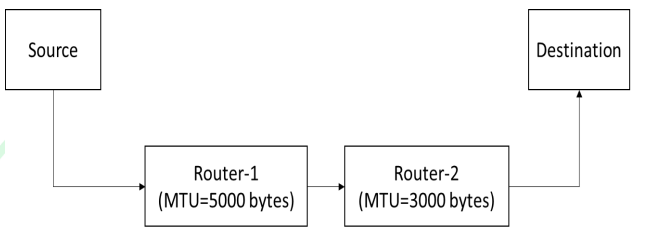
Suppose a message of size 15000 bytes is transmitted from a source to a destination using IPv4 protocol via two routers as shown in the figure. Each router has a defined maximum transmission unit (MTU) as shown in the figure, including IP header. The number of fragments that will be delivered to the destination is ________ . (Answer in integer)
- A machine receives an IPv4 datagram. The protocol field of the IPv4 header has the protocol number of a protocol X.
Which ONE of the following is NOT a possible candidate for X?


