Which class of IPv4 addresses supports the largest number of host addresses in a computer network?
Class A
In classful IPv4 addressing, the 32-bit address is split into a network portion and a host portion. The number of hosts a single network can hold depends on how many bits are left for the host field: each network reserves two addresses (all-zero host bits = the network address, all-one host bits = the broadcast address), so usable hosts = 2h − 2, where h is the number of host bits.
The more host bits a class allocates, the larger the host capacity per network:
| Class | Network bits | Host bits | Usable hosts per network |
|---|---|---|---|
| A | 8 | 24 | 224 − 2 = 16,777,214 |
| B | 16 | 16 | 216 − 2 = 65,534 |
| C | 24 | 8 | 28 − 2 = 254 |
| D | Reserved for multicast — no host addressing | ||
Because Class A leaves the full 24 bits for hosts, it supports the largest number of host addresses per network — over 16 million. This is why Class A blocks were historically assigned only to very large organizations.
Class B, with 16 host bits, tops out at 65,534 hosts — large, but far below Class A. Class C offers only 254 hosts, suited to small networks. Class D is not a host-addressing class at all; its addresses (224.x.x.x–239.x.x.x) are reserved for multicast group delivery, so it cannot be the answer.
Important Questions from IPv4
An organization is granted the block 130.56.0.0/16. The administrator wants to create 1024 subnets. Find first and last addresses of last subnet.
1.
130.56.0.0
130.56.254.255
2.
130.56.255.0
130.56.255.255
3.
130.56.0.192
130.255.255.255
4.
130.56.255.192
130.56.255.255
An organization is granted the block 130.56.0.0/16. The administrator wants to create 1024 subnets. Find the subnet prefix.
An organization is granted the block 130.56.0.0/16. The administrator wants to create 1024 subnets.
Find first and last addresses of First subnet.
1.
130.56.0.0
130.56.254.254
2.
130.56.0.0
130.56.0.63
3.
130.0.0.0
130.255.255.255
4.
130.56.0.0
130.56.255.63
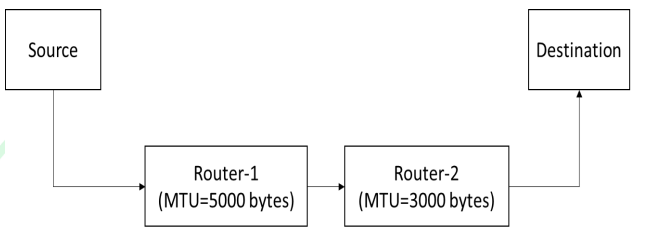
Suppose a message of size 15000 bytes is transmitted from a source to a destination using IPv4 protocol via two routers as shown in the figure. Each router has a defined maximum transmission unit (MTU) as shown in the figure, including IP header. The number of fragments that will be delivered to the destination is ________ . (Answer in integer)
- A machine receives an IPv4 datagram. The protocol field of the IPv4 header has the protocol number of a protocol X.
Which ONE of the following is NOT a possible candidate for X?