
IPv4 Octet Maximum Value Explained
An IPv4 address is structured into four parts, called octets or quads, separated by dots (e.g., 192.168.1.1). Each octet represents a sequence of 8 bits.
Understanding Binary Representation
In computing, a bit can hold one of two values: 0 or 1. An 8-bit sequence allows for $2^8$ unique combinations.
- Calculation: $2^8 = 2 \times 2 \times 2 \times 2 \times 2 \times 2 \times 2 \times 2 = 256$ possible combinations.
Determining the Maximum Value
These 256 combinations represent numerical values starting from 0. Therefore, the range of values for an 8-bit octet is from 0 to $2^8 - 1$.
- Maximum Value = $2^8 - 1$
- Maximum Value = $256 - 1$
- Maximum Value = 255
Thus, the maximum value that can be assigned to a single octet (quad) in an IPv4 address is 255.
Final Answer Check
Comparing this result with the given options:
- Option 1: 127 (Incorrect - This is the max value for a signed 8-bit integer, or the end of the loopback range)
- Option 2: 128 (Incorrect)
- Option 3: 255 (Correct)
- Option 4: 256 (Incorrect - This is the total number of values, not the maximum value)
The maximum value is 255.
Important Questions from IPv4
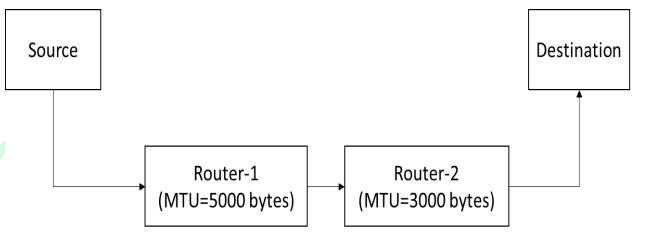
Suppose a message of size 15000 bytes is transmitted from a source to a destination using IPv4 protocol via two routers as shown in the figure. Each router has a defined maximum transmission unit (MTU) as shown in the figure, including IP header. The number of fragments that will be delivered to the destination is ________ . (Answer in integer)
- A machine receives an IPv4 datagram. The protocol field of the IPv4 header has the protocol number of a protocol X.
Which ONE of the following is NOT a possible candidate for X? - Consider a network that uses Ethernet and IPv4. Assume that IPv4 headers do not use any options field. Each Ethernet frame can carry a maximum of 1500 bytes in its data field. A UDP segment is transmitted. The payload (data) in the UDP segment is 7488 bytes.
Which ONE of the following choices has the CORRECT total number of fragments transmitted and the size of the last fragment including IPv4 header? Which class of IPv4 addresses supports the largest number of host addresses in a computer network?
Which of the following statements are true?
(a) The fragmentation fields in the base header section of IPv4 have moved to the fragmentation extension header in IPv6.
(b) The authentication extension header is new in IPv6.
(c) The record route option is not implemented in IPv6.


