
Find the correct sequence of the storage device in descending order based on their access time. (A) Registers (B) Magnetic Disk (C) Magnetic Tapes (D) Main memory (E) Optical Disk Choose the correct answer from the options given below :
(C), (E), (B), (D), (A)
Access time is the delay before a device can deliver requested data. It grows as we move down the memory hierarchy: registers inside the CPU, then main memory, then direct-access secondary storage, then sequential-access tape.
Step 1 — Magnetic Tapes (C): sequential access; the tape must be wound to the record, so access takes seconds — the longest.
Step 2 — Optical Disk (E): direct access, but slow seek and rotation give roughly 100 ms.
Step 3 — Magnetic Disk (B): seek plus rotational latency of a few milliseconds.
Step 4 — Main memory (D): RAM access of tens of nanoseconds.
Step 5 — Registers (A): accessed within a single CPU cycle, well under a nanosecond — the shortest.
Listed from longest to shortest access time the order is tape, optical disk, magnetic disk, main memory, registers. The sequences starting with the magnetic disk put registers second, and the one starting with tape followed by magnetic disk puts registers before main memory and optical disk, so none of them follows the hierarchy.
(C), (E), (B), (D), (A) option is correct.
Similar Questions
Various storage devices used by an operating system can be arranged as follows in increasing order of accessing speed :
Arrange the following in the increasing order with respect to access time.
A. Solid State Drive
B. Optical Disks
C. DRAMs
D. SRAMs
E. Registers
Choose the correct answer from the options given below:
Which of the following statement is/are True?
A. The processor has direct access to both primary and secondary memory
B. Primary memory stores the active instructions and data for the program being executed on the process
C. Secondary memory is used as a backup memory
D. Memory system is implemented on a single level memory
Choose the correct answer from the options given below:
Important Questions from Memory Hierarchy
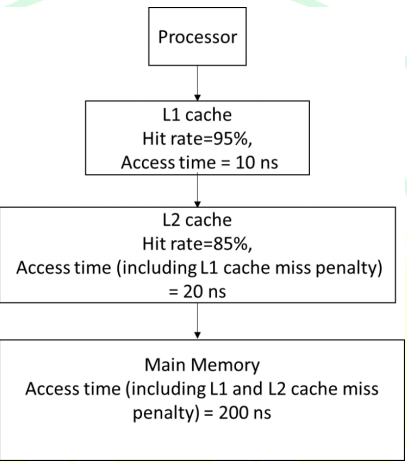
A computer has a memory hierarchy consisting of two-level cache (L1 and L2) and a main memory. If the processor needs to access data from memory, it first looks into L1 cache. If the data is not found in L1 cache, it goes to L2 cache. If it fails to get the data from L2 cache, it goes to main memory, where the data is definitely available. Hit rates and access times of various memory units are shown in the figure. The average memory access time in nanoseconds (ns) is ________. (rounded off to two decimal places)
- Match List I with List II
List I List II A. Address Space I. Associative Mapping B. Memory Space II. Logical address C. Cache Memory III. physical address D. Segmented Program IV. Virtual address
Choose the correct answer from the options given below: - What unit of memory is largest out of the following?
Related to computers, what is 'Wetware'?
____ number of lines are required to select __________ memory locations.



