A. Magnetic tape
B. RAM
C. Cache memory
D. Hard disk
E. Registers
Choose the correct answer from the options given below :
Memory Device Access Time Sequence Explained
Understanding the sequence of access times for different computer storage and memory devices is crucial for comprehending system performance. Access time refers to the delay between requesting data and receiving it. Generally, devices closer to the CPU and using faster electronic methods have lower access times compared to those further away or relying on mechanical or sequential operations.
Analyzing Storage and Memory Device Speeds
Let's examine the typical access speeds for the devices listed:
- Registers (E): Located directly within the CPU, registers provide the fastest access time. They hold data that the CPU is actively processing.
- Cache Memory (C): A small, fast type of memory typically located on or very close to the CPU. It stores frequently accessed data from the main memory (RAM) to reduce access time.
- RAM (B) (Random Access Memory): The main working memory of the computer. It offers significantly faster access than disk storage but is slower than cache memory and registers.
- Hard Disk (D): A secondary storage device. Traditional Hard Disk Drives (HDDs) involve mechanical parts (spinning platters and read/write heads), resulting in slower access times compared to RAM. Solid State Drives (SSDs), while faster than HDDs, are still slower than RAM.
- Magnetic Tape (A): Primarily used for long-term archival storage and backups. Magnetic tapes require sequential access, meaning the read/write head must wind through the tape to reach the desired data, making it the slowest option.
Ordering Memory Devices by Increasing Access Time
Based on the analysis of each device's characteristics, the order from the fastest access time (smallest delay) to the slowest access time (largest delay) can be represented using notation. Let $T_{Device}$ denote the access time for a specific device. The sequence of increasing access time is:
$$ T_{Registers} < T_{Cache} < T_{RAM} < T_{HardDisk} < T_{MagneticTape} $$
Using the given abbreviations (E for Registers, C for Cache memory, B for RAM, D for Hard disk, A for Magnetic tape), this translates to the sequence E, C, B, D, A.
| Device | Abbreviation | Access Time Rank (Fastest to Slowest) |
|---|---|---|
| Registers | E | 1 |
| Cache Memory | C | 2 |
| RAM | B | 3 |
| Hard disk | D | 4 |
| Magnetic tape | A | 5 |
Therefore, the correct sequence of increasing access time is E, C, B, D, A.
Important Questions from Memory Hierarchy
Suppose that the register A and register K have the bit configuration. Only the three leftmost bits of A are compared with memory words because K has 1's in these positions. Because of its organization, this type of memory is uniquely suited to parallel searches by data association. This type of memory is known as
Consider a system with 2 level cache. Access times of Level 1, Level 2 cache and main memory are 0.5 ns, 5 ns and 100 ns respectively. The hit rates of Level 1 and Level 2 caches are 0.7 and 0.8 respectively. What is the average access time of the system ignoring the search time within cache?
Related to computers, what is 'Wetware'?
____ number of lines are required to select __________ memory locations.
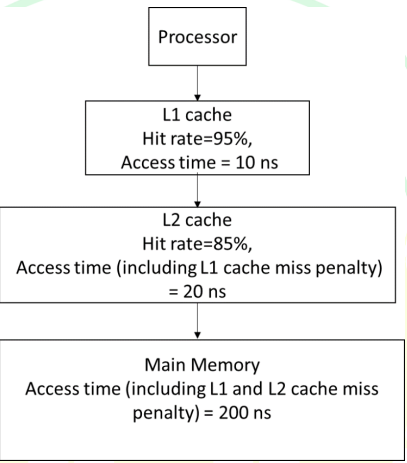
A computer has a memory hierarchy consisting of two-level cache (L1 and L2) and a main memory. If the processor needs to access data from memory, it first looks into L1 cache. If the data is not found in L1 cache, it goes to L2 cache. If it fails to get the data from L2 cache, it goes to main memory, where the data is definitely available. Hit rates and access times of various memory units are shown in the figure. The average memory access time in nanoseconds (ns) is ________. (rounded off to two decimal places)