
A computer has a memory hierarchy consisting of two-level cache (L1 and L2) and a main memory. If the processor needs to access data from memory, it first looks into L1 cache. If the data is not found in L1 cache, it goes to L2 cache. If it fails to get the data from L2 cache, it goes to main memory, where the data is definitely available. Hit rates and access times of various memory units are shown in the figure. The average memory access time in nanoseconds (ns) is ________. (rounded off to two decimal places)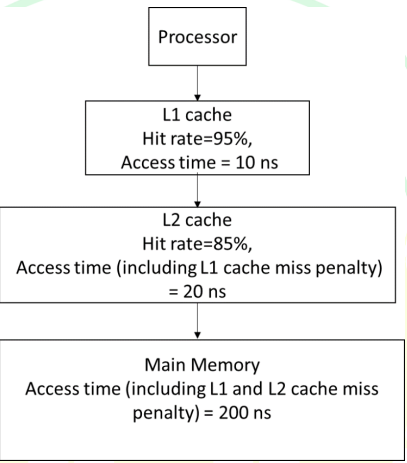
The average memory access time (AMAT) can be calculated using the formula:
AMAT = (Hit RateL1 × TimeL1) + (Miss RateL1 × Hit RateL2 × TimeL2) + (Miss RateL1 × Miss RateL2 × TimeMain)
Step 1: Identify Parameters
Hit RateL1 = 0.95, TimeL1 = 10 ns
Hit RateL2 = 0.85, TimeL2 = 20 ns
TimeMain = 200 ns
Step 2: Calculate Miss Rates
Miss RateL1 = 1 - Hit RateL1 = 0.05
Miss RateL2 = 1 - Hit RateL2 = 0.15
Step 3: Apply the Formula
AMAT = (0.95 × 10) + (0.05 × 0.85 × 20) + (0.05 × 0.15 × 200)
Step 4: Compute Each Term
(0.95 × 10) = 9.5
(0.05 × 0.85 × 20) = 0.85
(0.05 × 0.15 × 200) = 1.5
Step 5: Sum the Terms
AMAT = 9.5 + 0.85 + 1.5 = 11.85 ns
The average memory access time is 11.85 ns, which is within the range of [11.83, 11.87].
Important Questions from Memory Hierarchy
Suppose that the register A and register K have the bit configuration. Only the three leftmost bits of A are compared with memory words because K has 1's in these positions. Because of its organization, this type of memory is uniquely suited to parallel searches by data association. This type of memory is known as
Consider a system with 2 level cache. Access times of Level 1, Level 2 cache and main memory are 0.5 ns, 5 ns and 100 ns respectively. The hit rates of Level 1 and Level 2 caches are 0.7 and 0.8 respectively. What is the average access time of the system ignoring the search time within cache?
Related to computers, what is 'Wetware'?
____ number of lines are required to select __________ memory locations.
- Given a computing system with two levels of cache (L1 and L2) and a main memory. The first level (L1) cache access time is 1 nanosecond (ns) and the “hit rate" for L1 cache is 90% while the processor is accessing the data from L1 cache. Whereas, for the second level (L2) cache, the “hit rate" is 80% and the "miss penalty" for transferring data from L2 cache to L1 cache is 10 ns. The “miss penalty" for the data to be transferred from main memory to L2 cache is 100 ns.
Then the average memory access time in this system in nanoseconds is ____________ (rounded off to one decimal place)


