A. Millisecond
B. Picosecond
C. Nanosecond
D. Microsecond
E. Second
Choose the correct answer from the options given below:
Memory Access Time: Understanding Units
Memory access time refers to the duration it takes for a processor to read data from or write data to a memory location. This time is typically measured in very small units of time. Understanding the relative sizes of these units is crucial for comprehending memory performance.
Comparing Time Unit Magnitudes
Let's compare the given units of time to determine their order from largest to smallest:
- Second (s): This is the base unit of time in the International System of Units (SI).
- Millisecond (ms): A millisecond is one-thousandth of a second. Mathematically, $1 \text{ ms} = 10^{-3} \text{ s}$.
- Microsecond ($\mu$s): A microsecond is one-millionth of a second. Mathematically, $1 \mu\text{s} = 10^{-6} \text{ s}$.
- Nanosecond (ns): A nanosecond is one-billionth of a second. Mathematically, $1 \text{ ns} = 10^{-9} \text{ s}$.
- Picosecond (ps): A picosecond is one-trillionth of a second. Mathematically, $1 \text{ ps} = 10^{-12} \text{ s}$.
Memory Unit Ordering: Largest to Smallest
Based on their values in seconds, we can order these units from the largest magnitude to the smallest:
| Unit Name | Abbreviation | Value in Seconds | Order (Largest to Smallest) |
|---|---|---|---|
| Second | s | $1 \text{ s}$ | 1 (Largest) |
| Millisecond | ms | $10^{-3} \text{ s}$ | 2 |
| Microsecond | $\mu$s | $10^{-6} \text{ s}$ | 3 |
| Nanosecond | ns | $10^{-9} \text{ s}$ | 4 |
| Picosecond | ps | $10^{-12} \text{ s}$ | 5 (Smallest) |
Therefore, the correct sequence of memory access time units from largest to smallest is:
Second (E) > Millisecond (A) > Microsecond (D) > Nanosecond (C) > Picosecond (B)
This sequence corresponds to the order E, A, D, C, B.
Important Questions from Memory Hierarchy
Suppose that the register A and register K have the bit configuration. Only the three leftmost bits of A are compared with memory words because K has 1's in these positions. Because of its organization, this type of memory is uniquely suited to parallel searches by data association. This type of memory is known as
Consider a system with 2 level cache. Access times of Level 1, Level 2 cache and main memory are 0.5 ns, 5 ns and 100 ns respectively. The hit rates of Level 1 and Level 2 caches are 0.7 and 0.8 respectively. What is the average access time of the system ignoring the search time within cache?
Related to computers, what is 'Wetware'?
____ number of lines are required to select __________ memory locations.
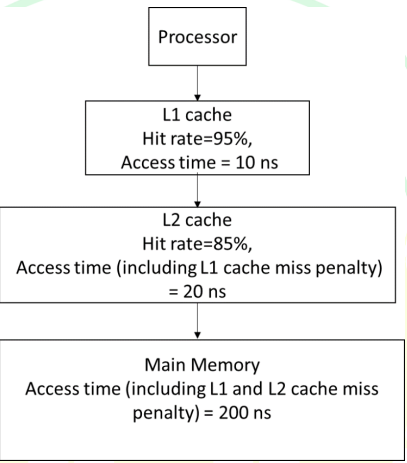
A computer has a memory hierarchy consisting of two-level cache (L1 and L2) and a main memory. If the processor needs to access data from memory, it first looks into L1 cache. If the data is not found in L1 cache, it goes to L2 cache. If it fails to get the data from L2 cache, it goes to main memory, where the data is definitely available. Hit rates and access times of various memory units are shown in the figure. The average memory access time in nanoseconds (ns) is ________. (rounded off to two decimal places)