Dimensions of Physical Constants
To determine the dimensions of the expression $\sigma_s k_B^{-1} b$, we first need the dimensions of each constant involved:
- Stefan-Boltzmann constant ($\sigma_s$): This constant relates to the energy radiated per unit area and time by a black body. Its dimensions are found to be $[M T^{-3} K^{-4}]$.
- Boltzmann constant ($k_B$): This constant relates the average kinetic energy of particles in a gas with the thermodynamic temperature. Its dimensions are $[M L^2 T^{-2} K^{-1}]$.
- Wien's displacement law constant ($b$): This constant relates the peak wavelength of emitted black-body radiation to its temperature. Its dimensions are $[L K]$.
Calculating Combined Dimensions
Now, we combine the dimensions of these constants according to the expression $\sigma_s k_B^{-1} b$. We substitute the dimensions of each term:
$ [\sigma_s k_B^{-1} b] = [\sigma_s] \times [k_B^{-1}] \times [b] $
First, find the dimensions of $k_B^{-1}$:
$ [k_B^{-1}] = \left( [M L^2 T^{-2} K^{-1}] \right)^{-1} = [M^{-1} L^{-2} T^{2} K^{1}] $
Next, substitute all dimensions into the expression:
$ [\sigma_s k_B^{-1} b] = [M T^{-3} K^{-4}] \times [M^{-1} L^{-2} T^{2} K^{1}] \times [L K] $
Combine the powers for each dimension (Mass M, Length L, Time T, Temperature K):
$ [\sigma_s k_B^{-1} b] = [M^{1 + (-1)}] [L^{0 + (-2) + 1}] [T^{-3 + 2}] [K^{-4 + 1 + 1}] $ $ [\sigma_s k_B^{-1} b] = [M^{0}] [L^{-1}] [T^{-1}] [K^{-2}] $
Simplifying, the dimensions are $[L^{-1} T^{-1} K^{-2}]$.
Similar Questions
- Each side of a metallic cube of mass $5.580 \text{ kg}$ is measured to be $9.0 \text{ cm}$. Keeping the significant figures in view, the density of the material of the cube can be best expressed as $X \times 10^3 \text{ kg m}^{-3}$, where the value of X is :
- The speed of light in vacuum is taken as unity. If light takes $6 \text{ min } 40 \text{ s}$ to reach the Earth from the Sun, the distance between the Sun and the Earth in new unit is :
Important Questions from General Physics
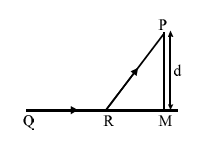
A man in a car at location Q on a straight highway is moving with speed v. He decides to reach a point P in qa field at a distance d from the highway (point m) as shown in the figure. Speed of the car in the field is half to that on the highway. What should be the distance RM, so that the time taken to reach P is minimum ?
- Let PQR be a triangle such that $\vec{PQ} = -2\hat{i} - \hat{j} + 2\hat{k}$ and $\vec{PR} = a\hat{i} + b\hat{j} - 4\hat{k}$, $a, b \in \mathbb{Z}$. Let S be the point on QR, which is equidistant from the lines PQ and PR. If $|\vec{PR}| = 9$ and $\vec{PS} = \hat{i} - 7\hat{j} + 2\hat{k}$, then the value of $3a - 4b$ is ________
- Given a charge $q$, current $I$ and permeability of vacuum $\mu_o$. Which of the following quantity has the dimension of momentum ?
- Density and volume of a body are given as $(20 \pm 4)\text{ gm/cm}^3$ and $(10 \pm 1)\text{ cm}^3$ respectively. The absolute error in measurement of mass is
- The velocity $v$ of a particle at time $t$ is given by $v = at + \frac{b}{t+c}$, where $a$, $b$ and $c$ are constants. The dimension of $a$, $b$ and $c$ are, respectively