
Determining Dimensions of Constants in Velocity Equation
We are given the velocity $v$ of a particle at time $t$ as: $v = at + \frac{b}{t+c}$ We need to find the dimensions of the constants $a$, $b$, and $c$. We will use the principle of dimensional homogeneity, which states that dimensions must be consistent throughout an equation.
Dimensional Analysis Steps
- Dimension of Velocity ($v$): Velocity is defined as displacement over time. Therefore, its dimensions are length per time. $[v] = LT^{-1}$
- Dimension of Constant $a$: The term $at$ must have the same dimensions as the velocity $v$, since it's added to other terms contributing to $v$. $[at] = [v]$ $[a][t] = LT^{-1}$ Since the dimension of time $t$ is $[t] = T$, we substitute this: $[a]T = LT^{-1}$ Solving for $[a]$: $[a] = \frac{LT^{-1}}{T} = LT^{-2}$
- Dimension of Constant $c$: In the term $t+c$, both $t$ and $c$ must have the same dimensions because quantities can only be added or subtracted if they have identical dimensions. $[c] = [t]$ $[c] = T$
- Dimension of Constant $b$: The term $\frac{b}{t+c}$ must also have the same dimensions as velocity $v$. $\left[\frac{b}{t+c}\right] = [v]$ $\frac{[b]}{[t+c]} = LT^{-1}$ From step 3, we know $[t+c] = [t] = T$. Substituting this: $\frac{[b]}{T} = LT^{-1}$ Solving for $[b]$: $[b] = LT^{-1} \times T = L$
Resulting Dimensions
The dimensions are found to be:
- Dimension of $a$: $LT^{-2}$
- Dimension of $b$: $L$
- Dimension of $c$: $T$
This matches option 3.
Similar Questions
- Density and volume of a body are given as $(20 \pm 4)\text{ gm/cm}^3$ and $(10 \pm 1)\text{ cm}^3$ respectively. The absolute error in measurement of mass is
Important Questions from General Physics
- Density and volume of a body are given as $(20 \pm 4)\text{ gm/cm}^3$ and $(10 \pm 1)\text{ cm}^3$ respectively. The absolute error in measurement of mass is
- The characteristic distance at which quantum gravitational effects are significant, the Planck length, can be determined from a suitable combination of the fundamental physical constants G, $\hbar$ and c. Which of the following correctly gives the Planck length ?
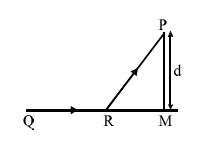
A man in a car at location Q on a straight highway is moving with speed v. He decides to reach a point P in qa field at a distance d from the highway (point m) as shown in the figure. Speed of the car in the field is half to that on the highway. What should be the distance RM, so that the time taken to reach P is minimum ?
- Three particles P, Q and R are moving along the vectors $\vec{A} = \hat{i} + \hat{j}$, $\vec{B} = \hat{j} + \hat{k}$ and $\vec{C} = -\hat{i} + \hat{j}$ respectively. They strike on a point and start to move in different directions.<br>Now particle P is moving normal to the plane which contains vector $\vec{A}$ and $\vec{B}$. Similarly particle Q is moving normal to the plane which contains vector $\vec{A}$ and $\vec{C}$. The angle between the direction of motion of P and Q is $\cos^{-1}\left(\frac{1}{\sqrt{x}}\right)$. Then the value of x is __________.
Three students $S_1$, $S_2$ and $S_3$ perform an experiment for determining the acceleration due to gravity (g) using a simple pendulum. They use different lengths of pendulum and record time for different number of oscillations. The observations are as shown in the table.
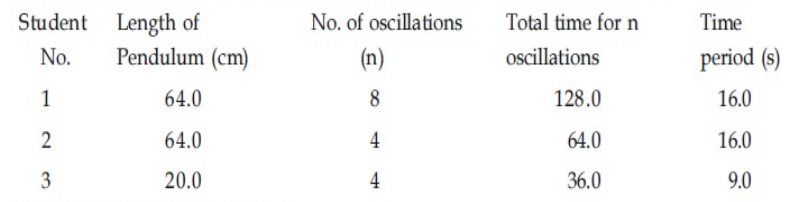
(least count of length =0.1 cm
least count for time =0.1s )
If $E_1$, $E_2$ and $E_3$ are the percentage errors in 'g' for students 1, 2 and 3 respectively, then the minimum percentage error is obtained by student no. __________.


