Understanding First Law of Thermodynamics
This question relates to the First Law of Thermodynamics, which describes the conservation of energy. The law states that the change in internal energy ($\Delta U$) of a system is equal to the heat added to the system ($Q$) minus the work done by the system ($W$).
Applying the Formula
The formula for the First Law of Thermodynamics is:
$ \Delta U = Q - W $
- Heat Absorbed ($Q$): The system absorbs 500 J, so $Q = +500$ J.
- Work Done ($W$): The work is done *by* the system, which is 200 J. In the formula $\Delta U = Q - W$, work done *by* the system is taken as positive. So, $W = +200$ J.
Calculating Internal Energy Change
Substitute the given values into the First Law equation:
$ \Delta U = 500 \text{ J} - 200 \text{ J} $
$ \Delta U = 300 \text{ J} $
Therefore, the change in internal energy of the system is 300 J.
Similar Questions
- Given below is an expression for the rate constant of a first order reaction occurring at a certain temperature, T (K).
$\ln k = 14.34 - \frac{1.25 \times 10^4}{T}$
The energy of activation in $\text{kcal mol}^{-1}$ for the reaction is :
(Given : $k \text{ in s}^{-1}$, $R = 1.987 \text{ cal mol}^{-1} \text{ K}^{-1}$) - The number of hydrogen atoms present in $5.4 \text{ g}$ of urea is :
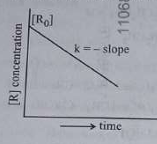
(Given : Molar mass of urea : $60 \text{ g mol}^{-1}$, $N_A : 6.022 \times 10^{23} \text{ particles mol}^{-1}$) For a certain reaction R $\rightarrow$ Product, the plot of [R] vs time has a negative slope as shown. The order of reaction is :
- Match List I with List II :
List I (Order of reaction) List II (Unit of rate constant) A. Zero order I. $mol^{-1} L s^{-1}$ B. First order II. $mol^{-2} L^2 s^{-1}$ C. Second order III. $s^{-1}$ D. Third order IV. $mol L^{-1} s^{-1}$
Choose the correct answer from the options given below : Calculate emf of the half cell given below :
$$Pt(s) | H_2 (g, 2 \text{ atm}) | HCl (aq, 0.02 \text{ M})$$
$$E_{H_2 /H^+}^\circ = 0 \text{ V}$$
(Given : $\frac{2.303 RT}{F} = 0.059$, $\log 2 = 0.3010$)At 298 K, a certain buffer solution contains equal concentrations of $X^{-}$ and $HX$. $K_b$ for $X^-$ is $10^{-10}$. What is the pH of this buffer solution ?
- Mixture of chloroform and acetone forms a solution with negative deviation from Raoult's law due to
- Identify the correct statements :
A. The molality of a 2.5 g of ethanoic acid (Molar mass : $60 \text{ g mol}^{-1}$) in 75 g of benzene solution is $0.556 \text{ m}$.
B. The molarity of a solution containing 5 g of NaOH (molar mass : $40 \text{ g mol}^{-1}$) in 450 mL of solution is 0.278 M at 298 K.
C. Aquatic species are more comfortable in cold water.
D. The solubility of gas increases with decrease in pressure.
E. For a binary mixture of A and B, the number of moles of A and B are $n_A$ and $n_B$ respectively, the mole fraction of B will be $x_B = \frac{n_A}{n_A + n_B}$.
Choose the correct answer from the options given below : - In a qualitative analysis, $Bi^{3+}$ is detected by appearance of precipitate of $BiO(OH)(s)$. Calculate pH when the following equilibrium exists at 298 K :
$$BiO(OH) (s) \rightleftharpoons BiO^+ (aq) + OH^- (aq)$$
$K = 4 \times 10^{-10}$
(Given : $\log 2 = 0.3010$) - Given below are certain reactions. Identify the reaction for which $K_p \neq K_c$.
Important Questions from Physical Chemistry
- Consider the following electrochemical cell :
$\text{Pt} \mid \text{O}_2\text{(g)}(1\text{bar}) \mid \text{HCl(aq)} \parallel \text{M}^{2+}\text{(aq, 1.0 M)} \mid \text{M(s)}$
The pH above which, oxygen gas would start to evolve at anode is _________ (nearest integer).
Given :
$\begin{bmatrix} \text{E}^\circ_{\text{M}^{2+}/\text{M}} = 0.994 \text{ V} \\ \text{E}^\circ_{\text{O}_2/\text{H}_2\text{O}} = 1.23 \text{ V} \end{bmatrix} \text{standard reduction potential}$
and $\frac{\text{RT}}{\text{F}} (2.303) = 0.059 \text{ V}$ at the given condition - X and Y are the number of electrons involved, respectively during the oxidation of $\text{I}^-$ to $\text{I}_2$ and $\text{S}^{2-}$ to S by acidified $\text{K}_2\text{Cr}_2\text{O}_7$. The value of X + Y is ______.
- Consider two Group IV metal ions $\text{X}^{2+}$ and $\text{Y}^{2+}$.
A solution containing 0.01 M $\text{X}^{2+}$ and 0.01 M $\text{Y}^{2+}$ is saturated with $\text{H}_2\text{S}$. The pH at which the metal sulphide YS will form as a precipitate is ______. (Nearest integer)
(Given: $\text{K}_{sp}(\text{XS}) = 1 \times 10^{-22}$ at $25^\circ\text{C}$, $\text{K}_{sp}(\text{YS}) = 4 \times 10^{-16}$ at $25^\circ\text{C}$, $[\text{H}_2\text{S}] = 0.1\text{M}$ in solution, $\text{K}_{a1} \times \text{K}_{a2}(\text{H}_2\text{S}) = 1.0 \times 10^{-21}$, $\log 2 = 0.30$, $\log 3 = 0.48$, $\log 5 = 0.70$) - Electricity is passed through an acidic solution of $\text{Cu}^{2+}$ till all the $\text{Cu}^{2+}$ was exhausted, leading to the deposition of 300 mg of Cu metal. However, a current of 600 mA was continued to pass through the same solution for another 28 minutes by keeping the total volume of the solution fixed at 200 mL. The total volume of oxygen evolved at STP during the entire process is ______ mL. (Nearest integer)
[Given:
$\text{Cu}^{2+}\text{(aq)} + 2\text{e}^- \rightarrow \text{Cu(s)} \quad \text{E}^\circ_{\text{red}} = +0.34 \text{ V}$
$\text{O}_2\text{(g)} + 4\text{H}^+ + 4\text{e}^- \rightarrow 2\text{H}_2\text{O} \quad \text{E}^\circ_{\text{red}} = +1.23 \text{ V}$
Molar mass of Cu = $63.54 \text{ g mol}^{-1}$
Molar mass of $\text{O}_2$ = $32 \text{ g mol}^{-1}$
Faraday Constant = $96500 \text{ C mol}^{-1}$
Molar volume at STP = 22.4 L] - Two liquids A and B form an ideal solution at temperature T K. At T K, the vapour pressures of pure A and B are 55 and $15 \text{ kN m}^{-2}$ respectively. What is the mole fraction of A in solution of A and B in equilibrium with a vapour in which the mole fraction of A is 0.8?