
An SCR is turned off by :
Reducing the current below the holding current
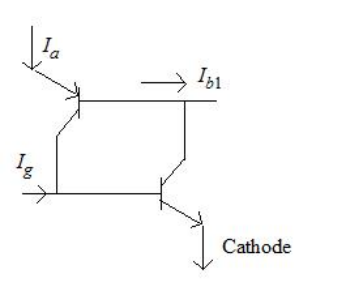
The defining property of a thyristor is that the gate loses control once the device is on. An SCR is a four-layer pnpn structure, best understood as two complementary transistors sharing terminals: the pnp's collector feeds the npn's base and vice versa. Once conduction starts, each transistor supplies the other's base drive, so the pair latches. That is why option 2 fails — removing the gate pulse does nothing at all, because the internal regenerative loop is already self-sustaining.
The only way out of that loop is to starve it. The regeneration survives while the loop gain stays above unity, which requires a minimum anode current. Drop the anode current below the holding current IH and the loop gain falls below one, the internal feedback collapses, and the device reverts to blocking — option 3.
| Current | Meaning | Relation |
|---|---|---|
| Latching current IL | Minimum anode current for the SCR to stay on after the gate pulse is removed | \(I_{L}\gt I_{H}\), typically 2 to 3 times |
| Holding current IH | Minimum anode current to keep an already-conducting SCR on |
Why the other options are wrong. Merely reducing the anode-to-cathode voltage (option 1) does not turn the device off — a conducting SCR drops only about 1 V anyway, and the current, not the voltage, is what matters; the voltage would have to be reduced far enough, or reversed, to drive the current below IH, which is really option 3 restated. Increasing the anode current (option 4) does the opposite of turning it off.
How this is arranged in real circuits — the two commutation families.
Natural (line) commutation comes free in AC circuits: the supply itself passes through zero every half cycle, carrying the anode current below IH, so the SCR turns off unaided. This is what makes phase-controlled rectifiers and AC regulators simple.
Forced commutation is needed on a DC supply, where no natural zero exists. An auxiliary LC circuit or a charged capacitor is switched across the device to drive its current momentarily to zero or negative — the McMurray inverter is the classic example. The device also needs a finite turn-off time tq, typically 10 to 100 μs, during which reverse voltage must be maintained while the stored charge recombines; reapplying forward voltage too soon simply turns it back on.
Hence, an SCR is turned off by reducing the current below the holding current.
Similar Questions
For a two transistor model, the value of α1 + α2 is equal to :
In two transistor model of an SCR the expression for anode current is given by:
Which of the following statements are true for SCR ?
(a) UJT is a phase controlling device for SCR rectifier.
(b) The average load voltage of SCR rectifier is greater than average load voltage of ordinary diode rectifier.
(c) Power delivered to the load in SCR rectifier is maximum when SCR firing angle is zero degree.
(d) SCR can control the amount of power fed to the load by switching current OFF and ON upto many thousand times a second.
Match the following lists :
List - I List - II a. SCR can be turned off by i. it turns off when anode current falls below this value. b. Turn on time of SCR can be reduced by ii. the rectangular pulse of high amplitude and narrow width c. Holding current for an SCR means iii. its anode current interruption d. A forward current can be applied to an SCR after iv. its gate recovery time Correct Codes are :
The voltage safety factor (Vf) of a thyristor is given by :
In SCR, the following statements are given :
(a) It acts as a short circuit device.
(b) It acts as an open circuit device.
(c) ON state voltage is approximately 2-5 Volts.
(d) ON state voltage is approximately 50-100 Volts.
Which of the above statements are correct ?
Important Questions from Thyristors
_______ exhibit a regenerative switching characteristic.
The minimum anode current, which must flow through the SCR in order for it to stay ON initially after the gate signal is removed, is known as ______.
What is the maximum firing angle achievable using resistance-capacitance triggering of SCR?
Which one of the following can be used in the lighting system for power interruptions?
SCR is



