
ABC is an equilateral triangle. If the area of the triangle is 36 √ 3 , then what is the radius of circle circumscribing the triangle ABC ?
Finding the Circumradius of an Equilateral Triangle Given its Area
The question asks for the radius of the circle circumscribing an equilateral triangle ABC, given its area is 36 √ 3.
Understanding Equilateral Triangle Properties
An equilateral triangle is a triangle where all three sides are equal in length, and all three angles are equal (each $60^\circ$).
The area of an equilateral triangle with side length 's' is given by the formula:
$\text{Area} = \frac{\sqrt{3}}{4} s^2$
Calculating the Side Length of the Triangle
We are given the area of the triangle as 36 √ 3 . We can use the area formula to find the side length 's'.
Given Area = $36\sqrt{3}$
Using the formula:
$36\sqrt{3} = \frac{\sqrt{3}}{4} s^2$
To find $s^2$, we can divide both sides by $\sqrt{3}$ and multiply by 4:
$36 = \frac{1}{4} s^2$
$s^2 = 36 \times 4$
$s^2 = 144$
Now, we take the square root of both sides to find 's':
$s = \sqrt{144}$
$s = 12$
So, the side length of the equilateral triangle ABC is 12 units.
Finding the Radius of the Circumscribing Circle (Circumradius)
For an equilateral triangle with side length 's', the radius of the circumscribing circle (also called the circumradius, denoted by R) is related to the side length by the formula:
$R = \frac{s}{\sqrt{3}}$
Now we can substitute the side length $s=12$ into this formula:
$R = \frac{12}{\sqrt{3}}$
To simplify this expression, we can rationalize the denominator by multiplying the numerator and denominator by $\sqrt{3}$:
$R = \frac{12}{\sqrt{3}} \times \frac{\sqrt{3}}{\sqrt{3}}$
$R = \frac{12\sqrt{3}}{3}$
Now, we can simplify the fraction:
$R = 4\sqrt{3}$
Therefore, the radius of the circle circumscribing the equilateral triangle ABC is $4\sqrt{3}$ units.
Summary of Calculations
| Parameter | Formula/Value | Calculated Value |
|---|---|---|
| Given Area | $36\sqrt{3}$ | $36\sqrt{3}$ |
| Area Formula | $\frac{\sqrt{3}}{4} s^2$ | - |
| Side Length (s) calculation | $s = \sqrt{\frac{4 \times \text{Area}}{\sqrt{3}}}$ | $s = 12$ |
| Circumradius Formula (R) | $\frac{s}{\sqrt{3}}$ | - |
| Circumradius (R) | - | $4\sqrt{3}$ |
The calculated radius $4\sqrt{3}$ matches one of the given options.
Revision Table: Equilateral Triangle Formulas
| Property | Formula (side 's') | Formula (height 'h') |
|---|---|---|
| Area | $\frac{\sqrt{3}}{4} s^2$ | $\frac{1}{\sqrt{3}} h^2$ |
| Height (h) | $\frac{\sqrt{3}}{2} s$ | h |
| Circumradius (R) | $\frac{s}{\sqrt{3}}$ | $\frac{2}{3} h$ |
| Inradius (r) | $\frac{s}{2\sqrt{3}}$ | $\frac{1}{3} h$ |
Additional Information on Circumscribed Circles
A circumscribed circle (or circumcircle) of a triangle is a circle that passes through all three vertices of the triangle. The center of the circumcircle is called the circumcenter, and its radius is the circumradius.
For any triangle, the circumcenter is the intersection point of the perpendicular bisectors of the sides. For an equilateral triangle, the circumcenter is also the centroid, incenter, and orthocenter. This makes calculations simpler.
The circumradius (R) and inradius (r) of an equilateral triangle are related: $R = 2r$.
Similar Questions
B 1is a point on the side AC of ΔABC and B 1B is joined. A line is drawn through A parallel to B 1B meeting BC at A 1and another line is drawn through C parallel to B 1B meeting AB produced at C 1. Then
D is the midpoint of side BC of ΔABC. Point E lies on AC such that CE = AC/3. BE and AD intersect at G. What is AG/GD?
∆ABC ~ ∆RQP and AB = 4 cm, BC = 6 cm and AC = 5 cm. If ar (∆ABC) : ar (∆PQR) = 9 : 4, Then PQ is equal to:
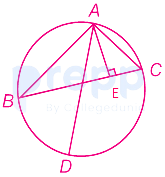
In the given figure, ABC is a triangle in which, AB = 10 cm, Ac = 6 cm and altitude AE = 4 cm. If AD is the diameter of the circumcircle, then what is the length (in cm) of circumradius?
PQR is a right angled triangle in which ∠R = 90°. If RS ⊥ PQ, PR = 3 cm and RQ = 4 cm, then what is the value of RS (in cm)?
Angle between the internal bisectors of two angles ∠B and ∠C of a ΔABC is 132°, then the value of ∠A is
In a triangle PQR, ∠PQR = 90°, PQ = 10 cm and PR = 26 cm, then what is the value (in cm) of inradius of incircle?
If the areas of two similar triangle are in the ratio 5 : 7, then what is the ratio of the corresponding sides of these two triangles?
PQRS is a square, M is the mid-point of PQ and N is a point on QR such that NR is two-third of QR. If the area of ΔMQN is 48cm 2, then what is the length (in cm) of PR?
In triangle ABC, D and E are the mid points of AB and BC respectively. If area(ΔCED) = 8 cm 2, then what is the area( ADEC) in cm 2?
Important Questions from Triangles, Congruence and Similarity
In a $\Delta ABC$, $\angle C = (9/4) \angle B = (3/2) (\angle A+\angle B)$. Find the measure of the angles.
- The areas of two similar triangles $\Delta$XYZ and $\Delta$LMN are 49 cm$^2$ and 9 cm$^2$, respectively. If LM = 9 cm, then the length of XY is:
Triangles \(PQR\) and \(ABC\) are similar triangles. Triangle \(ABC\) have the following sides
\(AB = 12 \text{ cm}\),
\(AC = 15 \text{ cm}\),
\(CB = 21 \text{ cm}\).
Triangle \(PQR\) have the following sides:
\(PQ = 4 \text{ cm}\),
\(RQ = 7 \text{ cm}\).
What is the length of side \(PR\)?
For a pair of similar triangles, the angles made at \(Q\) is same in both the triangles \(PQR\) and \(LQJ\).
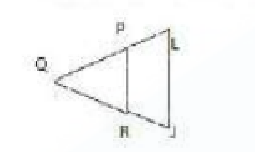
If the length of side \(QJ\) is 10 cm and \(QR\) is 5 cm, what is the ratio of their total areas?- In $\Delta ABC$ $\overline{PQ} \parallel \overline{AB}$. P and Q are on BC and CA respectively. If CQ : QA = 1 : 3 and CP = 4, then what is the value of BC?



