Calculating Internal Energy Change for Unknown Gas
The problem asks for the change in internal energy ($\Delta U$) of an unknown gas when heated at constant volume.
Key Information Given:
- Number of moles ($n$): 5 moles
- Initial Temperature ($T_1$): $10^\circ\text{C}$
- Final Temperature ($T_2$): $20^\circ\text{C}$
- Molar specific heat at constant pressure ($C_p$): $8 \text{ cal/mol.}^\circ\text{C}$
- Universal gas constant ($R$): $8.36 \text{ J/mol.}^\circ\text{C}$
- Process: Constant Volume Heating
- Target: $\Delta U$ in calories
Calculating Temperature Change:
The change in temperature ($\Delta T$) is calculated as:
$ \Delta T = T_2 - T_1 = 20^\circ\text{C} - 10^\circ\text{C} = 10^\circ\text{C} $
Converting Gas Constant R to Calories:
We need the value of $R$ in calories to match the units of $C_p$ and the desired output. Using the conversion factor $1 \text{ cal} \approx 4.18 \text{ J}$:
$ R_{\text{cal}} = \frac{R_{\text{J}}}{4.18} \approx \frac{8.36 \text{ J/mol.}^\circ\text{C}}{4.18 \text{ J/cal}} \approx 2.0 \text{ cal/mol.}^\circ\text{C} $
Determining Molar Specific Heat at Constant Volume ($C_v$):
For an ideal gas, the relationship between $C_p$ and $C_v$ is given by Mayer's relation:
$ C_p - C_v = R $
Rearranging to find $C_v$:
$ C_v = C_p - R $
Substituting the known values:
$ C_v = 8 \text{ cal/mol.}^\circ\text{C} - 2.0 \text{ cal/mol.}^\circ\text{C} = 6.0 \text{ cal/mol.}^\circ\text{C} $
Calculating Change in Internal Energy ($\Delta U$):
The change in internal energy for an ideal gas depends only on the temperature change and is given by the formula:
$ \Delta U = n C_v \Delta T $
Substituting the values:
$ \Delta U = (5 \text{ mol}) \times (6.0 \text{ cal/mol.}^\circ\text{C}) \times (10^\circ\text{C}) $
$ \Delta U = 300 \text{ cal} $
Conclusion:
The change in the internal energy of the gas is 300 calories.
Similar Questions
- When $300 \text{ J}$ of heat given to an ideal gas with $C_p = \frac{7}{2} R$ its temperature raises from $20^\circ\text{C}$ to $50^\circ\text{C}$ keeping its volume constant. The mass of the gas is (approximately) _______ g. ($R = 8.314 \text{ J/mol.K}$)
- Two cylindrical rods A and B made of different materials, are joined in a straight line. The ratios of lengths, radii and thermal conductivites of these rods are: $\frac{L_A}{L_B} = 1$, $\frac{r_A}{r_B} = 2$ and $\frac{K_A}{K_B} = \frac{1}{2}$. The free ends of rods A and B are maintained at 400 K, 200 K, respectively. The temperature of rods interface is ________ K, when equilibrium is established.
The internal energy of air in $4 m \times 4 m \times 3 m$ sized room at 1 atmospheric pressure will be ________ $\times 10^6$ J.
(Consider air as diatomic molecule)- A certain gas is isothermally compressed to $\left(\frac{1}{3}\right)^{\text{rd}}$ of its initial volume ($V_o = 3$ litre) by applying required pressure. If the bulk modulus of the gas is $3 \times 10^5 \text{ N/m}^2$, the magnitude of work done on the gas is _________ J.
- An insulated cylinder of volume $60 \text{ cm}^3$ is filled with a gas at $27^\circ\text{C}$ and 2 atmospheric pressure. Then the gas is compressed making the final volume as $20 \text{ cm}^3$ while allowing the temperature to rise to $77^\circ\text{C}$. The final pressure is _________ atmospheric pressure.
- A body takes 10 minutes to cool from $60^\circ C$ to $50^\circ C$. The temperature of surroundings is constant at $25^\circ C$. Then, the temperature of the body after next 10 minutes will be approximately :
- The value closest to the thermal velocity of a Helium atom at room temperature (300 K) in $ms^{-1}$ is : [$k_B = 1.4 \times 10^{-23}$ J/K; $m_{He} = 7 \times 10^{-27}$ kg]
- Two cornot engines A and B are operated in series. Engine A receives heat from a reservoir at 600 K and rejects heat to a reservoir at temperature T. Engine B receives heat rejected by engine A and in turn rejects it to a reservoir at 100 K. If the efficiencies of the two engines A and B are represented by $\eta_A$ and $\eta_B$, respectively, then what is the value of $\frac{\eta_B}{\eta_A}$ ?
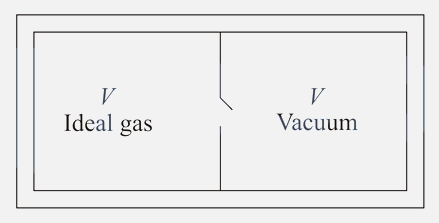
Consider the given diagram. An ideal gas is contained in a chamber (left) of volume $ V$ and is at an absolute temperature $ T.$ It is allowed to rush freely into the right chamber of volume $ V$ which is initially vacuum. The whole system is thermally isolated. What will be the final temperature of the equilibrium has been attained?
- $10 \text{ mole}$ of oxygen is heated at constant volume from $30^\circ\text{C}$ to $40^\circ\text{C}$. The change in the internal energy of the gas is ____________ $\text{cal}$. (The molecular specific heat of oxygen at constant pressure, $C_p = 7 \text{ cal/mol.}^\circ\text{C}$ and $R = 2 \text{ cal/mol.}^\circ\text{C}$.)
Important Questions from Heat and Thermodynamics
- When $300 \text{ J}$ of heat given to an ideal gas with $C_p = \frac{7}{2} R$ its temperature raises from $20^\circ\text{C}$ to $50^\circ\text{C}$ keeping its volume constant. The mass of the gas is (approximately) _______ g. ($R = 8.314 \text{ J/mol.K}$)
- Two cylindrical rods A and B made of different materials, are joined in a straight line. The ratios of lengths, radii and thermal conductivites of these rods are: $\frac{L_A}{L_B} = 1$, $\frac{r_A}{r_B} = 2$ and $\frac{K_A}{K_B} = \frac{1}{2}$. The free ends of rods A and B are maintained at 400 K, 200 K, respectively. The temperature of rods interface is ________ K, when equilibrium is established.
The internal energy of air in $4 m \times 4 m \times 3 m$ sized room at 1 atmospheric pressure will be ________ $\times 10^6$ J.
(Consider air as diatomic molecule)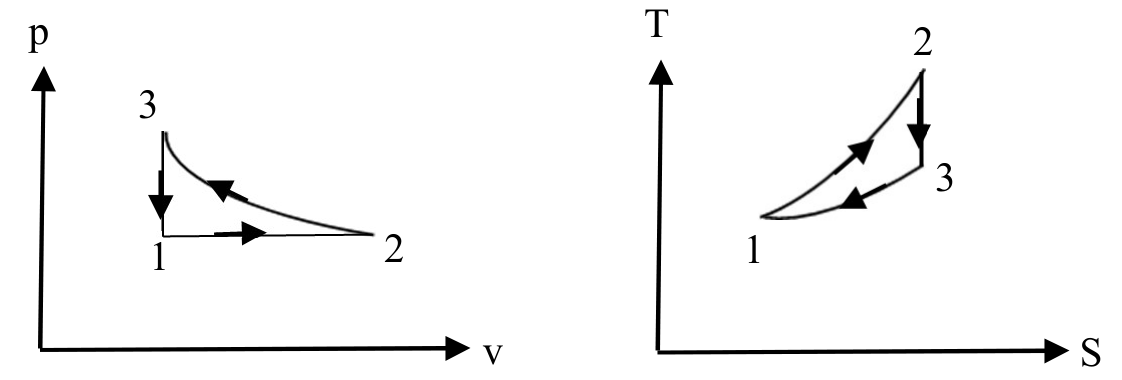
A cyclic process is shown in p-v diagram and T-S diagram. Which of the following statement(s) is/are true ?
A given quantity of gas is taken from A to C in two ways; a) directly from A → C along a straight line and b) in two steps, from A → B and then from B → C. Work done and heat absorbed along the direct path A→C is 200 J and 280 J respectively.
If the work done along A→B→C is 80 J, then heat absorbed along this path is,