Consider the given diagram. An ideal gas is contained in a chamber (left) of volume $ V$ and is at an absolute temperature $ T.$ It is allowed to rush freely into the right chamber of volume $ V$ which is initially vacuum. The whole system is thermally isolated. What will be the final temperature of the equilibrium has been attained?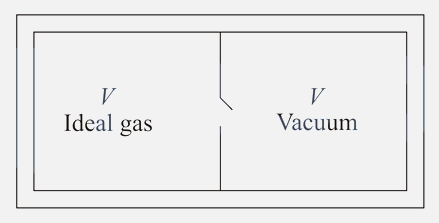
Similar Questions
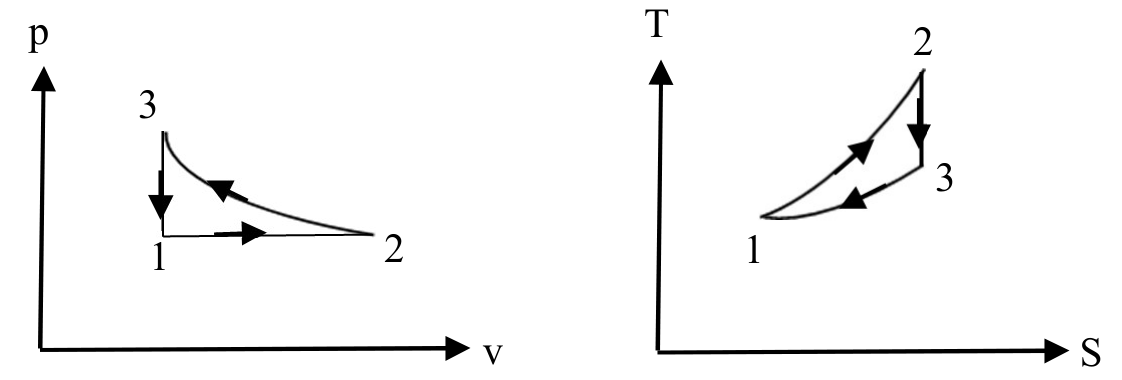
A cyclic process is shown in p-v diagram and T-S diagram. Which of the following statement(s) is/are true ?
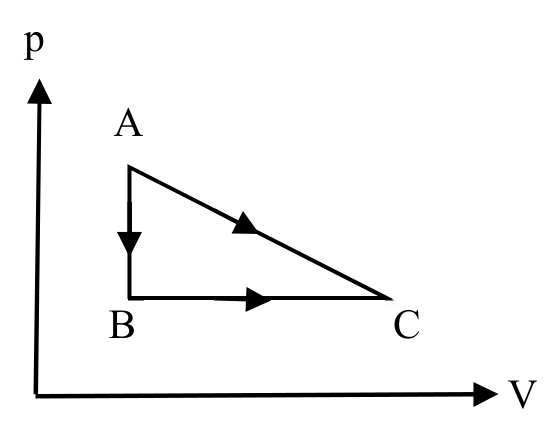
A given quantity of gas is taken from A to C in two ways; a) directly from A → C along a straight line and b) in two steps, from A → B and then from B → C. Work done and heat absorbed along the direct path A→C is 200 J and 280 J respectively.
If the work done along A→B→C is 80 J, then heat absorbed along this path is,
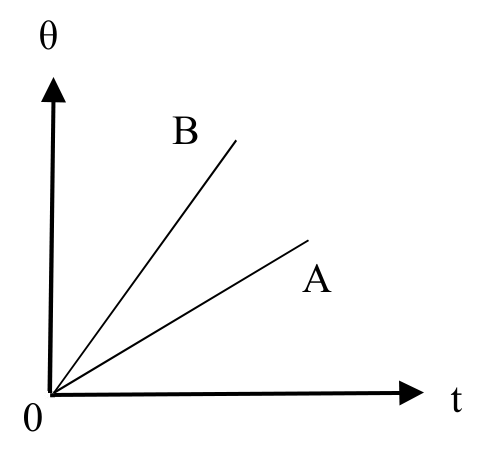
Two substances A and B of same mass are heated at constant rate. The variation of temperature θ of the substances with time t is shown in the figure. Choose the correct statement.
Six molecules of an ideal gas have velocities 1, 3, 5, 5, 6 and 5 m/s respectively. At any given temperature, if \(\bar{V}\) and Vrms represent average and rms speed of the molecules, then
Let \(\overline{V}\), Vrms, Vp denotes the mean speed, root mean square speed and most probable speed of the molecules each of mass m in an ideal monoatomic gas at absolute temperature T Kelvin. Which statement(s) is/are correct?
The apparent coefficient of expansion of a liquid, when heated in a copper vessel is C and when heated in silver vessel is S. If A is linear coefficient of expansion of copper, then linear coefficient of expansion of silver is
Temperature of a body θ is slightly more than the temperature of the surrounding θ0. Its rate of cooling (R) versus temperature of the body (θ) is plotted. Its shape would be
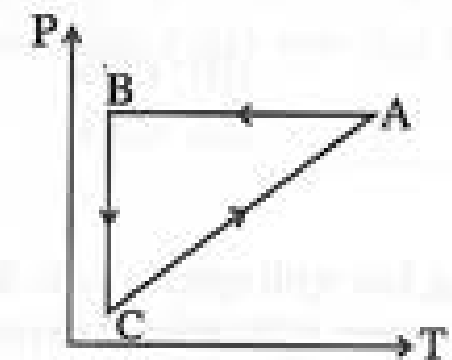
For an ideal gas, a cyclic process ABCA as shown in P–T diagram, when presented in P–V plot, it would be
A solid rectangular sheet has two different coefficients of linear expansion \(\alpha_1\) and \(\alpha_2\) along its length and breadth respectively. The coefficient of surface expansion is (for \(\alpha_1 t \ll 1, \alpha_2 t \ll 1\))
2 moles of an ideal monatomic gas is carried from a state \((P_0, V_0)\) to a state \((2P_0, 2V_0)\) along a straight line path in a P-V diagram. The amount of heat absorbed by the gas in the process is given by
Important Questions from Heat and Thermodynamics
- When $300 \text{ J}$ of heat given to an ideal gas with $C_p = \frac{7}{2} R$ its temperature raises from $20^\circ\text{C}$ to $50^\circ\text{C}$ keeping its volume constant. The mass of the gas is (approximately) _______ g. ($R = 8.314 \text{ J/mol.K}$)
- Two cylindrical rods A and B made of different materials, are joined in a straight line. The ratios of lengths, radii and thermal conductivites of these rods are: $\frac{L_A}{L_B} = 1$, $\frac{r_A}{r_B} = 2$ and $\frac{K_A}{K_B} = \frac{1}{2}$. The free ends of rods A and B are maintained at 400 K, 200 K, respectively. The temperature of rods interface is ________ K, when equilibrium is established.
The internal energy of air in $4 m \times 4 m \times 3 m$ sized room at 1 atmospheric pressure will be ________ $\times 10^6$ J.
(Consider air as diatomic molecule)- 5 moles of unknown gas is heated at constant volume from $10^\circ\text{C}$ to $20^\circ\text{C}$. The molar specific heat of this gas at constant pressure $C_p = 8\text{ cal/mol.}^\circ\text{C}$ and $R = 8.36\text{ J/mol.}^\circ\text{C}$. The change in the internal energy of the gas is __________ calorie.
A cyclic process is shown in p-v diagram and T-S diagram. Which of the following statement(s) is/are true ?