UGC NET Dec Exam Pattern 2026, Check Paper 1 & Paper 2 Pattern
UGC NET Exam Pattern 2026 for Dec session is formulated to evaluate candidates’ teaching aptitude and subject-specific knowledge. It consists of two papers: Paper 1, which tests general teaching and research skills, and Paper 2, which assesses domain expertise in the chosen subject. Both papers are objective-type and conducted in Computer Based Test (CBT) mode, with a total duration of 3 hours. Understanding this exam pattern is crucial for candidates to plan their preparation effectively and optimize performance during the exam.
UGC NET Dec 2026 Exam Pattern Highlights
UGC NET Dec 2026 exam will be conducted in Computer-Based Test (CBT) mode only, across selected cities nationwide, as per the official schedule.
| Aspect | Details |
|---|---|
| Exam Mode | Computer-Based Test (CBT) |
| Total Papers | 2 (Paper 1 & Paper 2) |
| Total Questions | 150 (50 in Paper 1 + 100 in Paper 2) |
| Total Marks | 300 (100 in Paper 1 + 200 in Paper 2) |
| Duration | 3 hours (180 minutes) without any break |
| Question Type | Objective Type (Multiple Choice Questions) |
| Medium of Question | English and Hindi (except language papers) |
| Negative Marking | No negative marking |
| Marking Scheme | 2 marks for each correct answer |
UGC NET Dec 2026 Exam Pattern: Complete Breakdown
UGC NET Dec 2026 will be conducted entirely in Computer Based Test (CBT) mode by the National Testing Agency (NTA). UGC NET Dec exam consists of two papers, both objective type, multiple-choice questions (MCQs), with a combined duration of 3 hours.
UGC NET Paper 1: Teaching and Research Aptitude
| Parameter | Details |
|---|---|
| Number of Questions | 50 |
| Total Marks | 100 |
| Duration | Included in total 3 hours (no separate time) |
| Purpose | To assess teaching/research aptitude, reasoning, reading comprehension, divergent thinking, and general awareness. |
| Question Type | Multiple Choice Questions (MCQs) |
| Difficulty Level | Moderate |
| Weightage | 1/3 of total marks |
Key Features:
- Tests general teaching and research skills.
- Questions focus on logical reasoning, comprehension, and analytical ability.
- Designed to evaluate your aptitude as an academic and researcher.
UGC NET Paper 2: Subject-Specific Domain Knowledge
| Parameter | Details |
|---|---|
| Number of Questions | 100 |
| Total Marks | 200 |
| Duration | Included in total 3 hours (alongside Paper 1) |
| Purpose | To evaluate candidates' knowledge in their chosen subject. |
| Question Type | Multiple Choice Questions (MCQs) |
| Difficulty Level | Moderate to Difficult |
| Weightage | 2/3 of total marks |
Key Features:
- Questions based on the syllabus of the subject selected by the candidate.
- Tests in-depth understanding of concepts, theories, and practical knowledge.
- The syllabus spans over 80 subjects, including Commerce, Psychology, English, Environmental Science, History, Political Science, Sociology, and more.
Total Duration and Structure
- The entire exam lasts 3 hours (180 minutes).
- There is no break between Paper 1 and Paper 2.
- Both papers are conducted in a single sitting.
- Candidates must answer all questions; there are no optional questions.
- The exam is computer-based, so candidates answer questions on a screen using a mouse and keyboard.
UGC NET Dec 2026 Marking Scheme
Understanding UGC NET Dec 2026 marking scheme is vital for devising a smart exam strategy:
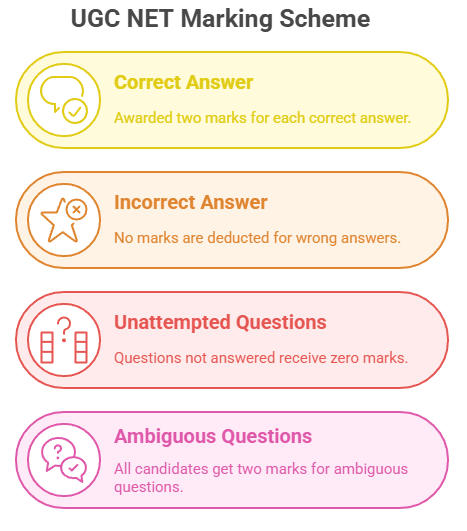
Note: This no-negative marking policy encourages candidates to attempt every question confidently.
Medium of UGC NET Dec 2026 Question Paper
UGC NET Dec 2026 question paper will be available in multiple languages, depending on the subject and exam requirements. The medium of the question paper is given below.
- The question paper is available in English and Hindi for all subjects except language papers, which are in the respective language.
- Candidates must select their preferred medium at the time of filling the application form.
- This choice cannot be changed later.
- In case of any ambiguity or translation issue, the English version will be considered final.
Why Understanding UGC NET Dec 2026 Exam Pattern is Crucial?
UGC NET Dec exam pattern 2026 outlines how the exam is structured. It covers the number of questions, types of questions, subjects, duration, and marking scheme. Understanding this pattern is essential because:
- Preparation Planning: It helps candidates design a focused study plan targeting each section efficiently.
- Time Management: Knowing the number of questions and duration allows you to practice time-bound mock tests.
- Strategic Attempt: Awareness of no negative marking encourages attempt of all questions without fear.
- Subject Focus: Helps in allocating proper time to Paper 1 and Paper 2 based on their weightage and difficulty.
With a detailed understanding of the exam pattern, aspirants can streamline their preparation and increase their chances of qualifying.
UGC NET Dec 2026 Syllabus
UGC NET syllabus for the Dec session is divided into two parts: Paper 1 and Paper 2. Paper 1 is a general paper common to all candidates, designed to assess teaching aptitude, research skills, reasoning ability, communication, and awareness of higher education policies in India.
UGC NET Dec 2026 Paper 2 is subject-specific and tests candidates’ in-depth knowledge of the discipline they have studied at the postgraduate level. With 85 subjects available, UGC NET Paper 2 syllabus is tailored to assess the theoretical and practical understanding of each field, ensuring candidates are well-prepared for teaching and research roles.
How to Prepare According to UGC NET Dec Exam Pattern 2026?
1. Focus on Paper 1: Teaching and Research Aptitude
- Practice reasoning and comprehension exercises daily.
- Solve previous years’ question papers to understand the pattern.
- Improve your time management by taking mock tests.
2. Master Your Subject for Paper 2
- Cover all topics as per the official syllabus.
- Make concise notes for quick revisions.
- Refer to standard textbooks and online resources.
- Take subject-wise mock tests regularly.
3. Utilize the No Negative Marking Scheme
- Attempt every question since wrong answers do not deduct marks.
- Use elimination methods to increase the chance of correct answers.
4. Time Management
- Allocate roughly 1 hour for Paper 1 and 2 hours for Paper 2 during practice.
- Improve reading speed for comprehension questions.
- Take timed mock tests to simulate exam conditions.
Important Tips for UGC NET Exam Day
- Reach the exam center early and carry all required documents.
- Follow the instructions for CBT carefully.
- Read each question attentively before answering.
- Use the on-screen calculator only if allowed.
- Keep calm and manage your time wisely.
UGC NET Dec Exam Pattern 2026 is designed to assess a candidate’s teaching aptitude and subject expertise comprehensively. With two papers—one testing research and teaching skills and the other evaluating subject knowledge—aspirants need a focused, strategic approach to preparation.
UGC NET Dec 2026 Exam Pattern FAQs
Ques: How many subjects are available for Paper 2 in UGC NET Dec 2026?
Ans: UGC NET Dec 2026 offers 85 subjects for Paper 2, spanning Humanities, Sciences, Commerce, and Languages.
Ques: Are all questions in UGC NET Dec compulsory?
Ans: Yes, all questions in both Paper 1 and Paper 2 are compulsory.
Ques: Can I attempt all questions without fear of negative marking?
Ans: Yes, since UGC NET Dec 2026 has no negative marking, candidates should attempt all questions to maximize scores.
Ques: What is the weightage of Paper 1 and Paper 2 in UGC NET Dec 2026?
Ans: Paper 1 carries 100 marks (1/3 weightage), and Paper 2 carries 200 marks (2/3 weightage) in UGC NET Dec 2026 exam.
Ques: Is UGC NET Dec 2026 exam pattern different for JRF and Assistant Professor eligibility?
Ans: No, the exam pattern is the same for both Junior Research Fellowship and Assistant Professor eligibility.
Ques: How many attempts can I take for UGC NET?
Ans: There is no limit on the number of attempts, but candidates must meet the age and other eligibility criteria set by UGC.
Download the PREPP App and attempt FREE CBSE UGC NET Mock Tests and get complete study material!

Full Test-05: UGC NET Paper II
Full Test-04: UGC NET Paper II
UGC NET 2025 Geography Question Paper (03-Jan-2026) (Shift 2)
UGC NET 2025 Criminology Question Paper (03-Jan-2026) (Shift 1)

17 February 2025 | The Hindu Must Read Articles | Current Affairs

16 February 2026 | The Hindu Must Read Articles | Current Affairs

13 February 2026 | The Hindu Must Read Articles | Current Affairs









Comments