
Consider the following for the next three (03) items that follow : In the triangle ABC, AB = 6 cm, BC = 8 cm and AC = 10 cm. The perpendicular dropped from B meets the side AC at D. A circle of radius BD (with centre B) cuts AB and BC at P and Q respectively as shown in the figure. 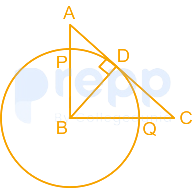
What is the radius of the circle ?
4.8 cm
Triangle ABC Geometry Problem Analysis
We are given a triangle ABC with side lengths AB = 6 cm, BC = 8 cm, and AC = 10 cm. A perpendicular line segment BD is dropped from vertex B to the side AC, meeting AC at point D. A circle is drawn with its center at B and radius equal to the length of BD. We need to find the radius of this circle, which is the length of BD.
Identifying the Triangle Type using Pythagorean Theorem
Let's first determine if the triangle ABC is a right-angled triangle by checking if the side lengths satisfy the Pythagorean theorem (\(a^2 + b^2 = c^2\)). The longest side is AC = 10 cm, which would be the hypotenuse if it's a right triangle.
Calculate the square of the lengths of the two shorter sides:
- \(AB^2 = 6^2 = 36\)
- \(BC^2 = 8^2 = 64\)
Sum of the squares of the shorter sides: \(AB^2 + BC^2 = 36 + 64 = 100\).
Calculate the square of the longest side:
\(AC^2 = 10^2 = 100\).
Since \(AB^2 + BC^2 = AC^2\), the triangle ABC is indeed a right-angled triangle, with the right angle located at vertex B.
Calculating the Area of the Triangle
The area of a right-angled triangle can be calculated easily using the two sides that form the right angle as the base and height. In triangle ABC, AB and BC are the legs forming the right angle at B.
Area of triangle ABC \(= \frac{1}{2} \times \text{base} \times \text{height} = \frac{1}{2} \times AB \times BC\)
Substitute the values of AB and BC:
Area \(= \frac{1}{2} \times 6 \text{ cm} \times 8 \text{ cm} = \frac{1}{2} \times 48 \text{ cm}^2 = 24 \text{ cm}^2\).
Finding the Perpendicular Height BD using Area
The area of any triangle can also be calculated using any side as the base and the corresponding altitude (perpendicular height) from the opposite vertex to that side.
In triangle ABC, we can consider AC as the base and BD as the corresponding height because BD is the perpendicular dropped from B to AC.
Area of triangle ABC \(= \frac{1}{2} \times \text{base} \times \text{height} = \frac{1}{2} \times AC \times BD\)
We know the area of triangle ABC is 24 cm² and AC is 10 cm. Substitute these values into the formula:
\(24 = \frac{1}{2} \times 10 \times BD\)
\(24 = 5 \times BD\)
Now, solve for BD:
\(BD = \frac{24}{5}\)
\(BD = 4.8 \text{ cm}\).
Determining the Circle's Radius
The problem states that the circle has a radius equal to the length of BD. Since we found BD = 4.8 cm, the radius of the circle is 4.8 cm.
Triangle Properties Revision Table
| Property | Description | Application in this Problem |
|---|---|---|
| Pythagorean Theorem | For a right triangle with legs a, b and hypotenuse c, \(a^2 + b^2 = c^2\). | Used to confirm ABC is a right triangle (\(6^2 + 8^2 = 10^2\)). |
| Area of a Triangle | General formula: \(\frac{1}{2} \times \text{base} \times \text{height}\). | Used to calculate area in two ways to find BD. |
| Altitude (Perpendicular Height) | A line segment from a vertex perpendicular to the opposite side. | BD is the altitude from B to AC. Its length is the circle's radius. |
Additional Information on Right Triangle Altitudes
In a right-angled triangle, the altitude drawn from the right angle to the hypotenuse has some special properties. The length of this altitude (BD in our case) is the geometric mean of the two segments it divides the hypotenuse into (AD and DC).
Also, there is a direct formula for the altitude from the right angle to the hypotenuse in a right triangle with legs a, b and hypotenuse c: \(h = \frac{a \times b}{c}\).
Using this formula for triangle ABC (a=6, b=8, c=10):
\(BD = \frac{AB \times BC}{AC} = \frac{6 \times 8}{10} = \frac{48}{10} = 4.8 \text{ cm}\).
This confirms our calculation using the area method. The length of the perpendicular BD, which is the radius of the circle, is 4.8 cm.
Similar Questions
An equilateral triangle ABC and a scalene triangle DBC are inscribed in a circle on same side of the arc. what is ∠BDC equal to?
What is the length of QC ?
What is the relation between x and y ?
If y = 15, then what is ∠ACB equal to ?
If ∠ABD = θ, then what is sin θ equal to ?
What is the radius of the circle ?
What is the area of the minor segment ?
- What is the area of the major segment ?
What is the length of the chord a unit circle which subtends an angle 2θ at the centre, where θ < 45°?
Consider the following statements :
1. If two chords AB and AC of a circle are equal, then the centre of the circle lies on the angle bisector of angle CAB.
2. If two concentric circles are intersected by a line at A, B, C and D respectively, then AC = BD.
Which of the above statements is/are correct?
Important Questions from Circles, Chords and Tangents
AB is a chord of a circle with centre O and P is any point on the circle. If ∠APB = 112°, then what is the measure of ∠OAB ?
The distance between the centres of two circles is 24 cm. If the radius of the two circles are 4 cm and 8 cm, then what is the sum of the lengths (in cm) of the direct common tangent and the transverse common tangent?
An equilateral triangle ABC and a scalene triangle DBC are inscribed in a circle on same side of the arc. what is ∠BDC equal to?
What can be the maximum number of common tangent which can be drawn to two non-intersecting circles?
There are two identical circles of radius 10 cm each. If the length of the direct common tangent is 26 cm, then what is the length (in cm) of the transverse common tangent?



