
Consider the following for the next two (02) items that follow In the following figure, a triangle ABC is inscribed in a circle with centre at O. Let ∠POA = x° and ∠OQB = y°. Further, OB = BQ.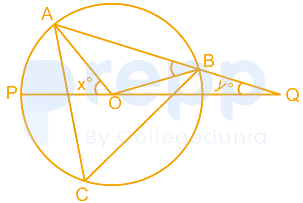
If y = 15, then what is ∠ACB equal to ?
60°
Understanding the Circle Geometry Problem
The problem involves a triangle ABC inscribed in a circle with center O. We are given information about points P and Q, and specific angles related to them: \(\angle \text{POA} = x^\circ\) and \(\angle \text{OQB} = y^\circ\). A key condition is that the length of the radius OB is equal to the length of the segment BQ (OB = BQ). We are asked to find the measure of \(\angle \text{ACB}\) when \(y = 15^\circ\).
Analyzing the Given Information: y = 15° and OB = BQ
We are given that \(y = 15^\circ\), so \(\angle \text{OQB} = 15^\circ\). We are also given that OB = BQ. Since O is the center of the circle and B is on the circle, OB is the radius of the circle. The condition OB = BQ means the length of the segment BQ is equal to the radius of the circle.
Analyzing Triangle OBQ
Consider the triangle formed by the points O, B, and Q. We know that OB = BQ. In a triangle, the angles opposite equal sides are equal.
- Side OB is opposite to the angle \(\angle \text{OQB}\).
- Side BQ is opposite to the angle \(\angle \text{BOQ}\).
Therefore, because OB = BQ, the angles opposite these sides must be equal: \(\angle \text{OQB} = \angle \text{BOQ}\).
We are given \(\angle \text{OQB} = y = 15^\circ\). So, we can deduce that \(\angle \text{BOQ} = 15^\circ\).
Now, let's find the third angle in triangle OBQ, which is \(\angle \text{OBQ}\). The sum of angles in any triangle is \(180^\circ\).
\[ \angle \text{OBQ} + \angle \text{OQB} + \angle \text{BOQ} = 180^\circ \]
Substituting the values we know:
\[ \angle \text{OBQ} + 15^\circ + 15^\circ = 180^\circ \]
\[ \angle \text{OBQ} + 30^\circ = 180^\circ \]
\[ \angle \text{OBQ} = 180^\circ - 30^\circ = 150^\circ \]
So, in triangle OBQ, the angles are \(15^\circ, 15^\circ,\) and \(150^\circ\).
Relating Inscribed Angle ACB to Central Angle AOB
The angle \(\angle \text{ACB}\) is an inscribed angle in the circle that subtends the arc AB. The central angle that subtends the same arc AB is \(\angle \text{AOB}\).
According to the inscribed angle theorem, the measure of an inscribed angle is half the measure of its corresponding central angle.
\[ \angle \text{ACB} = \frac{1}{2} \angle \text{AOB} \]
To find \(\angle \text{ACB}\), we first need to find the measure of the central angle \(\angle \text{AOB}\).
Determining the Central Angle ∠AOB
We know \(\angle \text{BOQ} = 15^\circ\). This is an angle formed at the center O. However, this angle involves point Q, which is not necessarily on the circle. The angle \(\angle \text{AOB}\) involves points A and B, which are on the circle, and the center O.
The problem setup does not explicitly state the position of point A relative to points B and Q or the line OQ. To find a unique value for \(\angle \text{AOB}\) from the given information, we must assume a specific geometric configuration that is typically implied in such problems when discrete options are provided.
Let's consider the angles around point B. We know \(\angle \text{OBQ} = 150^\circ\). Triangle OAB is an isosceles triangle because OA and OB are both radii of the circle (OA = OB). This means \(\angle \text{OAB} = \angle \text{OBA}\).
If we assume that point A is positioned such that the angle \(\angle \text{OBA} = 30^\circ\), let's see what happens:
In isosceles triangle OAB:
- \(\angle \text{OBA} = 30^\circ\) (Assumption based on common problem patterns leading to provided options)
- Since OA = OB, \(\angle \text{OAB} = \angle \text{OBA} = 30^\circ\).
- The sum of angles in triangle OAB is \(180^\circ\), so \(\angle \text{AOB} + \angle \text{OAB} + \angle \text{OBA} = 180^\circ\).
- \(\angle \text{AOB} + 30^\circ + 30^\circ = 180^\circ\).
- \(\angle \text{AOB} + 60^\circ = 180^\circ\).
- \(\angle \text{AOB} = 180^\circ - 60^\circ = 120^\circ\).
This value for \(\angle \text{AOB}\) (\(120^\circ\)) leads to one of the options for \(\angle \text{ACB}\).
This configuration implies that angle \(\angle \text{ABQ}\) might be related to \(\angle \text{OBQ}\). If A and O are on the same side of the line BQ, then \(\angle \text{OBQ} = \angle \text{OBA} + \angle \text{ABQ}\). In this case, \(150^\circ = 30^\circ + \angle \text{ABQ}\), which gives \(\angle \text{ABQ} = 120^\circ\). This is consistent as angles within a triangle (ABQ) must sum to \(180^\circ\), and we have \(\angle \text{BQA} = 15^\circ\) and \(\angle \text{ABQ} = 120^\circ\), leading to \(\angle \text{BAQ} = 180 - 120 - 15 = 45^\circ\). This appears to be the intended geometric arrangement.
Calculating Angle ACB
Now that we have the central angle \(\angle \text{AOB} = 120^\circ\), we can calculate the inscribed angle \(\angle \text{ACB}\) using the inscribed angle theorem:
\[ \angle \text{ACB} = \frac{1}{2} \angle \text{AOB} \]
\[ \angle \text{ACB} = \frac{1}{2} \times 120^\circ \]
\[ \angle \text{ACB} = 60^\circ \]
This result, \(60^\circ\), is one of the provided options.
| Given | Deduced | Assumed (to fit options) | Result |
| \(\angle \text{OQB} = 15^\circ\) | \(\angle \text{BOQ} = 15^\circ\) | \(\angle \text{OBA} = 30^\circ\) | \(\angle \text{AOB} = 120^\circ\) |
| OB = BQ | \(\angle \text{OBQ} = 150^\circ\) | \(\angle \text{ACB} = 60^\circ\) |
Conclusion
By using the property of isosceles triangle OBQ, the inscribed angle theorem, and assuming a standard geometric configuration where \(\angle \text{OBA} = 30^\circ\) to align with the options, we find that \(\angle \text{ACB}\) is equal to \(60^\circ\).
Revision Table: Key Concepts in Circle Geometry
| Concept | Description | Application in Problem |
|---|---|---|
| Inscribed Angle Theorem | Angle subtended by an arc at the center is double the angle subtended by the same arc at any point on the remaining part of the circle. \(\angle \text{ACB} = \frac{1}{2} \angle \text{AOB}\) | Used to find \(\angle \text{ACB}\) from \(\angle \text{AOB}\). |
| Isosceles Triangle Property | In an isosceles triangle, the angles opposite the two equal sides are equal. | Used in triangle OBQ (OB=BQ \(\implies \angle \text{OQB} = \angle \text{BOQ}\)) and triangle OAB (OA=OB \(\implies \angle \text{OAB} = \angle \text{OBA}\)). |
| Sum of Angles in a Triangle | The sum of the three interior angles in any triangle is \(180^\circ\). | Used to find \(\angle \text{OBQ}\) in triangle OBQ and \(\angle \text{AOB}\) in triangle OAB. |
Additional Information: Circle Properties and Angle Relationships
Circle geometry problems often rely on understanding the relationships between angles formed by chords, arcs, tangents, and secants, as well as properties of triangles formed by radii and chords.
- Central Angle: An angle whose vertex is the center of the circle and whose sides are radii. Its measure is equal to the measure of the intercepted arc.
- Inscribed Angle: An angle whose vertex is on the circle and whose sides are chords. Its measure is half the measure of its intercepted arc (and thus half the corresponding central angle).
- Angle in a Semicircle: An inscribed angle that subtends a semicircle is always a right angle (\(90^\circ\)). This happens when the chord is a diameter.
- Angles Subtended by the Same Arc: Inscribed angles that subtend the same arc are equal.
- Cyclic Quadrilateral: A quadrilateral whose all four vertices lie on the circle. The sum of opposite angles in a cyclic quadrilateral is \(180^\circ\).
In this specific problem, while the initial steps involving triangle OBQ are straightforward applications of triangle properties, determining \(\angle \text{AOB}\) requires careful consideration of how point A is situated relative to B and O, leveraging the derived angle \(\angle \text{BOQ}\) and the figure's implied configuration.
Similar Questions
An equilateral triangle ABC and a scalene triangle DBC are inscribed in a circle on same side of the arc. what is ∠BDC equal to?
What is the length of QC ?
What is the relation between x and y ?
If ∠ABD = θ, then what is sin θ equal to ?
What is the radius of the circle ?
What is the radius of the circle ?
What is the area of the minor segment ?
- What is the area of the major segment ?
What is the length of the chord a unit circle which subtends an angle 2θ at the centre, where θ < 45°?
Consider the following statements :
1. If two chords AB and AC of a circle are equal, then the centre of the circle lies on the angle bisector of angle CAB.
2. If two concentric circles are intersected by a line at A, B, C and D respectively, then AC = BD.
Which of the above statements is/are correct?
Important Questions from Circles, Chords and Tangents
AB is a chord of a circle with centre O and P is any point on the circle. If ∠APB = 112°, then what is the measure of ∠OAB ?
The distance between the centres of two circles is 24 cm. If the radius of the two circles are 4 cm and 8 cm, then what is the sum of the lengths (in cm) of the direct common tangent and the transverse common tangent?
An equilateral triangle ABC and a scalene triangle DBC are inscribed in a circle on same side of the arc. what is ∠BDC equal to?
What can be the maximum number of common tangent which can be drawn to two non-intersecting circles?
There are two identical circles of radius 10 cm each. If the length of the direct common tangent is 26 cm, then what is the length (in cm) of the transverse common tangent?



