
A chord 21 cm long is drawn in a circle of diameter 25 cm. The perpendicular distance of the chord from the centre is:
√46
Understanding the Circle and Chord Problem
This problem asks us to find the perpendicular distance from the center of a circle to a chord. We are given the length of the chord and the diameter of the circle. This involves applying basic geometric principles related to circles, specifically the properties of a chord and the radius.
Given Information:
- Length of the chord = 21 cm
- Diameter of the circle = 25 cm
Step-by-Step Solution for Perpendicular Distance
First, let's find the radius of the circle. The radius is half the diameter.
Radius \(r = \frac{\text{Diameter}}{2} = \frac{25 \text{ cm}}{2} = 12.5 \text{ cm}\)
Next, recall a key property of circles: a perpendicular drawn from the center of a circle to a chord bisects the chord. This means it divides the chord into two equal parts.
Let the chord be AB, and the center of the circle be O. Let D be the point where the perpendicular from O meets the chord AB. Then OD is the perpendicular distance we want to find, and D is the midpoint of AB.
Length of each half of the chord = \(\frac{\text{Length of chord}}{2} = \frac{21 \text{ cm}}{2} = 10.5 \text{ cm}\)
So, AD = DB = 10.5 cm.
Now, consider the triangle ODA. This is a right-angled triangle because OD is perpendicular to AB. The sides of this triangle are:
- OA = radius (r) = 12.5 cm (This is the hypotenuse)
- AD = half of the chord length = 10.5 cm (This is one leg)
- OD = perpendicular distance from the center = ? (This is the other leg)
We can use the Pythagorean theorem in the right-angled triangle ODA. The theorem states that in a right-angled triangle, the square of the hypotenuse is equal to the sum of the squares of the other two sides.
\((\text{OA})^2 = (\text{AD})^2 + (\text{OD})^2\)
\(r^2 = (\frac{\text{chord length}}{2})^2 + (\text{perpendicular distance})^2\)
Let the perpendicular distance be \(d\).
\((12.5)^2 = (10.5)^2 + d^2\)
Calculate the squares:
\(12.5^2 = 12.5 \times 12.5 = 156.25\)
\(10.5^2 = 10.5 \times 10.5 = 110.25\)
Substitute these values back into the equation:
\(156.25 = 110.25 + d^2\)
Now, isolate \(d^2\):
\(d^2 = 156.25 - 110.25\)
\(d^2 = 46\)
To find \(d\), take the square root of both sides:
\(d = \sqrt{46}\)
The perpendicular distance of the chord from the center is \(\sqrt{46}\) cm.
Checking the Options
Let's look at the given options:
- √41
- √23
- √56
- √46
Our calculated distance is \(\sqrt{46}\) cm, which matches option 4.
| Geometric Element | Value |
|---|---|
| Chord Length | 21 cm |
| Diameter | 25 cm |
| Radius | 12.5 cm |
| Half Chord Length | 10.5 cm |
| Perpendicular Distance | \(\sqrt{46}\) cm |
Conclusion
By using the property that the perpendicular from the center bisects the chord and applying the Pythagorean theorem to the right-angled triangle formed by the radius, half the chord, and the perpendicular distance, we found the distance to be \(\sqrt{46}\) cm.
Revision Table: Circle and Chord Properties
| Concept | Description / Formula |
|---|---|
| Radius (r) | \(\frac{\text{Diameter}}{2}\) |
| Perpendicular from Center | Bisects the chord. |
| Pythagorean Theorem | In a right triangle with legs a, b and hypotenuse c: \(a^2 + b^2 = c^2\). Used here as \(r^2 = (\frac{\text{chord}}{2})^2 + d^2\). |
Additional Information on Circle Geometry
Understanding chords and their relationship with the circle's center is fundamental in geometry. A chord is simply a line segment connecting two points on the circle's circumference. The longest chord in a circle is the diameter.
The property used in this problem - that a perpendicular from the center to a chord bisects the chord - is derived from the congruence of the two right-angled triangles formed (ODA and ODB in our example, where OA=OB=radius, OD is common, and angles at D are 90°). Conversely, the line joining the center to the midpoint of a chord is perpendicular to the chord.
These properties are useful for solving various problems involving distances, lengths, and angles within circles.
Similar Questions
In a circle with radius 5 cm, a chord is at a distance of 3 cm from the centre. The length of the chord is:
The distance between the centres of two circles is 24 cm. If the radius of the two circles are 4 cm and 8 cm, then what is the sum of the lengths (in cm) of the direct common tangent and the transverse common tangent?
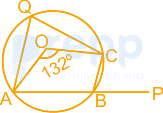
In a circle with centre O, an arc ABC subtends an angle of 132° at the center of the circle. Chord AB is produced to point P. Then ∠CBP is equal to∶
What can be the maximum number of common tangent which can be drawn to two non-intersecting circles?
There are two identical circles of radius 10 cm each. If the length of the direct common tangent is 26 cm, then what is the length (in cm) of the transverse common tangent?
AB is a chord in the minor segment of a circle with centre O. C is a point on the minor arc (between A and B). The tangents to the circle at A and B meet at a point P. If ∠ACB = 108°, then ∠APB is equal to:
AB is the chord of a circle such that AB = 10 cm. If the diameter of the circle is 20 cm, then the angle subtended by the chord at the centre is ________.
Select the INCORRECT statement with respect to the properties of a circle.
The radius of a circle is 5 cm. Calculate the length of a tangent drawn to this circle from a point at a distance of 10 cm from its centre.
If two circles of radii 18 cm and 8 cm touch externally, then the length of a direct common tangent is:
Important Questions from Circles, Chords and Tangents
AB is a chord of a circle with centre O and P is any point on the circle. If ∠APB = 112°, then what is the measure of ∠OAB ?
In a circle with radius 5 cm, a chord is at a distance of 3 cm from the centre. The length of the chord is:
The distance between the centres of two circles is 24 cm. If the radius of the two circles are 4 cm and 8 cm, then what is the sum of the lengths (in cm) of the direct common tangent and the transverse common tangent?
An equilateral triangle ABC and a scalene triangle DBC are inscribed in a circle on same side of the arc. what is ∠BDC equal to?
In a circle with centre O, an arc ABC subtends an angle of 132° at the center of the circle. Chord AB is produced to point P. Then ∠CBP is equal to∶



