
AB is the chord of a circle such that AB = 10 cm. If the diameter of the circle is 20 cm, then the angle subtended by the chord at the centre is ________.
60 degree
Understanding the Geometry Problem
The question asks for the angle subtended by a chord at the centre of a circle, given the chord's length and the circle's diameter. Let's break down the given information:
- Length of the chord AB = 10 cm.
- Diameter of the circle = 20 cm.
We need to find the angle formed by the chord AB at the centre of the circle. Let O be the centre of the circle.
Calculating the Circle's Radius
The radius of a circle is half of its diameter. Given the diameter is 20 cm, the radius (let's call it 'r') is:
$\text{r} = \frac{\text{Diameter}}{2}$
$\text{r} = \frac{20 \text{ cm}}{2}$
$\text{r} = 10 \text{ cm}$
So, the radius of the circle is 10 cm.
Forming a Triangle at the Centre
Consider the triangle formed by the two radii connecting the endpoints of the chord to the centre, and the chord itself. In our case, this is triangle AOB, where O is the centre, and A and B are the endpoints of the chord AB.
- OA is a radius, so OA = 10 cm.
- OB is a radius, so OB = 10 cm.
- AB is the chord, and its length is given as 10 cm.
So, the sides of triangle AOB are OA = 10 cm, OB = 10 cm, and AB = 10 cm.
Identifying the Type of Triangle AOB
In triangle AOB, we observe that all three sides are equal in length:
OA = OB = AB = 10 cm
A triangle with all three sides equal in length is known as an equilateral triangle.
Determining the Angles of Triangle AOB
A key property of equilateral triangles is that all three internal angles are equal. The sum of angles in any triangle is 180 degrees.
Let $\angle\text{AOB}$, $\angle\text{OAB}$, and $\angle\text{OBA}$ be the angles of triangle AOB.
Since it is an equilateral triangle, $\angle\text{AOB} = \angle\text{OAB} = \angle\text{OBA}$.
The sum of angles = $\angle\text{AOB} + \angle\text{OAB} + \angle\text{OBA} = 180^\circ$.
Let $\angle\text{AOB} = \theta$. Then $\theta + \theta + \theta = 180^\circ$.
$3\theta = 180^\circ$
$\theta = \frac{180^\circ}{3}$
$\theta = 60^\circ$
Thus, each angle in triangle AOB is 60 degrees.
The Angle Subtended at the Centre
The angle subtended by the chord AB at the centre O is $\angle\text{AOB}$. We found that $\angle\text{AOB} = 60^\circ$.
Analysis of Options
Let's look at the given options for the angle subtended by the chord AB at the centre:
| Option | Angle | Analysis |
|---|---|---|
| 1 | 45 degree | Incorrect. This would not form an equilateral triangle with equal radii and chord length. |
| 2 | 60 degree | Correct. This angle forms an equilateral triangle with the two radii and the chord, matching the given side lengths (10 cm, 10 cm, 10 cm). |
| 3 | 30 degree | Incorrect. This would not form an equilateral triangle. |
| 4 | 90 degree | Incorrect. This would form a right-angled triangle, but not one with sides 10, 10, 10. (By Pythagoras, hypotenuse would be $\sqrt{10^2 + 10^2} = \sqrt{200} \approx 14.14$ cm). |
Based on our calculation, the angle subtended by the chord AB at the centre is 60 degrees.
Revision Table: Circle Chord Angle
| Concept | Description | Formula/Property |
|---|---|---|
| Radius (r) | Distance from centre to circumference. | r = Diameter / 2 |
| Chord | A line segment connecting two points on the circle. | Length given as 10 cm. |
| Angle at Centre | Angle formed by radii to chord endpoints at the centre. | $\angle\text{AOB}$ in this case. |
| Equilateral Triangle | A triangle with all three sides equal. | All internal angles are $60^\circ$. |
Additional Information on Circle Geometry
Understanding chords and the angles they subtend is fundamental in circle geometry. Here are some related concepts:
- Angle at the Circumference: The angle subtended by a chord at any point on the circumference is half the angle subtended by the same chord at the centre, provided both angles are on the same side of the chord. In this case, the angle subtended at the circumference would be $60^\circ / 2 = 30^\circ$.
- Perpendicular from Centre: A perpendicular drawn from the centre of a circle to a chord bisects the chord. If we draw a perpendicular from O to AB, it would meet AB at its midpoint, say M. Then AM = MB = 5 cm. Triangle OMA would be a right-angled triangle.
- Congruent Chords: Equal chords of a circle subtend equal angles at the centre. Conversely, if two chords subtend equal angles at the centre, they are equal in length.
These properties are useful for solving various problems involving chords and angles in circles.
Similar Questions
The distance between the centres of two circles is 24 cm. If the radius of the two circles are 4 cm and 8 cm, then what is the sum of the lengths (in cm) of the direct common tangent and the transverse common tangent?
What can be the maximum number of common tangent which can be drawn to two non-intersecting circles?
There are two identical circles of radius 10 cm each. If the length of the direct common tangent is 26 cm, then what is the length (in cm) of the transverse common tangent?
AB is a chord in the minor segment of a circle with centre O. C is a point on the minor arc (between A and B). The tangents to the circle at A and B meet at a point P. If ∠ACB = 108°, then ∠APB is equal to:
The radius of a circle is 5 cm. Calculate the length of a tangent drawn to this circle from a point at a distance of 10 cm from its centre.
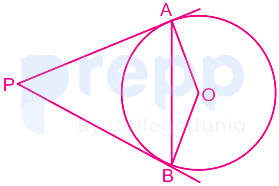
In the given figure, if PA and PB are tangents to the circle with centre O such that ∠APB = 54°, then ∠ OBA = ________.
In a circle, a ten cm long chord is at a distance of 12 cm from the centre of the circle. The length of the diameter of the circle (in cm) is:
PRT is a tangent to a circle with centre O, at the point R on it. Diameter SQ of the circle is produced to meet the tangent at P and QR is jointed. If ∠QRP = 28°, then the measure of ∠SPR is:
PAB and PCD are two secants to a circle. If PA = 10 cm, AB = 12 cm and PC = 11 cm, then what is the value (in cm) of PD?
A circle is inscribed in ΔABC, touching AB, BC and AC at the points P, Q and R respectively. If AB - BC = 4 cm, AB - AC = 2 cm and the perimeter of ΔABC = 32 cm, then PB + AR is equal to∶
Important Questions from Circles, Chords and Tangents
AB is a chord of a circle with centre O and P is any point on the circle. If ∠APB = 112°, then what is the measure of ∠OAB ?
The distance between the centres of two circles is 24 cm. If the radius of the two circles are 4 cm and 8 cm, then what is the sum of the lengths (in cm) of the direct common tangent and the transverse common tangent?
An equilateral triangle ABC and a scalene triangle DBC are inscribed in a circle on same side of the arc. what is ∠BDC equal to?
What can be the maximum number of common tangent which can be drawn to two non-intersecting circles?
There are two identical circles of radius 10 cm each. If the length of the direct common tangent is 26 cm, then what is the length (in cm) of the transverse common tangent?



