
Consider the following for the next three (03) items that follow : In the triangle ABC, AB = 6 cm, BC = 8 cm and AC = 10 cm. The perpendicular dropped from B meets the side AC at D. A circle of radius BD (with centre B) cuts AB and BC at P and Q respectively as shown in the figure. 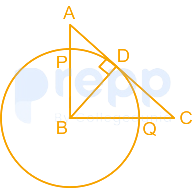
If ∠ABD = θ, then what is sin θ equal to ?
0.6
Understanding the Geometry Problem
The problem provides a triangle ABC with specific side lengths: AB = 6 cm, BC = 8 cm, and AC = 10 cm. We are told that a perpendicular is dropped from vertex B to the side AC, meeting AC at point D. We are also given that \(\angle \text{ABD} = \theta\) and asked to find the value of \(\sin \theta\). A circle centered at B with radius BD cuts AB and BC at points P and Q respectively, but this information about the circle and points P, Q is not needed to solve for \(\sin \theta\). We need to focus on the triangle ABC and the perpendicular BD.
Identifying the Triangle Type: ABC
First, let's check if triangle ABC is a right-angled triangle. We can do this by checking if the square of the longest side is equal to the sum of the squares of the other two sides (Pythagorean theorem).
- Longest side: AC = 10 cm
- Other sides: AB = 6 cm, BC = 8 cm
Let's calculate:
\( \text{AB}^2 + \text{BC}^2 = 6^2 + 8^2 = 36 + 64 = 100 \)
\( \text{AC}^2 = 10^2 = 100 \)
Since \( \text{AB}^2 + \text{BC}^2 = \text{AC}^2 \), the triangle ABC is a right-angled triangle with the right angle at vertex B (\(\angle \text{ABC} = 90^\circ\)).
Analyzing the Perpendicular BD
BD is the altitude (perpendicular) from the right angle vertex B to the hypotenuse AC in the right-angled triangle ABC. This altitude divides the triangle ABC into two smaller triangles: triangle ABD and triangle BCD. Both of these smaller triangles are also right-angled (at D) and are similar to the original triangle ABC and to each other.
Finding the Length of Segment AD
In a right-angled triangle, when an altitude is drawn from the right angle to the hypotenuse, several relationships hold true due to similarity. One such relationship is that the square of a leg is equal to the product of the hypotenuse and the segment of the hypotenuse adjacent to that leg.
For leg AB in triangle ABC:
\( \text{AB}^2 = \text{AC} \times \text{AD} \)
We know AB = 6 and AC = 10. We can find AD:
\( 6^2 = 10 \times \text{AD} \)
\( 36 = 10 \times \text{AD} \)
\( \text{AD} = \frac{36}{10} = 3.6 \text{ cm} \)
Calculating sin θ in Triangle ABD
Now consider the triangle ABD. Since BD is perpendicular to AC, \(\angle \text{ADB} = 90^\circ\). Triangle ABD is a right-angled triangle with the right angle at D. The hypotenuse of triangle ABD is the side opposite the right angle, which is AB = 6 cm.
We are interested in \(\sin \theta\), where \(\theta = \angle \text{ABD}\). In a right-angled triangle, the sine of an acute angle is defined as the ratio of the length of the side opposite the angle to the length of the hypotenuse.
In right triangle ABD:
- Angle: \(\angle \text{ABD} = \theta\)
- Side opposite to \(\angle \text{ABD}\): AD = 3.6 cm
- Hypotenuse: AB = 6 cm
So, \( \sin \theta = \frac{\text{Opposite side}}{\text{Hypotenuse}} = \frac{\text{AD}}{\text{AB}} \)
Let's substitute the values:
\( \sin \theta = \frac{3.6}{6} \)
To simplify the fraction:
\( \sin \theta = \frac{36}{60} = \frac{6 \times 6}{10 \times 6} = \frac{6}{10} = 0.6 \)
Thus, the value of \(\sin \theta\) is 0.6.
Verification using Angles
Alternatively, consider the angles. In right triangle ABC, \(\cos(\angle \text{BAC}) = \frac{\text{AB}}{\text{AC}} = \frac{6}{10} = 0.6\). In right triangle ABD, \(\angle \text{ADB} = 90^\circ\). The angles in triangle ABD are \(\angle \text{BAD}\), \(\angle \text{ABD} = \theta\), and \(\angle \text{ADB} = 90^\circ\). Their sum is \(180^\circ\), so \(\angle \text{BAD} + \theta + 90^\circ = 180^\circ\), which means \(\angle \text{BAD} = 90^\circ - \theta\). Note that \(\angle \text{BAD}\) is the same as \(\angle \text{BAC}\).
So, \(\angle \text{BAC} = 90^\circ - \theta\).
We found \(\cos(\angle \text{BAC}) = 0.6\). Therefore, \(\cos(90^\circ - \theta) = 0.6\).
Using the trigonometric identity \( \cos(90^\circ - \theta) = \sin \theta \), we get:
\( \sin \theta = 0.6 \)
Both methods yield the same result.
| Key Information | Value/Description |
|---|---|
| Triangle ABC sides | AB=6, BC=8, AC=10 |
| Triangle ABC type | Right-angled at B (\(6^2 + 8^2 = 10^2\)) |
| BD | Perpendicular from B to AC (altitude) |
| \(\angle \text{ABD}\) | \(\theta\) |
| Triangle ABD type | Right-angled at D |
| AD length | 3.6 cm (\(AB^2 = AC \times AD\)) |
| Hypotenuse of \(\triangle\) ABD | AB = 6 cm |
Revision Table: Important Concepts
| Concept | Description |
|---|---|
| Pythagorean Theorem | In a right triangle with legs a, b and hypotenuse c, \(a^2 + b^2 = c^2\). Used to identify if a triangle is right-angled. |
| Altitude in Right Triangle | The perpendicular segment from the right-angle vertex to the hypotenuse. It creates similar triangles. |
| Geometric Mean Theorem (Leg Rule) | In a right triangle, the square of a leg is equal to the product of the hypotenuse and the projection of the leg onto the hypotenuse. \((\text{leg})^2 = (\text{hypotenuse}) \times (\text{adjacent segment})\). |
| Sine Ratio | In a right triangle, \(\sin(\text{angle}) = \frac{\text{Length of opposite side}}{\text{Length of hypotenuse}}\). |
| Complementary Angle Identity | \( \cos(90^\circ - \theta) = \sin \theta \) and \( \sin(90^\circ - \theta) = \cos \theta \). |
Additional Information: Similar Triangles Formed by Altitude
When the altitude BD is drawn from the right angle B to the hypotenuse AC in triangle ABC, three similar triangles are formed:
- Triangle ABC
- Triangle ADB
- Triangle BDC
These triangles are similar in the order \(\triangle \text{ABC} \sim \triangle \text{ADB} \sim \triangle \text{BDC}\). This similarity leads to important proportional relationships between their sides, such as:
- \( \frac{\text{AD}}{\text{AB}} = \frac{\text{DB}}{\text{BC}} = \frac{\text{AB}}{\text{AC}} \) (from \(\triangle \text{ADB} \sim \triangle \text{ABC}\))
- \( \frac{\text{BD}}{\text{AD}} = \frac{\text{CD}}{\text{BD}} = \frac{\text{BC}}{\text{AB}} \) (from \(\triangle \text{ADB} \sim \triangle \text{BDC}\)) - Note: this similarity order might need careful check depending on vertex correspondence.
A simpler way to write the useful similarity relations is:
- \( \triangle \text{ADB} \sim \triangle \text{ABC} \implies \frac{\text{AD}}{\text{AB}} = \frac{\text{AB}}{\text{AC}} \implies \text{AB}^2 = \text{AD} \times \text{AC} \) (Leg Rule)
- \( \triangle \text{BDC} \sim \triangle \text{ABC} \implies \frac{\text{CD}}{\text{BC}} = \frac{\text{BC}}{\text{AC}} \implies \text{BC}^2 = \text{CD} \times \text{AC} \) (Leg Rule)
- \( \triangle \text{ADB} \sim \triangle \text{BDC} \implies \frac{\text{AD}}{\text{BD}} = \frac{\text{BD}}{\text{CD}} \implies \text{BD}^2 = \text{AD} \times \text{CD} \) (Altitude Rule)
We used the relationship \( \text{AB}^2 = \text{AD} \times \text{AC} \) to find AD, which was crucial for calculating \(\sin \theta\) in triangle ABD.
Similar Questions
An equilateral triangle ABC and a scalene triangle DBC are inscribed in a circle on same side of the arc. what is ∠BDC equal to?
What is the length of QC ?
What is the relation between x and y ?
If y = 15, then what is ∠ACB equal to ?
What is the radius of the circle ?
What is the radius of the circle ?
What is the area of the minor segment ?
- What is the area of the major segment ?
What is the length of the chord a unit circle which subtends an angle 2θ at the centre, where θ < 45°?
Consider the following statements :
1. If two chords AB and AC of a circle are equal, then the centre of the circle lies on the angle bisector of angle CAB.
2. If two concentric circles are intersected by a line at A, B, C and D respectively, then AC = BD.
Which of the above statements is/are correct?
Important Questions from Circles, Chords and Tangents
AB is a chord of a circle with centre O and P is any point on the circle. If ∠APB = 112°, then what is the measure of ∠OAB ?
The distance between the centres of two circles is 24 cm. If the radius of the two circles are 4 cm and 8 cm, then what is the sum of the lengths (in cm) of the direct common tangent and the transverse common tangent?
An equilateral triangle ABC and a scalene triangle DBC are inscribed in a circle on same side of the arc. what is ∠BDC equal to?
What can be the maximum number of common tangent which can be drawn to two non-intersecting circles?
There are two identical circles of radius 10 cm each. If the length of the direct common tangent is 26 cm, then what is the length (in cm) of the transverse common tangent?



