
Triangle Area Calculation
The problem asks for the area of a triangle with a base of 8 cm and two equal sides of 6 cm. This is an isosceles triangle.
Finding Triangle Height
To calculate the area of a triangle, we use the formula:
\(\text{Area} = \frac{1}{2} \times \text{base} \times \text{height}\)
We know the base is 8 cm, but we need to find the height. We can find the height by dividing the isosceles triangle into two identical right-angled triangles. The height acts as one leg, half the base (4 cm) is the other leg, and one of the equal sides (6 cm) is the hypotenuse.
Using the Pythagorean theorem (\(a^2 + b^2 = c^2\)):
\(\text{height}^2 + (\frac{\text{base}}{2})^2 = \text{side}^2\)
\(h^2 + (4 \text{ cm})^2 = (6 \text{ cm})^2\)
\(h^2 + 16 \text{ cm}^2 = 36 \text{ cm}^2\)
\(h^2 = 36 \text{ cm}^2 - 16 \text{ cm}^2\)
\(h^2 = 20 \text{ cm}^2\)
\(h = \sqrt{20 \text{ cm}^2} = \sqrt{4 \times 5} \text{ cm} = 2\sqrt{5} \text{ cm}\)
Calculating Triangle Area
Now we can calculate the area using the base and the calculated height:
\(\text{Area} = \frac{1}{2} \times 8 \text{ cm} \times 2\sqrt{5} \text{ cm}\)
\(\text{Area} = 4 \text{ cm} \times 2\sqrt{5} \text{ cm}\)
\(\text{Area} = 8\sqrt{5} \text{ cm}^2\)
The area of the triangle is \(8\sqrt{5}\) sq. cm.
Similar Questions
- What is the area of a square whose diagonal measures 4 cm?
- Calculate the length of the diagonal of a square if the area of the square is 32 cm\(^2\).
- A farmer wants to fence his rectangular field of length 200 m and area 3000 \(\text{m}^2\). If the cost of fencing per metre is 5 rupees, what is the total cost of fencing in rupees?
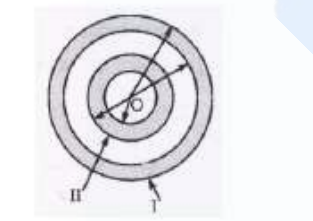
The inner and outer diameters of ring 1 of a dartboard are 15 cm and 17 cm respectively and those of ring II are 12 cm and 13 cm respectively. What is the total area of these two rings?
- A car has two wipers which do not overlap. Each wiper has a blade of length 18 cm sweeping through an angle of \(126^\circ\). Find the total area cleaned at each sweep of the blades. Take \(\pi = 22/7\)
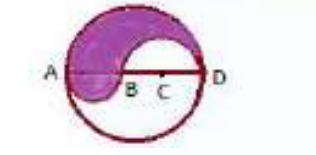
\(ABCD\) is a diameter of a circle of radius 12 cm. The lengths \(AB\), \(BC\) and \(CD\) are equal. Semi-circles are drawn on \(AB\) and \(BD\) as diameters as shown in the given figure. Find area of the shaded region.
- The length of a board is 12 cm and its breadth is 3 cm. The board needs to be taped around its sides covering all four sides. How long the tape should be?
- What is the area of the parallelogram whose base is \(5\text{ cm}\) and corresponding height is \(6\text{ cm}\)?
- The length of a side of a square is equal to the diameter of a circle. If the area of the square is equal to \(196 \text{ cm}^2\), then find the area of the circle (in \(\text{cm}^2\)). (Use \(\pi = \frac{22}{7}\))
Important Questions from 2-D Mensuration
- The length of a rectangular plot is $(x^2 + xy + y^2)$ m and its breadth is $(x^2 - 5xy - y^2)$ m.
Find its perimeter, when $x = 1$ and $y = -1$. - The ratio between the perimeter and breadth of a rectangle is 3: 1. If the area of the rectangle is $98 \text{ cm}^2$, find the perimeter (in cm) of the rectangle.
The shorter side of a rectangle is 15 cm less than the longer side. The numerical value of its area is equal to 5 times the numerical value of its perimeter. What is the length (in cm) of its longer side?
- In a circle of radius 10.5 cm, if the angle of a sector is $\frac{2\pi}{3}$, then the perimeter of the sector is (in cm):
(Take $\pi = \frac{22}{7}$) - Find the circumference (in m) of the largest circle that can be inscribed in a rectangle whose dimensions are given as 114 m and 63 m.
Take $\pi = \frac{22}{7}$



