
Calculating Tape Length for Board Sides
The problem requires finding the total length of tape needed to cover all four sides of a rectangular board. This is equivalent to calculating the perimeter of the rectangle.
Given Dimensions
- Length of the board, \(L = 12\) cm
- Breadth of the board, \(B = 3\) cm
Perimeter Calculation
The tape needs to cover all four sides, so the required tape length is the perimeter of the rectangle. The formula for the perimeter \(P\) of a rectangle is:
\(P = 2 \times (L + B)\)
Substitute the given values into the formula:
\(P = 2 \times (12 \text{ cm} + 3 \text{ cm})\)
First, calculate the sum of the length and breadth:
\(P = 2 \times (15 \text{ cm})\)
Now, multiply by 2 to find the total perimeter:
\(P = 30 \text{ cm}\)
Conclusion
The tape should be 30 cm long to cover all four sides of the board.
Similar Questions
- What is the area of a square whose diagonal measures 4 cm?
- Calculate the length of the diagonal of a square if the area of the square is 32 cm\(^2\).
- A farmer wants to fence his rectangular field of length 200 m and area 3000 \(\text{m}^2\). If the cost of fencing per metre is 5 rupees, what is the total cost of fencing in rupees?
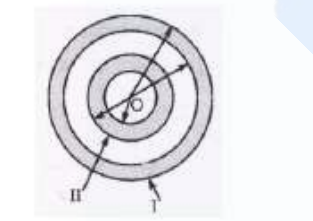
The inner and outer diameters of ring 1 of a dartboard are 15 cm and 17 cm respectively and those of ring II are 12 cm and 13 cm respectively. What is the total area of these two rings?
- A car has two wipers which do not overlap. Each wiper has a blade of length 18 cm sweeping through an angle of \(126^\circ\). Find the total area cleaned at each sweep of the blades. Take \(\pi = 22/7\)
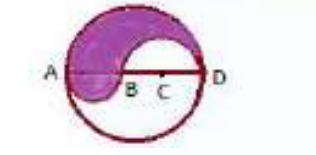
\(ABCD\) is a diameter of a circle of radius 12 cm. The lengths \(AB\), \(BC\) and \(CD\) are equal. Semi-circles are drawn on \(AB\) and \(BD\) as diameters as shown in the given figure. Find area of the shaded region.
- What is the area in sq. cm. of the triangle with a base of 8 cm and sides of length 6 cm each?
- What is the area of the parallelogram whose base is \(5\text{ cm}\) and corresponding height is \(6\text{ cm}\)?
- The length of a side of a square is equal to the diameter of a circle. If the area of the square is equal to \(196 \text{ cm}^2\), then find the area of the circle (in \(\text{cm}^2\)). (Use \(\pi = \frac{22}{7}\))
Important Questions from 2-D Mensuration
- The length of a rectangular plot is $(x^2 + xy + y^2)$ m and its breadth is $(x^2 - 5xy - y^2)$ m.
Find its perimeter, when $x = 1$ and $y = -1$. - The ratio between the perimeter and breadth of a rectangle is 3: 1. If the area of the rectangle is $98 \text{ cm}^2$, find the perimeter (in cm) of the rectangle.
The shorter side of a rectangle is 15 cm less than the longer side. The numerical value of its area is equal to 5 times the numerical value of its perimeter. What is the length (in cm) of its longer side?
- In a circle of radius 10.5 cm, if the angle of a sector is $\frac{2\pi}{3}$, then the perimeter of the sector is (in cm):
(Take $\pi = \frac{22}{7}$) - Find the circumference (in m) of the largest circle that can be inscribed in a rectangle whose dimensions are given as 114 m and 63 m.
Take $\pi = \frac{22}{7}$



