
What is a DISADVANTAGE of LED lights over LASER lights?
Costlier than LASER
Understanding LED and LASER Lights
LEDs (Light Emitting Diodes) and LASERs (Light Amplification by Stimulated Emission of Radiation) are both types of semiconductor light sources, but they work differently and have distinct characteristics that make them suitable for different applications. Understanding these differences is key to identifying potential disadvantages of one compared to the other.
Let's look at some key properties:
- Coherence: LASER light is highly coherent (photons are in phase, same frequency, same direction), while LED light is incoherent (photons are random in phase, frequency, and direction).
- Directionality: LASER light is highly directional (a very narrow beam), while LED light is typically more diffuse or spreads out over a wider angle.
- Spectral Width: LASER light is nearly monochromatic (a very narrow range of wavelengths/colors), while LED light has a broader spectral width.
- Power: Both can range from low to high power, but LASERs can achieve much higher power concentrations in a focused beam.
- Efficiency: LEDs are generally very energy-efficient for lighting purposes. LASER efficiency varies greatly depending on the type and application.
- Availability: LEDs are mass-produced and widely available for numerous applications, from indicators to general lighting. LASERs, especially high-power or specific wavelength ones, can be less common and more specialized.
- Cost: Simple LEDs are very inexpensive. LASER diodes and complete LASER systems are typically significantly more expensive due to complexity, precision manufacturing, and associated optics/cooling.
Analyzing Potential Disadvantages of LED Lights vs LASER Lights
Now let's evaluate the given options as potential disadvantages of LED lights when compared to LASER lights:
-
Option 1: Non-coherent light source
As mentioned, LED light is incoherent, while LASER light is coherent. Coherence is a critical property for applications like holography, long-distance fiber optic communication, and precise scientific measurements. For these uses, the lack of coherence in LEDs is a significant disadvantage compared to LASERs.
-
Option 2: Hardly available
This statement claims LEDs are hardly available. This is generally incorrect. LEDs are one of the most common and widely available light sources today, used in everything from consumer electronics to vehicle headlights and general illumination. Therefore, being "hardly available" is not a disadvantage of LEDs compared to LASERs; in fact, LEDs are often *more* readily available and in a wider variety of consumer applications than many types of LASERs.
-
Option 3: Consuming more power
This statement claims LEDs consume more power than LASERs. LEDs are known for their energy efficiency, especially in lighting applications, consuming significantly less power than older technologies like incandescent bulbs. While high-power LEDs and high-power LASERs exist, comparing typical power consumption is complex and depends heavily on the specific devices being considered and their output. However, generally speaking, for similar light output (luminous flux for LEDs, optical power for LASERs), LEDs are often *more* power-efficient than many types of LASERs, particularly complex high-power systems which require substantial energy and cooling. Thus, consuming more power is generally not a disadvantage of LEDs compared to LASERs; often the opposite is true for comparable applications.
-
Option 4: Costlier than LASER
This statement claims LEDs are costlier than LASERs. Simple LEDs are typically very inexpensive, manufactured in vast quantities for indicator lights, displays, and basic illumination. LASER diodes and LASER systems, requiring precise manufacturing, optical components, and often cooling systems, are generally significantly more expensive than comparable individual LEDs or LED arrays used for general lighting. Therefore, LEDs are typically *less* expensive than LASERs. However, this option is presented as a disadvantage in the list provided.
Selecting the Disadvantage
Based on the analysis of the provided options, Option 1 (Non-coherent light source) is a genuine disadvantage of LEDs compared to LASERs for specific applications. Options 2 and 3 describe characteristics that are generally not true disadvantages of LEDs; LEDs are widely available and often more power-efficient than LASERs. Option 4 claims LEDs are costlier than LASERs, which is generally contrary to typical costs where LEDs are less expensive than LASERs.
However, among the choices provided, one must be selected as the disadvantage. Evaluating the options strictly as presented:
- Option 1 presents a real optical difference that acts as a disadvantage in certain contexts.
- Options 2 and 3 describe traits that are generally advantages of LEDs (availability, efficiency).
- Option 4 presents a cost comparison where LEDs are claimed to be costlier, framed as a disadvantage.
Selecting from the given list, and focusing on the options provided as potential disadvantages, Option 4 is the one presented as a relative disadvantage in terms of cost, despite the common understanding of LED and LASER costs.
Revision Table: LED vs LASER Properties
| Property | LED | LASER | Comparison Note |
|---|---|---|---|
| Coherence | Incoherent | Highly Coherent | LASER advantage for specific applications (e.g., holography, long fiber optics) |
| Directionality | Diffuse/Wide Angle | Highly Directional (Narrow Beam) | LASER advantage for focused beams |
| Spectral Width | Broader Spectrum | Narrow Spectrum (Monochromatic) | LASER advantage for specific wavelengths/colors |
| Availability | Very High | Moderate (varies by type/power) | LED advantage for mass-market applications |
| Energy Efficiency | Generally High | Varies, often lower than LEDs for general lighting equivalent | LED advantage for general illumination efficiency |
| Cost | Generally Low | Generally High | LED advantage in typical cost comparison |
Additional Information on LED and LASER Applications
LEDs and LASERs are used in a vast array of applications, leveraging their unique properties.
- LED Applications: Indicator lights, displays (TVs, phones), general illumination (bulbs, streetlights), vehicle lights, signage, data transmission over short distances (e.g., infrared remotes). Their low cost, efficiency, and long lifespan make them ideal for widespread use.
- LASER Applications: Barcode scanners, optical storage (CD, DVD, Blu-ray), fiber optic communication (long distance), medical procedures (surgery, eye treatment), industrial cutting and welding, scientific research, pointers, holography, printing. Their coherence, directionality, and high power density in a beam are crucial for these uses.
The choice between an LED and a LASER depends entirely on the specific requirements of the application. If coherence and a highly directional beam are needed, a LASER is necessary. If general illumination, low cost, and efficiency are priorities, an LED is usually the better choice.
Similar Questions
- The wavelength of the laser used in a DVD player is _____.
Important Questions from Laser
The following is not a candidate material for Laser source in Fiber Optics
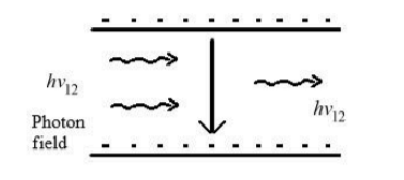
In a LASER device the instantaneous populations of energy $E_1$ and $E_2$ (figure below) to be $n_1$ and $n_2$ respectively. At thermal equilibrium the relative population is given by $n_2 = n_1e^{-h\nu_{12}/KT}$
The condition for population inversion when stimulated emission dominates is given by
The following are correct about a semiconductor LASER :
1. It requires population inversion
2. It has shorter lifetime than LED
3. It demonstrates spontaneous emission phenomenon
4. It generates monochromatic incoherent light.Find out the correct answer :
In comparison to LED, LASER has
1. high emission frequency
2. no tuning arrangement
3. narrow spectral bandwidth
4. provision for confinementWhich of the following conditions is applicable in semiconductor LASERs ?



