Vapour pressure of 0.5 molal solution of non-volatile solute in organic solvent at 30°C would be : (Given : vapour pressure of pure organic solvent is 100 torr; the molecular weight of organic solvent is 100 g mol-1).
90.25 torr
Raoult's law for a non-volatile solute gives \(P = x_{solvent}\,P^{\circ}\), so the calculation is really about converting molality to mole fraction.
Step 1 — moles of solute. 0.5 molal means 0.5 mol of solute per 1 kg of solvent.
Step 2 — moles of solvent. With \(M = 100\) g mol-1, one kilogram contains \(\frac{1000}{100} = 10\) mol.
Step 3 — mole fraction of solvent. \(x_{solvent} = \frac{10}{10 + 0.5} = \frac{10}{10.5} = 0.952\).
Step 4 — apply Raoult's law. \(P = 0.952 \times 100 = 95.2\) torr.
Two sanity checks confirm the method. A non-volatile solute can only lower the vapour pressure, so any answer above 100 torr is impossible on physical grounds — which excludes both 125.50 and 119.95 torr immediately. And the solution is dilute, so the lowering should be modest, of the order of 5 torr.
The correctly computed value of 95.2 torr does not appear among the four options; 90.25 torr is the nearest, and 100.25 torr would require the vapour pressure to rise.
Note: the SPPU final answer key marked this question with code 9 ("No option is correct or the question is wrong"), consistent with the calculation above. The answer recorded here is the closest available option and is flagged as key-disputed.
Similar Questions
Analysis of four different samples of an alloy yielded 12.12, 12.14, 12.10 and 12.22% of metal. The mean deviation of the result is :
For the first order consecutive reaction :
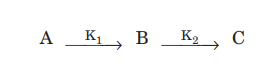
Which of the following statement is incorrect ?
A given reaction is fitted into the following Arrhenius form :
K2 = 6.0 × 10¹⁴ (S-1) . exp \(\left[-\frac{104.4\ (\mathrm{kJ\,mol^{-1}})}{RT}\right]\)
Value of the rate constant at very high temperature would be :
E° value for various ions are as follows :
E°(MnO4-) = +1.51 V
E°(Ag/Ag+) = +0.7996 V
E°(Au/Au+) = +1.692 V
E°(Zn/Zn2+) = -0.761 V
Based on this data, permaganate can be used to oxidize :
The following half cell represents, normal hydrogen electrode (NHE) :
If, we discharge the electrochemical cell rapidly, then :
Consider the reaction :
H2S(g) + \(\tfrac{3}{2}\) O2(g) → SO2(g) + H2O(g), ΔH° = 518.62 kJ
What is the effect of increase of temperature and pressure on the reaction ?
The number of microstates of distributing five quanta of energy among four distinguishable particles is :
The variation of Cp with pressure at constant temperature is given by :
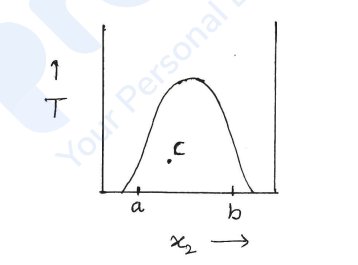
According to the phase diagram given below, the composition of the layer `a' relative to the layer `b' at point `c' is :
Important Questions from Thermodynamics
Two blocks of ice when pressed together join to form one block because
The ratio C p/C vof the specific heats at constant pressure and volume of a monoatomic ideal gas in two dimensions is
The total number of phonon modes in a solid of volume V is \(\int_{\rm{0}}^{{\rm{ω_ D}}} {{\rm{g}}\left( {\rm{ω }} \right)\,} {\rm{dω }}\) = 3N, where N is the number of primitive cells, ω Dis the Debye frequency and density of photon modes is g( ω ) = AV ω2 (with A > 0 a constant). If the density of the solid doubles in a phase transition, the Debye temperature θ D, will
The dispersion relation of a gas of non-interacting bosons in d dimensions is E(k) = ak s, where a and s are positive constants. Bose-Einstein condensation will occur for all values of
Example of thermoplastic among the following is