If, we discharge the electrochemical cell rapidly, then :
The cell will give out maximum entropy
The question contrasts a rapid discharge with a slow one, and the whole answer follows from the difference between reversible and irreversible operation.
A cell delivers its maximum electrical work only when discharged reversibly — infinitely slowly, against an opposing potential just short of the cell emf. In that limit the useful work equals the Gibbs free energy change, \(w_{elec} = \Delta G = -nFE\), and no entropy is generated internally.
Discharging rapidly is strongly irreversible. Large currents flow, and with them come several dissipative losses: ohmic (IR) drop through the electrolyte, activation overpotential at the electrode surfaces, and concentration polarisation as ions cannot diffuse fast enough to keep up. Each of these degrades free energy into heat.
The thermodynamic statement of this is that irreversible processes generate entropy: \(\Delta S_{universe} > 0\), and the faster and further from equilibrium the process, the more entropy is produced. So a rapid discharge produces the maximum entropy.
The other options are each the reverse of this. "Maximum enthalpy converted to useful work" is wrong twice over — the theoretical limit on useful work is \(\Delta G\), not \(\Delta H\), and rapid discharge falls short of even that. "Small amount of entropy generated" describes the slow, near-reversible case. And "maximum energy density" is wrong because the measured cell voltage sags under heavy load, so less energy is extracted before the cutoff voltage is reached — the familiar observation that a battery drained quickly delivers less total energy, and gets hot doing it.
Hence rapid discharge means the cell gives out maximum entropy.
Similar Questions
Analysis of four different samples of an alloy yielded 12.12, 12.14, 12.10 and 12.22% of metal. The mean deviation of the result is :
For the first order consecutive reaction :
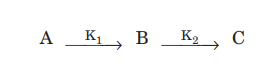
Which of the following statement is incorrect ?
A given reaction is fitted into the following Arrhenius form :
K2 = 6.0 × 10¹⁴ (S-1) . exp \(\left[-\frac{104.4\ (\mathrm{kJ\,mol^{-1}})}{RT}\right]\)
Value of the rate constant at very high temperature would be :
E° value for various ions are as follows :
E°(MnO4-) = +1.51 V
E°(Ag/Ag+) = +0.7996 V
E°(Au/Au+) = +1.692 V
E°(Zn/Zn2+) = -0.761 V
Based on this data, permaganate can be used to oxidize :
Vapour pressure of 0.5 molal solution of non-volatile solute in organic solvent at 30°C would be :
(Given : vapour pressure of pure organic solvent is 100 torr; the molecular weight of organic solvent is 100 g mol-1).
The following half cell represents, normal hydrogen electrode (NHE) :
Consider the reaction :
H2S(g) + \(\tfrac{3}{2}\) O2(g) → SO2(g) + H2O(g), ΔH° = 518.62 kJ
What is the effect of increase of temperature and pressure on the reaction ?
The number of microstates of distributing five quanta of energy among four distinguishable particles is :
The variation of Cp with pressure at constant temperature is given by :
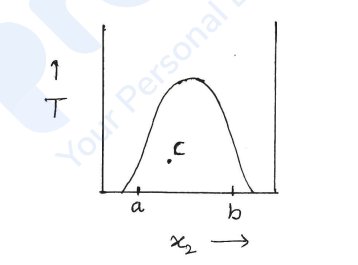
According to the phase diagram given below, the composition of the layer `a' relative to the layer `b' at point `c' is :
Important Questions from Thermodynamics
Two blocks of ice when pressed together join to form one block because
The ratio C p/C vof the specific heats at constant pressure and volume of a monoatomic ideal gas in two dimensions is
The total number of phonon modes in a solid of volume V is \(\int_{\rm{0}}^{{\rm{ω_ D}}} {{\rm{g}}\left( {\rm{ω }} \right)\,} {\rm{dω }}\) = 3N, where N is the number of primitive cells, ω Dis the Debye frequency and density of photon modes is g( ω ) = AV ω2 (with A > 0 a constant). If the density of the solid doubles in a phase transition, the Debye temperature θ D, will
The dispersion relation of a gas of non-interacting bosons in d dimensions is E(k) = ak s, where a and s are positive constants. Bose-Einstein condensation will occur for all values of
Example of thermoplastic among the following is