The following half cell represents, normal hydrogen electrode (NHE) :
Pt|H+ (1M HCl)|H2(g) (1 atm)
The question asks specifically for the normal hydrogen electrode, and the distinction between NHE and SHE is exactly what it is testing. The two are often used loosely as synonyms, but they are defined differently.
The SHE (standard hydrogen electrode) is the rigorous thermodynamic reference. It requires hydrogen ion activity equal to 1, \(a_{H^{+}} = 1\), together with H2 at unit fugacity. Activity is the thermodynamically effective concentration, \(a = \gamma c\), and because interionic attractions make \(\gamma < 1\) in any real solution, unit activity is a hypothetical ideal state rather than something poured from a bottle.
The NHE (normal hydrogen electrode) is the older, practical version defined on a concentration basis — a 1 normal (1 M) acid solution, conventionally 1 M HCl, with hydrogen at 1 atm over a platinised platinum electrode. Being defined by concentration rather than activity, it is realisable in the laboratory, and its potential differs from the SHE by only a few millivolts.
So the option written in terms of \(a = 1\) describes the SHE, not the NHE, and is the correct answer to a different question.
Among the concentration-based options, hydrochloric acid is the right choice because it is a strong monoprotic acid, fully dissociated, so a 1 M solution really does deliver 1 M H+.
1 M H2SO4 fails because it is diprotic: the first ionisation is complete but the second is not, so the hydrogen ion concentration is neither 1 M nor well defined.
1 M H3PO4 fails because it is a weak triprotic acid, only partly dissociated, giving far less than 1 M H+.
The platinised platinum serves as an inert, high-surface-area catalyst for the H+/H2 equilibrium rather than taking part in the reaction.
Hence the NHE is Pt|H+ (1M HCl)|H2(g) (1 atm).
Similar Questions
Analysis of four different samples of an alloy yielded 12.12, 12.14, 12.10 and 12.22% of metal. The mean deviation of the result is :
For the first order consecutive reaction :
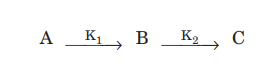
Which of the following statement is incorrect ?
A given reaction is fitted into the following Arrhenius form :
K2 = 6.0 × 10¹⁴ (S-1) . exp \(\left[-\frac{104.4\ (\mathrm{kJ\,mol^{-1}})}{RT}\right]\)
Value of the rate constant at very high temperature would be :
E° value for various ions are as follows :
E°(MnO4-) = +1.51 V
E°(Ag/Ag+) = +0.7996 V
E°(Au/Au+) = +1.692 V
E°(Zn/Zn2+) = -0.761 V
Based on this data, permaganate can be used to oxidize :
Vapour pressure of 0.5 molal solution of non-volatile solute in organic solvent at 30°C would be :
(Given : vapour pressure of pure organic solvent is 100 torr; the molecular weight of organic solvent is 100 g mol-1).
If, we discharge the electrochemical cell rapidly, then :
Consider the reaction :
H2S(g) + \(\tfrac{3}{2}\) O2(g) → SO2(g) + H2O(g), ΔH° = 518.62 kJ
What is the effect of increase of temperature and pressure on the reaction ?
The number of microstates of distributing five quanta of energy among four distinguishable particles is :
The variation of Cp with pressure at constant temperature is given by :
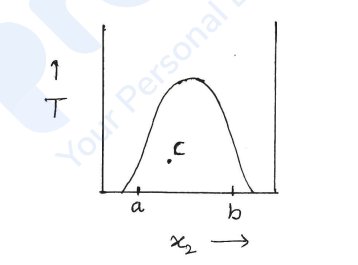
According to the phase diagram given below, the composition of the layer `a' relative to the layer `b' at point `c' is :
Important Questions from Thermodynamics
Two blocks of ice when pressed together join to form one block because
The ratio C p/C vof the specific heats at constant pressure and volume of a monoatomic ideal gas in two dimensions is
The total number of phonon modes in a solid of volume V is \(\int_{\rm{0}}^{{\rm{ω_ D}}} {{\rm{g}}\left( {\rm{ω }} \right)\,} {\rm{dω }}\) = 3N, where N is the number of primitive cells, ω Dis the Debye frequency and density of photon modes is g( ω ) = AV ω2 (with A > 0 a constant). If the density of the solid doubles in a phase transition, the Debye temperature θ D, will
The dispersion relation of a gas of non-interacting bosons in d dimensions is E(k) = ak s, where a and s are positive constants. Bose-Einstein condensation will occur for all values of
Example of thermoplastic among the following is