Consider the reaction : H2S(g) + \(\tfrac{3}{2}\) O2(g) → SO2(g) + H2O(g), ΔH° = 518.62 kJ What is the effect of increase of temperature and pressure on the reaction ?
Retardation and advancement of reaction, respectively
Le Chatelier's principle is applied twice, once for each change.
Effect of pressure. Count the gas moles on each side: \(1 + \tfrac{3}{2} = 2.5\) on the left against \(1 + 1 = 2\) on the right. The reaction proceeds with a decrease in the number of gas molecules, so raising the pressure shifts the equilibrium forward — an advancement.
Effect of temperature. The combustion of hydrogen sulphide is strongly exothermic; heat is a product. Raising the temperature therefore pushes the equilibrium backward — a retardation.
So on the chemically correct reading the answer is retardation with increasing temperature and advancement with increasing pressure.
The difficulty is that the stem prints \(\Delta H^{\circ} = +518.62\) kJ, a positive value, which would make the reaction endothermic. Taken literally that sign would reverse the temperature argument and give advancement in both cases. But the combustion of H2S to SO2 and water is unambiguously exothermic — the standard value is close to \(-518\) kJ mol-1 — so the printed sign is almost certainly a misprint for \(-518.62\) kJ.
It is worth noting that pressure affects the position of equilibrium here only because \(\Delta n_{gas} \ne 0\); had the moles balanced, pressure would have had no effect at all.
Note: the SPPU final answer key marked this question with code 9 ("No option is correct or the question is wrong"), consistent with the contradictory enthalpy sign. The answer recorded here follows the chemically correct exothermic reading and is flagged as key-disputed.
Similar Questions
Analysis of four different samples of an alloy yielded 12.12, 12.14, 12.10 and 12.22% of metal. The mean deviation of the result is :
For the first order consecutive reaction :
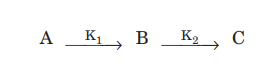
Which of the following statement is incorrect ?
A given reaction is fitted into the following Arrhenius form :
K2 = 6.0 × 10¹⁴ (S-1) . exp \(\left[-\frac{104.4\ (\mathrm{kJ\,mol^{-1}})}{RT}\right]\)
Value of the rate constant at very high temperature would be :
E° value for various ions are as follows :
E°(MnO4-) = +1.51 V
E°(Ag/Ag+) = +0.7996 V
E°(Au/Au+) = +1.692 V
E°(Zn/Zn2+) = -0.761 V
Based on this data, permaganate can be used to oxidize :
Vapour pressure of 0.5 molal solution of non-volatile solute in organic solvent at 30°C would be :
(Given : vapour pressure of pure organic solvent is 100 torr; the molecular weight of organic solvent is 100 g mol-1).
The following half cell represents, normal hydrogen electrode (NHE) :
If, we discharge the electrochemical cell rapidly, then :
The number of microstates of distributing five quanta of energy among four distinguishable particles is :
The variation of Cp with pressure at constant temperature is given by :
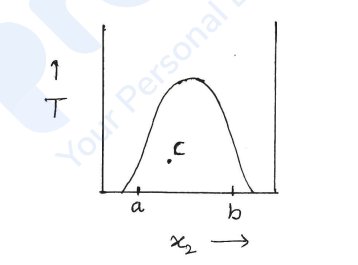
According to the phase diagram given below, the composition of the layer `a' relative to the layer `b' at point `c' is :
Important Questions from Thermodynamics
Two blocks of ice when pressed together join to form one block because
The ratio C p/C vof the specific heats at constant pressure and volume of a monoatomic ideal gas in two dimensions is
The total number of phonon modes in a solid of volume V is \(\int_{\rm{0}}^{{\rm{ω_ D}}} {{\rm{g}}\left( {\rm{ω }} \right)\,} {\rm{dω }}\) = 3N, where N is the number of primitive cells, ω Dis the Debye frequency and density of photon modes is g( ω ) = AV ω2 (with A > 0 a constant). If the density of the solid doubles in a phase transition, the Debye temperature θ D, will
The dispersion relation of a gas of non-interacting bosons in d dimensions is E(k) = ak s, where a and s are positive constants. Bose-Einstein condensation will occur for all values of
Example of thermoplastic among the following is