
Two circles each of radius 36 cm are intersecting each other such that each circle is passing through the centre of the other circle. What is the length of common chord to the two circles ?
36 \(\sqrt{3}\) cm
Finding the Length of the Common Chord
This problem involves two identical circles that intersect in a specific way: each circle passes through the center of the other. This creates a symmetrical arrangement with some key geometric properties.
Understanding the Geometry of Intersecting Circles
Let's consider the two circles. Let the center of the first circle be \(C_1\) and the center of the second circle be \(C_2\). Both circles have a radius of 36 cm. The problem states that the first circle passes through \(C_2\) and the second circle passes through \(C_1\). This means the distance between the centers, \(C_1C_2\), is equal to the radius of both circles, which is 36 cm.
The common chord is the line segment connecting the two points where the circles intersect. Let these intersection points be \(A\) and \(B\). The common chord is the line segment \(AB\).
Key Geometric Properties
- The line connecting the centers of the two circles (\(C_1C_2\)) is perpendicular to the common chord (\(AB\)).
- The line connecting the centers bisects the common chord. Let \(M\) be the point where \(C_1C_2\) intersects \(AB\). Then \(AM = MB\).
- Consider the triangle formed by the centers and one intersection point, for example, triangle \(C_1AC_2\). The sides of this triangle are \(C_1A\), \(C_2A\), and \(C_1C_2\).
Analyzing Triangle \(C_1AC_2\)
- \(C_1A\) is the radius of the first circle, which is 36 cm.
- \(C_2A\) is the radius of the second circle, which is also 36 cm.
- \(C_1C_2\) is the distance between the centers. Since each circle passes through the center of the other, \(C_1C_2\) is equal to the radius, which is 36 cm.
Therefore, triangle \(C_1AC_2\) is an equilateral triangle with side length 36 cm.
Similarly, triangle \(C_1BC_2\) is also an equilateral triangle with side length 36 cm.
Using the Properties to Find the Common Chord Length
As mentioned, the line \(C_1C_2\) is perpendicular to \(AB\) at point \(M\), and \(M\) is the midpoint of \(C_1C_2\). In triangle \(C_1AC_2\), \(AM\) is the altitude from \(A\) to the base \(C_1C_2\).
In an equilateral triangle, the altitude from a vertex to the opposite side is also the median. This means \(M\) is the midpoint of \(C_1C_2\).
The length of \(C_1C_2\) is 36 cm. So, \(C_1M = MC_2 = \frac{1}{2} \times C_1C_2 = \frac{1}{2} \times 36 = 18\) cm.
Applying the Pythagorean Theorem
Now consider the right-angled triangle \(C_1MA\). We know:
- Hypotenuse \(C_1A = 36\) cm (radius)
- Side \(C_1M = 18\) cm (half the distance between centers)
- Side \(AM\) is half the length of the common chord.
Using the Pythagorean theorem, \(C_1A^2 = C_1M^2 + AM^2\).
\(36^2 = 18^2 + AM^2\)
\(1296 = 324 + AM^2\)
\(AM^2 = 1296 - 324\)
\(AM^2 = 972\)
To find \(AM\), we take the square root of 972:
\(AM = \sqrt{972}\)
We can simplify the square root:
\(972 = 324 \times 3 = 18^2 \times 3\)
\(AM = \sqrt{18^2 \times 3} = 18\sqrt{3}\) cm.
Calculating the Common Chord Length AB
The common chord \(AB\) is twice the length of \(AM\).
\(AB = 2 \times AM\)
\(AB = 2 \times 18\sqrt{3}\)
\(AB = 36\sqrt{3}\) cm.
Thus, the length of the common chord is \(36\sqrt{3}\) cm.
Revision Table: Intersecting Circles and Common Chord
| Concept | Description | Relevance to Problem |
|---|---|---|
| Radius | Distance from center to any point on the circle. | Given as 36 cm. Defines circle size and distance \(C_1A\), \(C_2A\). |
| Distance between Centers | Distance between \(C_1\) and \(C_2\). | Equal to the radius (36 cm) because each circle passes through the other's center. This forms equilateral triangles. |
| Common Chord | Line segment connecting intersection points (\(A\) and \(B\)). | The length we need to find (\(AB\)). |
| Line of Centers | The line passing through \(C_1\) and \(C_2\). | Perpendicular bisector of the common chord. |
| Equilateral Triangle | Triangle with all sides equal. | \(C_1AC_2\) and \(C_1BC_2\) are equilateral triangles in this specific intersection case. |
| Pythagorean Theorem | \(a^2 + b^2 = c^2\) in a right triangle. | Used to find half the common chord length (\(AM\)) in right triangle \(C_1MA\). |
Additional Information: Common Chord Properties
When two circles intersect, the line segment connecting their intersection points is called the common chord. The line passing through the centers of the two circles has several important properties related to the common chord:
- The line of centers is always perpendicular to the common chord.
- The line of centers bisects the common chord. This means the common chord is divided into two equal halves by the line of centers.
- The length of the common chord depends on the radii of the two circles and the distance between their centers. For circles of unequal radii or different distances between centers, the calculation would vary.
In the special case where two circles of equal radius intersect, and each passes through the center of the other, the distance between centers is equal to the radius, and the triangles formed by the centers and intersection points are equilateral, simplifying the calculation significantly.
Similar Questions
A chord 21 cm long is drawn in a circle of diameter 25 cm. The perpendicular distance of the chord from the centre is:
The distance between the centres of two circles is 24 cm. If the radius of the two circles are 4 cm and 8 cm, then what is the sum of the lengths (in cm) of the direct common tangent and the transverse common tangent?
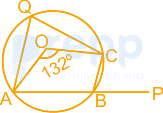
In a circle with centre O, an arc ABC subtends an angle of 132° at the center of the circle. Chord AB is produced to point P. Then ∠CBP is equal to∶
What can be the maximum number of common tangent which can be drawn to two non-intersecting circles?
There are two identical circles of radius 10 cm each. If the length of the direct common tangent is 26 cm, then what is the length (in cm) of the transverse common tangent?
AB is a chord in the minor segment of a circle with centre O. C is a point on the minor arc (between A and B). The tangents to the circle at A and B meet at a point P. If ∠ACB = 108°, then ∠APB is equal to:
AB is the chord of a circle such that AB = 10 cm. If the diameter of the circle is 20 cm, then the angle subtended by the chord at the centre is ________.
Select the INCORRECT statement with respect to the properties of a circle.
The radius of a circle is 5 cm. Calculate the length of a tangent drawn to this circle from a point at a distance of 10 cm from its centre.
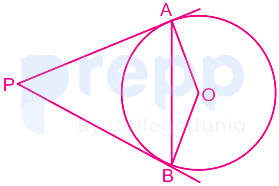
In the given figure, if PA and PB are tangents to the circle with centre O such that ∠APB = 54°, then ∠ OBA = ________.
Important Questions from Circles, Chords and Tangents
A chord 21 cm long is drawn in a circle of diameter 25 cm. The perpendicular distance of the chord from the centre is:
AB is a chord of a circle with centre O and P is any point on the circle. If ∠APB = 112°, then what is the measure of ∠OAB ?
The distance between the centres of two circles is 24 cm. If the radius of the two circles are 4 cm and 8 cm, then what is the sum of the lengths (in cm) of the direct common tangent and the transverse common tangent?
An equilateral triangle ABC and a scalene triangle DBC are inscribed in a circle on same side of the arc. what is ∠BDC equal to?
In a circle with centre O, an arc ABC subtends an angle of 132° at the center of the circle. Chord AB is produced to point P. Then ∠CBP is equal to∶



