
Three statements are followed by three conclusions numbered I, II and III. You have to consider these statements to be true, even if they seem to be at variance with commonly known facts. Decide which of the given conclusions logically follow/s from the given statements. Statements : Few chips are cakes. All cakes are ice creams. All ice creams are sweets. Conclusions : (I) Some sweets are cakes. (II) Some ice creams are cakes. (III) All cakes are sweets.
All conclusions I, II and III follow
Understanding Syllogism Statements and Conclusions
This question asks us to evaluate three conclusions based on three given statements. In syllogism problems, we must strictly adhere to the information provided in the statements, even if it contradicts common knowledge. We need to determine which conclusions logically follow from the statements.
Analyzing the Statements
Let's break down the given statements:
- Statement 1: Few chips are cakes. This means there is an overlap between the categories of "chips" and "cakes". In other words, some chips are cakes.
- Statement 2: All cakes are ice creams. This is a universal affirmative statement. It implies that the set of "cakes" is completely contained within the set of "ice creams".
- Statement 3: All ice creams are sweets. Another universal affirmative statement. This means the set of "ice creams" is completely contained within the set of "sweets".
Drawing Inferences from Statements
We can combine these statements to draw further inferences:
- From Statement 2 ("All cakes are ice creams") and Statement 3 ("All ice creams are sweets"), we can logically conclude that All cakes are sweets. This is a transitive property: if A is in B, and B is in C, then A is in C (where A=cakes, B=ice creams, C=sweets).
- From Statement 2 ("All cakes are ice creams"), if all cakes are ice creams, then it must be true that Some ice creams are cakes. The universal affirmative "All A are B" implies the particular affirmative "Some B are A".
- From the inference that "All cakes are sweets", it must be true that Some sweets are cakes. Again, applying the rule: "All A are B" implies "Some B are A".
- Statement 1 tells us "Few chips are cakes", which is equivalent to "Some chips are cakes". Combining this with "All cakes are ice creams", we can infer that Some chips are ice creams.
- Combining "Some chips are cakes" with "All cakes are sweets", we can infer that Some chips are sweets.
Evaluating the Conclusions
Now let's check the given conclusions against the statements and our inferences:
- Conclusion I: Some sweets are cakes.
As inferred from "All cakes are sweets" (which itself is derived from Statement 2 and Statement 3), this conclusion logically follows. If all members of one group (cakes) are part of another group (sweets), then some members of the larger group (sweets) must be from the first group (cakes). - Conclusion II: Some ice creams are cakes.
From Statement 2, "All cakes are ice creams", we can directly infer that "Some ice creams are cakes". This conclusion logically follows. - Conclusion III: All cakes are sweets.
As inferred from Statement 2 ("All cakes are ice creams") and Statement 3 ("All ice creams are sweets"), this conclusion logically follows.
Summary of Conclusions
Based on our analysis, all three conclusions logically follow from the given statements.
| Conclusion | Logical Follows? | Reasoning |
|---|---|---|
| I: Some sweets are cakes. | Yes | Derived from "All cakes are sweets" (Statements 2 & 3). |
| II: Some ice creams are cakes. | Yes | Derived directly from Statement 2 ("All cakes are ice creams"). |
| III: All cakes are sweets. | Yes | Derived from Statements 2 ("All cakes are ice creams") and 3 ("All ice creams are sweets"). |
Therefore, all conclusions I, II, and III follow.
Revision Table: Syllogism Rules
| Statement Type | Example | Valid Conversion |
|---|---|---|
| All A are B | All cakes are ice creams | Some B are A (Some ice creams are cakes) |
| No A are B | No dog is cat | No B are A (No cat is dog) Some A are not B Some B are not A |
| Some A are B | Some chips are cakes | Some B are A (Some cakes are chips) |
| Some A are not B | Some students are not smart | No valid direct conversion (Some B are not A is not always true) |
Additional Information: Types of Syllogism Statements
Categorical syllogisms use statements that relate categories or classes. The four standard types of categorical statements are:
- Universal Affirmative (A): All S are P (e.g., All dogs are mammals).
- Universal Negative (E): No S are P (e.g., No fish are birds).
- Particular Affirmative (I): Some S are P (e.g., Some students are athletes). 'Few' often translates to 'Some' in syllogism problems.
- Particular Negative (O): Some S are not P (e.g., Some fruits are not sweet).
Understanding these types helps in correctly interpreting the relationships between different categories mentioned in the statements.
Similar Questions
Which two numbers and two signs should be interchanged to make the given equation correct?
5 + 44 - 8 × 25 = 203
Select the set in which the numbers are related in the same way as are the numbers of the following set.
(NOTE: Operations should be performed on the whole numbers, without breaking down the numbers into its constituent digits.)
(60, 5, 6)
(48, 8, 3)
A & B means ‘A is the son of B’
A # B means ‘A is the sister of B’
A @ B means ‘A is the brother of B’
A % B means ‘A is the father of B’
A - B means ‘A is the daughter of B’
A * B means ‘A is the wife of B’
If C # D @ E % Z & L # M - N * P, then how is Z related to N?
Select the figure that will come next in the following figure series.

Select the figure from among the given options that can replace the question mark (?) in the following series.

Read the given statements and conclusions carefully. Assuming that the information given in the statements is true, even if it appears to be at variance with commonly known facts, decide which of the given conclusions logically follow(s) from the statements.
Statements:
All pens are plates.
All plates are trays.
Some trays are boxes.
Conclusions:
I. Some boxes are plates.
II. Some trays are pens.
III. Some boxes are pens.
IV. No tray is a plate.
In the following question, select the missing number from the given series.
69, 70, 73, 78, 85, ?
If A × B means that A is the father of B, A + B means that A is the mother of B, A ÷ B means that A is the brother of B then which of the following expression shows that A is the paternal uncle of C?
Select the cube that can be formed by folding the given sheet along the lines.
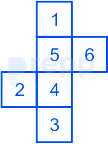
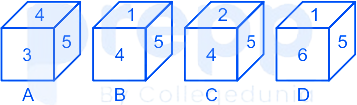
Three of the following letter-clusters are alike in some manner and hence form a group. Which letter-cluster does not belong to that group?
Important Questions from Miscellaneous
Which gas shields the surface of the earth from ultraviolet radiation from the sun?
Which event is marked as an Intangible Cultural Heritage of Humanity by UNESCO?
Who has been conferred with the rank of the Commander of the Order of the British Empire in 2018?
Who directead the film ‘Bhuvan Shome’?
The book “In my mother’s house” is written by _______



