The principle of adaptation shown in the following diagram (depicting the skull containing venous blood, arterial blood, brain, mass, and CSF within a fixed volume) is explained by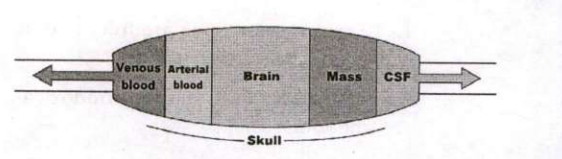
Monro-Kellie doctrine
The principle is the Monro-Kellie doctrine: the adult cranium is a rigid, non-expansile box of fixed volume containing three incompressible components - brain (about 80 per cent), blood (about 10 per cent) and CSF (about 10 per cent). Since total volume is constant, a fourth component such as a tumour, haematoma or oedema must be offset by displacement of an equal volume of CSF into the spinal thecal sac and of venous blood out of the skull. This keeps intracranial pressure near normal at first; once buffering is exhausted the pressure-volume curve rises steeply, so a small further increase causes a large ICP rise, falling cerebral perfusion pressure and herniation.
Moynihan's aphorism is a surgical dictum on decisive operating and the gallstone masquerade, not intracranial dynamics. Goodsall's rule predicts the internal opening of a fistula-in-ano. Cushing's reflex - hypertension, bradycardia and irregular respiration - is the physiological response to raised ICP, a consequence rather than the explanation of volume adaptation.
Key point: Compensation occurs first by CSF and venous blood displacement; Cushing's triad signals that compensation has already failed.
Similar Questions
Astrocytomas are associated with all of the following syndromes, except
Important Questions from Brain & Nervous System Surgery
- The term mid-line shift is associated with:
- In diffuse axonal injury all are true EXCEPT:
- A 70 years old man on anticoagulants due to some heart disease suffered a minor head injury. One month later he has severe headache with slowly developing neurological signs. The probable diagnosis is:
- A patient with suspected head injury is brought to the emergency following road traffic accident. At the time of examination, patient is conscious with GCS 14/15 and stable vitals. There is bleeding from right ear and CSF leak from nose. Bruising is present behind the right ear. The most probable clinical diagnosis in this patient is
- A comatose patient after sustaining severe head injury has been admitted in neurosurgical ICU. Which of the following parameters should ideally be maintained in this patient ?
1. pCO$_2$ = 4.5 – 5.0 kPa (33-38 mm Hg)
2. MAP = 80 – 90 mm of Hg
3. pO$_2$ > 11 kPa (> 80 mm Hg)
4. Na$^+$ < 130 meq/L
Select the correct answer using the code given below :