The polypyrrole ring present in vitamin B12 is :
Corrin
All four names describe macrocycles built from four pyrrole rings, so the distinction lies in how those rings are joined and how saturated they are.
Vitamin B12 contains the corrin ring. Corrin differs from the others in a structurally decisive way: one of the four methine bridges is missing. Rings A and D are joined directly, carbon to carbon, rather than through a =CH- bridge. That contraction makes the corrin macrocycle smaller than a porphyrin and gives it a smaller central cavity, which suits the cobalt ion it holds. Corrin is also more reduced — less conjugated — than porphyrin, which is why B12 is red rather than the intense purple of a fully conjugated porphyrin.
Porphyrin has all four methine bridges present, giving a fully conjugated, planar, aromatic 18-π macrocycle. It is the ligand of haem and of the cytochromes.
Protoporphyrin (specifically protoporphyrin IX) is a particular substituted porphyrin bearing vinyl, methyl and propionate side chains — the exact ligand found in haemoglobin and myoglobin, so it is a member of the porphyrin family rather than an alternative to it.
Chlorin is a porphyrin in which one pyrrole ring has been reduced at its two β carbons. This is the macrocycle of chlorophyll, and the partial reduction is what shifts its absorption to give plants their green colour.
The cobalt in B12 sits in the corrin cavity with a benzimidazole below the ring and, in the coenzyme forms, a methyl or 5'-deoxyadenosyl group above — one of the very few genuine metal-carbon bonds in biology.
Hence the polypyrrole ring in vitamin B12 is corrin.
Similar Questions
Iron-enterobactin [Fe (ent)]3- complex has a dissociation content of 10-49 at pH = 7. Calculate the number of uncomplexed Fe3+ ions in a litre of 1 M solution in water at pH = 7.
The metal ions that are commonly present at the active site of hydrolytic enzymes is :
In the enzymolysis, the following graph represent Lineweaver-Burk plots for :
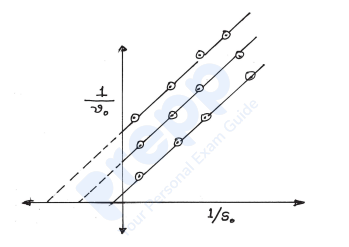
Enzymolysis with the following mechanism :
\[ E + S \xrightleftharpoons[k_{-1}]{k_1} ES \] \[ ES \xrightarrow{k_2} E + P \] \[ E + I \rightleftharpoons EI \] \[ \therefore\ (I \equiv \text{inhibitor}) \quad I_1 < I_2 < I_3 \]
The following behaviors are noted.
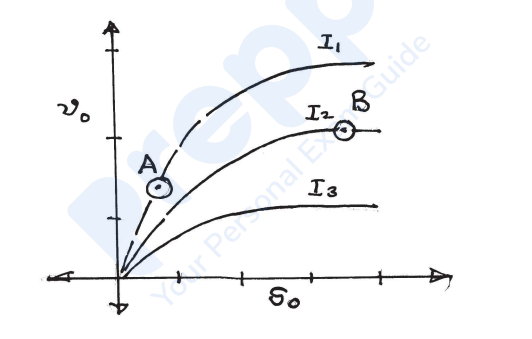
Orders of the reaction, at point `A' and point `B' marked on the graph would be :
Important Questions from Biomolecules
The chemical name of Vitamin D 3is:
Which of the following food comes under complex carbohydrate?
I. Potatoes
II. Sweets
III. Pasta
IV. Wheat
Following are the pKa's of the ionizable groups in lysine
pKa 1 = 2.16 (α - carboxylic group)
pKa 2 = 9.06 (α - amino group)
pKa 3 = 10.54 (ε - amino group)
Which one of the following options represents the pl of lysine?
How many hydrogen bonds involving the backbone CO and NH can be observed in an α‐helix consisting of 15 amino acid residues?
In eukaryotic cells, covalently attached lipids help to anchor some water soluble proteins to the plasma membrane. One group of cytosolic proteins are anchored to the cytosolic face of membrane by a fatty acyl group (e.g. myristate or palmitate). These groups are generally covalently attached to which amino acids present at the N‐terminus of the polypeptide chain?