Enzymolysis with the following mechanism : \[ E + S \xrightleftharpoons[k_{-1}]{k_1} ES \] \[ ES \xrightarrow{k_2} E + P \] \[ E + I \rightleftharpoons EI \] \[ \therefore\ (I \equiv \text{inhibitor}) \quad I_1 < I_2 < I_3 \] The following behaviors are noted. Orders of the reaction, at point `A' and point `B' marked on the graph would be : 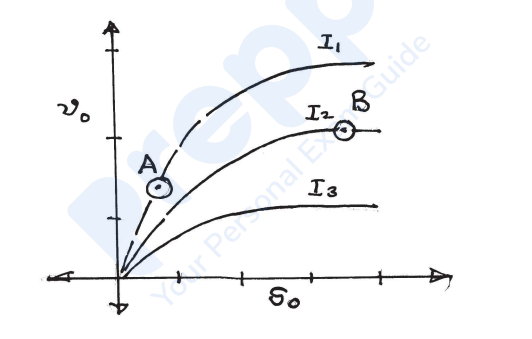
One and zero
The stem carries a drawn graph; the four options are text and are reproduced in full above.
The Michaelis-Menten rate law is \(v = \frac{V_{max}[S]}{K_m + [S]}\), and its order in substrate is not fixed — it changes along the curve. That is exactly what the two marked points test.
At low substrate concentration (\([S] \ll K_m\)), the denominator is dominated by \(K_m\), so
\(v \approx \frac{V_{max}}{K_m}[S]\).
The rate is directly proportional to [S], so the reaction is first order. Physically, most of the enzyme is sitting free and unoccupied, so adding more substrate immediately increases the rate. This is the steeply rising, near-linear part of the curve.
At high substrate concentration (\([S] \gg K_m\)), the \(K_m\) in the denominator becomes negligible and [S] cancels:
\(v \approx V_{max}\).
The rate no longer depends on [S] at all, so the reaction is zero order. Physically the enzyme is saturated — every active site is occupied, and the turnover step \(k_2\) is now rate limiting. This is the flat plateau of the curve.
So a point on the rising portion is first order and a point on the plateau is zero order, giving one and zero. At \([S] = K_m\) exactly, the rate is half \(V_{max}\) and the order is intermediate, between one and zero — which is why no option offers a fractional value for both points.
Per the official final answer key the answer is one and zero.
Similar Questions
Iron-enterobactin [Fe (ent)]3- complex has a dissociation content of 10-49 at pH = 7. Calculate the number of uncomplexed Fe3+ ions in a litre of 1 M solution in water at pH = 7.
The polypyrrole ring present in vitamin B12 is :
The metal ions that are commonly present at the active site of hydrolytic enzymes is :
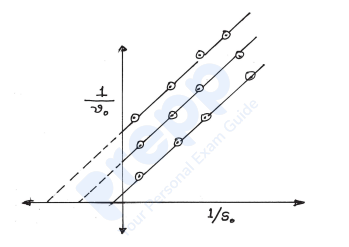
In the enzymolysis, the following graph represent Lineweaver-Burk plots for :
Important Questions from Biomolecules
The chemical name of Vitamin D 3is:
Which of the following food comes under complex carbohydrate?
I. Potatoes
II. Sweets
III. Pasta
IV. Wheat
Following are the pKa's of the ionizable groups in lysine
pKa 1 = 2.16 (α - carboxylic group)
pKa 2 = 9.06 (α - amino group)
pKa 3 = 10.54 (ε - amino group)
Which one of the following options represents the pl of lysine?
How many hydrogen bonds involving the backbone CO and NH can be observed in an α‐helix consisting of 15 amino acid residues?
In eukaryotic cells, covalently attached lipids help to anchor some water soluble proteins to the plasma membrane. One group of cytosolic proteins are anchored to the cytosolic face of membrane by a fatty acyl group (e.g. myristate or palmitate). These groups are generally covalently attached to which amino acids present at the N‐terminus of the polypeptide chain?