In the enzymolysis, the following graph represent Lineweaver-Burk plots for :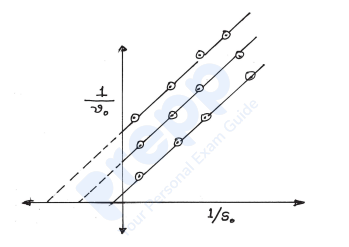
Uncompetative inhibition
The stem carries a drawn graph; the four options are text and are reproduced in full above.
A Lineweaver-Burk plot graphs \(\frac{1}{v}\) against \(\frac{1}{[S]}\), giving a straight line with slope \(\frac{K_m}{V_{max}}\), y-intercept \(\frac{1}{V_{max}}\) and x-intercept \(-\frac{1}{K_m}\). Each type of inhibition changes these in its own signature way, so the pattern of lines identifies the mechanism.
Competitive inhibition — the inhibitor binds the free enzyme at the active site and competes with substrate. \(K_m\) rises but \(V_{max}\) is unchanged, because enough substrate still saturates the enzyme. The lines therefore intersect on the y-axis.
Non-competitive inhibition — the inhibitor binds equally well to E and to ES at a separate site. \(V_{max}\) falls but \(K_m\) is unchanged, so the lines intersect on the x-axis.
Uncompetitive inhibition — the inhibitor binds only to the enzyme-substrate complex, never to free enzyme. Both \(V_{max}\) and \(K_m\) fall, and crucially they fall by the same factor, so the ratio \(\frac{K_m}{V_{max}}\) — the slope — stays constant. The signature is therefore a set of parallel lines.
So the reading rule is simple: lines meeting on the y-axis mean competitive, lines meeting on the x-axis mean non-competitive, and parallel lines mean uncompetitive.
Per the official final answer key the answer is uncompetitive inhibition.
Similar Questions
Iron-enterobactin [Fe (ent)]3- complex has a dissociation content of 10-49 at pH = 7. Calculate the number of uncomplexed Fe3+ ions in a litre of 1 M solution in water at pH = 7.
The polypyrrole ring present in vitamin B12 is :
The metal ions that are commonly present at the active site of hydrolytic enzymes is :
Enzymolysis with the following mechanism :
\[ E + S \xrightleftharpoons[k_{-1}]{k_1} ES \] \[ ES \xrightarrow{k_2} E + P \] \[ E + I \rightleftharpoons EI \] \[ \therefore\ (I \equiv \text{inhibitor}) \quad I_1 < I_2 < I_3 \]
The following behaviors are noted.
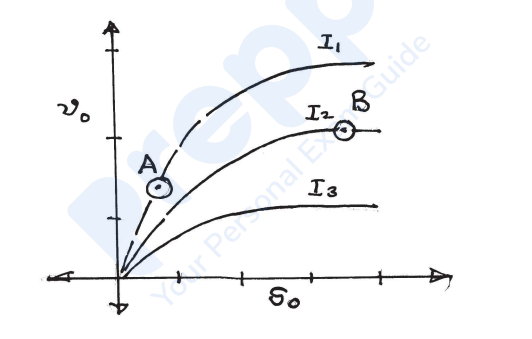
Orders of the reaction, at point `A' and point `B' marked on the graph would be :
Important Questions from Biomolecules
The chemical name of Vitamin D 3is:
Which of the following food comes under complex carbohydrate?
I. Potatoes
II. Sweets
III. Pasta
IV. Wheat
Following are the pKa's of the ionizable groups in lysine
pKa 1 = 2.16 (α - carboxylic group)
pKa 2 = 9.06 (α - amino group)
pKa 3 = 10.54 (ε - amino group)
Which one of the following options represents the pl of lysine?
How many hydrogen bonds involving the backbone CO and NH can be observed in an α‐helix consisting of 15 amino acid residues?
In eukaryotic cells, covalently attached lipids help to anchor some water soluble proteins to the plasma membrane. One group of cytosolic proteins are anchored to the cytosolic face of membrane by a fatty acyl group (e.g. myristate or palmitate). These groups are generally covalently attached to which amino acids present at the N‐terminus of the polypeptide chain?