The pH of the mixture of 800 ml of 0.1 M HCl and 200 ml of 0.3 M NaOH is close to :
1.70
This is a limiting-reagent neutralisation, so work in moles rather than concentrations until the end.
Step 1 — moles of acid. \(n_{H^{+}} = 0.800 \times 0.1 = 0.08\) mol.
Step 2 — moles of base. \(n_{OH^{-}} = 0.200 \times 0.3 = 0.06\) mol.
Step 3 — neutralise. H+ and OH- react 1 : 1, so 0.06 mol of each is consumed, leaving
\(0.08 - 0.06 = 0.02\) mol of excess H+. The acid is in excess, so the solution must be acidic — which already eliminates the basic and near-neutral options.
Step 4 — find the new concentration. Total volume is \(800 + 200 = 1000\) mL = 1.000 L, so
\([H^{+}] = \frac{0.02}{1.000} = 0.02\) M.
Step 5 — take the pH.
\(\mathrm{pH} = -\log(0.02) = -\log(2 \times 10^{-2}) = 2 - \log 2 = 2 - 0.30 = 1.70\).
A quick check on plausibility: the original acid at 0.1 M would have had pH 1.00, and partial neutralisation plus dilution must raise that figure somewhat — 1.70 fits, whereas 1.10 would imply almost no neutralisation occurred.
Note that dilution alone is accounted for by using the combined volume; forgetting it is the commonest source of error in this type of calculation.
Hence the pH is close to 1.70.
Similar Questions
The property measured in derivative thermogravimetric analysis (DTG) is :
Analysis of four different samples of an alloy yielded 12.12, 12.14, 12.10 and 12.22% of metal. The mean deviation of the result is :
For the first order consecutive reaction :
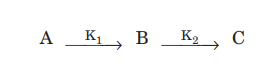
Which of the following statement is incorrect ?
A given reaction is fitted into the following Arrhenius form :
K2 = 6.0 × 10¹⁴ (S-1) . exp \(\left[-\frac{104.4\ (\mathrm{kJ\,mol^{-1}})}{RT}\right]\)
Value of the rate constant at very high temperature would be :
The following half cell represents, normal hydrogen electrode (NHE) :
If, we discharge the electrochemical cell rapidly, then :
E° value for various ions are as follows :
E°(MnO4-) = +1.51 V
E°(Ag/Ag+) = +0.7996 V
E°(Au/Au+) = +1.692 V
E°(Zn/Zn2+) = -0.761 V
Based on this data, permaganate can be used to oxidize :
Vapour pressure of 0.5 molal solution of non-volatile solute in organic solvent at 30°C would be :
(Given : vapour pressure of pure organic solvent is 100 torr; the molecular weight of organic solvent is 100 g mol-1).
Molar conductance of 0.01 M acetic acid was found to be 16 × 10-4 S m2 mol-1 at 30°C. Molar conductance of H+ and CH3COO- ions at infinite dilution are 350 × 10-4 S m2 mol-1 and 50 × 10-4 S m2 mol-1, respectively at same temperature. What percentage of acetic acid is dissociated at that concentration ?
The variation of Cp with pressure at constant temperature is given by :
Important Questions from Thermodynamics
Two blocks of ice when pressed together join to form one block because
The ratio C p/C vof the specific heats at constant pressure and volume of a monoatomic ideal gas in two dimensions is
The total number of phonon modes in a solid of volume V is \(\int_{\rm{0}}^{{\rm{ω_ D}}} {{\rm{g}}\left( {\rm{ω }} \right)\,} {\rm{dω }}\) = 3N, where N is the number of primitive cells, ω Dis the Debye frequency and density of photon modes is g( ω ) = AV ω2 (with A > 0 a constant). If the density of the solid doubles in a phase transition, the Debye temperature θ D, will
The dispersion relation of a gas of non-interacting bosons in d dimensions is E(k) = ak s, where a and s are positive constants. Bose-Einstein condensation will occur for all values of
Example of thermoplastic among the following is