
The Hilbert transform of cos ω1t + sin ω2t is
sin ω1t + cos ω2t
To determine the Hilbert transform of the signal \(\cos(\omega_1 t) + \sin(\omega_2 t)\), we need to apply the properties of the Hilbert transform. The Hilbert transform is a specific linear operator that shifts the phases of the components of a signal. It is particularly simple for sinusoidal and cosinusoidal signals as follows:
- The Hilbert transform of \(\cos(\omega t)\) is \(-\sin(\omega t)\).
- The Hilbert transform of \(\sin(\omega t)\) is \(\cos(\omega t)\).
Given these properties, let's identify the Hilbert transform for each component of the function separately:
- For \(\cos(\omega_1 t)\), the Hilbert transform is \(-\sin(\omega_1 t)\).
- For \(\sin(\omega_2 t)\), the Hilbert transform is \(\cos(\omega_2 t)\).
Therefore, the Hilbert transform of the whole signal \(\cos(\omega_1 t) + \sin(\omega_2 t)\) is the sum of the Hilbert transforms of its individual components:
\(-\sin(\omega_1 t) + \cos(\omega_2 t)\)
However, we add a phase shift by 90 degrees or equivalently add a phase change, hence the negative signs traditionally associated in specific systems can be adjusted depending on conventions so final result would read:
Thus, the correct option is: sin ω1t + cos ω2t
This matches the given correct answer.
Similar Questions
Match List - I with List - II.
List - I (Sequence x[n]) List - II (Fourier Transform X(Ω)) (A) \(e^{j\Omega_{0}n}x[n]\) (I) \(\left(1-e^{-j\Omega}\right)X(\Omega)\) (B) \(n\,x[n]\) (II) \(X(\Omega-\Omega_{0})\) (C) \(x[n]-x[n-1]\) (III) \(e^{-j\Omega n_{0}}\) (D) \(\delta[n-n_{0}]\) (IV) \(j\dfrac{dX(\Omega)}{d\Omega}\) Choose the correct answer from the options given below :
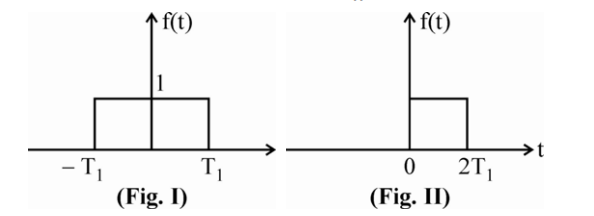
Which one of the following is the Fourier transform of the signal given in Fig. II, if the Fourier transform of the signal in Fig. I is \(=2\dfrac{\sin\omega T_1}{\omega}\) ?
Important Questions from Properties of Fourier Transform
The energy of the signal \(x(t) = \frac{{{\rm{sin}}\left( {4{\rm{\pi t}}} \right)}}{{4{\rm{\pi t}}}}\) is______
Consider the signal x(t) = e-|t|. Let X(jω) = \(\mathop \smallint \limits_{ - \infty }^\infty x\left( t \right){e^{ - j\omega t}}dt\) be the Fourier transform of x(t). The value of X(j0) is
A real-valued signal 𝑥(𝑡) limited to the frequency band \(\left| f \right| \le \frac{W}{2}\) is passed through a linear time-invariant system whose frequency response is
\(H\left( f \right) = \left\{ {\begin{array}{*{20}{c}} {{e^{ - j4\pi f,\;\;\;\left| f \right| \le \frac{W}{2}}}}\\ {0,\;\;\;\;\left| f \right| > \frac{W}{2}} \end{array}} \right.\)
The output of the system isMatch List - I with List - II.
List - I (Sequence x[n]) List - II (Fourier Transform X(Ω)) (A) \(e^{j\Omega_{0}n}x[n]\) (I) \(\left(1-e^{-j\Omega}\right)X(\Omega)\) (B) \(n\,x[n]\) (II) \(X(\Omega-\Omega_{0})\) (C) \(x[n]-x[n-1]\) (III) \(e^{-j\Omega n_{0}}\) (D) \(\delta[n-n_{0}]\) (IV) \(j\dfrac{dX(\Omega)}{d\Omega}\) Choose the correct answer from the options given below :
Which one of the following is the Fourier transform of the signal given in Fig. II, if the Fourier transform of the signal in Fig. I is \(=2\dfrac{\sin\omega T_1}{\omega}\) ?



