
The energy of the signal \(x(t) = \frac{{{\rm{sin}}\left( {4{\rm{\pi t}}} \right)}}{{4{\rm{\pi t}}}}\) is______
We know,
\({\rm{x}}\left( {\rm{t}} \right) = \frac{{{\rm{sin}}4{\rm{\pi t}}}}{{4{\rm{\pi t}}}}\)
Integrating mod square of x(t) to find the energy will be a tedious process.
 Alternate Method
Fourier transform of \(\frac{{{\rm{sin}}4{\rm{\pi t}}}}{{4{\rm{\pi t}}}}\)
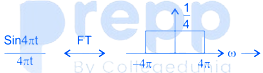
From Parseval’s theorem
\(\mathop \smallint \limits_{ - \infty }^\infty {\left| {{\rm{x}}\left( {\rm{t}} \right)} \right|^2}{\rm{dt}} = \frac{1}{{2{\rm{\pi }}}}\mathop \smallint \limits_{ - \infty }^\infty {\left| {{\rm{X}}\left( {\rm{\omega }} \right)} \right|^2}{\rm{d\omega }}\)
we have,
\(\begin{array}{l} \frac{1}{{2{\rm{\pi }}}}\mathop \smallint \limits_{ - 4{\rm{\pi }}}^{4{\rm{\pi }}} {\left( {\frac{1}{4}} \right)^2}{\rm{d\omega }} = \frac{1}{{2{\rm{\pi }}}}\mathop \smallint \limits_{ - 4{\rm{\pi }}}^{4{\rm{\pi }}} \frac{1}{{16}}{\rm{d\omega }}\\ \Rightarrow = \left. {\frac{1}{{2{\rm{\pi }}}}.\frac{1}{{16}}{\rm{\omega }}} \right|_{ - 4{\rm{\pi }}}^{4{\rm{\pi }}}\\ = \frac{1}{{2{\rm{\pi }}}}.\frac{1}{{16}}.8{\rm{\pi }} = \frac{1}{4} \end{array}\)
Thus,
signal's energy \(\mathop \smallint \limits_{ - \infty }^\infty {\left| {{\rm{x}}\left( {\rm{t}} \right)} \right|^2}{\rm{dt}} = \frac{1}{4}\)
Important Questions from Properties of Fourier Transform
Consider the signal x(t) = e-|t|. Let X(jω) = \(\mathop \smallint \limits_{ - \infty }^\infty x\left( t \right){e^{ - j\omega t}}dt\) be the Fourier transform of x(t). The value of X(j0) is
A real-valued signal 𝑥(𝑡) limited to the frequency band \(\left| f \right| \le \frac{W}{2}\) is passed through a linear time-invariant system whose frequency response is
\(H\left( f \right) = \left\{ {\begin{array}{*{20}{c}} {{e^{ - j4\pi f,\;\;\;\left| f \right| \le \frac{W}{2}}}}\\ {0,\;\;\;\;\left| f \right| > \frac{W}{2}} \end{array}} \right.\)
The output of the system isMatch List - I with List - II.
List - I (Sequence x[n]) List - II (Fourier Transform X(Ω)) (A) \(e^{j\Omega_{0}n}x[n]\) (I) \(\left(1-e^{-j\Omega}\right)X(\Omega)\) (B) \(n\,x[n]\) (II) \(X(\Omega-\Omega_{0})\) (C) \(x[n]-x[n-1]\) (III) \(e^{-j\Omega n_{0}}\) (D) \(\delta[n-n_{0}]\) (IV) \(j\dfrac{dX(\Omega)}{d\Omega}\) Choose the correct answer from the options given below :
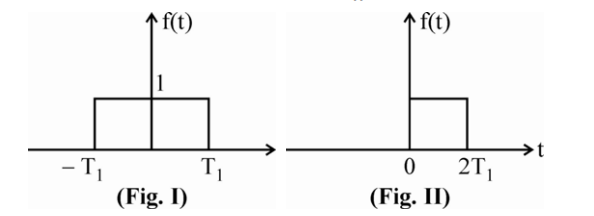
Which one of the following is the Fourier transform of the signal given in Fig. II, if the Fourier transform of the signal in Fig. I is \(=2\dfrac{\sin\omega T_1}{\omega}\) ?
The Hilbert transform of cos ω1t + sin ω2t is


