
A real-valued signal 𝑥(𝑡) limited to the frequency band \(\left| f \right| \le \frac{W}{2}\) is passed through a linear time-invariant system whose frequency response is \(H\left( f \right) = \left\{ {\begin{array}{*{20}{c}} {{e^{ - j4\pi f,\;\;\;\left| f \right| \le \frac{W}{2}}}}\\ {0,\;\;\;\;\left| f \right| > \frac{W}{2}} \end{array}} \right.\)
x(t - 2)
When a signal \( x(t) \) passes through a linear time-invariant (LTI) system, its output \( y(t) \) can be determined in the frequency domain by multiplying the input signal's Fourier Transform \( X(f) \) with the system's frequency response \( H(f) \). This relationship is fundamental in signal processing.
Signal Processing Basics
An LTI system modifies an input signal based on its frequency response. The input signal \( x(t) \) is given as a real-valued signal limited to the frequency band \( \left| f \right| \le \frac{W}{2} \). This means its Fourier Transform, \( X(f) \), is non-zero only within this specific frequency range and is zero outside it.
The frequency response of the system, \( H(f) \), is provided as:
$$ H\left( f \right) = \left\{ {\begin{array}{} {{e^{ - j4\pi f,\;\;\;\left| f \right| \le \frac{W}{2}}}}\\ {0,\;\;\;\;\left| f \right| > \frac{W}{2}} \end{array}} \right. $$
Since the input signal \( x(t) \) is band-limited to \( \left| f \right| \le \frac{W}{2} \), its Fourier Transform \( X(f) \) is zero for \( \left| f \right| > \frac{W}{2} \). Consequently, for frequencies where \( X(f) \) has non-zero values, the system's frequency response is simply \( H(f) = e^{-j4\pi f} \).
System Output Calculation
In the frequency domain, the output signal's Fourier Transform, \( Y(f) \), is given by the product of the input signal's Fourier Transform \( X(f) \) and the system's frequency response \( H(f) \):
$$ Y(f) = X(f) H(f) $$
Substituting the effective \( H(f) \) for the relevant frequency band:
$$ Y(f) = X(f) e^{-j4\pi f} $$
Time-Shifting Property Application
To find the output \( y(t) \) in the time domain, we need to apply the inverse Fourier Transform. We can recognize the form of \( Y(f) \) by recalling the Fourier Transform's time-shifting property.
The time-shifting property states that if \( x(t) \leftrightarrow X(f) \) (where \( \leftrightarrow \) denotes a Fourier Transform pair), then a time-shifted version of the signal, \( x(t - t_0) \), has a Fourier Transform given by:
$$ x(t - t_0) \leftrightarrow X(f)e^{-j2\pi f t_0} $$
Comparing our derived \( Y(f) \) with this property:
$$ Y(f) = X(f) e^{-j4\pi f} $$
We can equate the exponential terms:
$$ e^{-j2\pi f t_0} = e^{-j4\pi f} $$
For this equality to hold, the exponents must be equal:
$$ -j2\pi f t_0 = -j4\pi f $$
Dividing both sides by \( -j2\pi f \) (assuming \( f \neq 0 \)):
$$ t_0 = \frac{-j4\pi f}{-j2\pi f} $$
$$ t_0 = 2 $$
Therefore, the output signal \( y(t) \) is a time-shifted version of the input signal \( x(t) \) with a time shift of \( t_0 = 2 \).
$$ y(t) = x(t - 2) $$
This indicates that the LTI system introduces a delay of 2 units in the signal.
The final answer is \( x(t - 2) \).
Important Questions from Properties of Fourier Transform
The energy of the signal \(x(t) = \frac{{{\rm{sin}}\left( {4{\rm{\pi t}}} \right)}}{{4{\rm{\pi t}}}}\) is______
Consider the signal x(t) = e-|t|. Let X(jω) = \(\mathop \smallint \limits_{ - \infty }^\infty x\left( t \right){e^{ - j\omega t}}dt\) be the Fourier transform of x(t). The value of X(j0) is
Match List - I with List - II.
List - I (Sequence x[n]) List - II (Fourier Transform X(Ω)) (A) \(e^{j\Omega_{0}n}x[n]\) (I) \(\left(1-e^{-j\Omega}\right)X(\Omega)\) (B) \(n\,x[n]\) (II) \(X(\Omega-\Omega_{0})\) (C) \(x[n]-x[n-1]\) (III) \(e^{-j\Omega n_{0}}\) (D) \(\delta[n-n_{0}]\) (IV) \(j\dfrac{dX(\Omega)}{d\Omega}\) Choose the correct answer from the options given below :
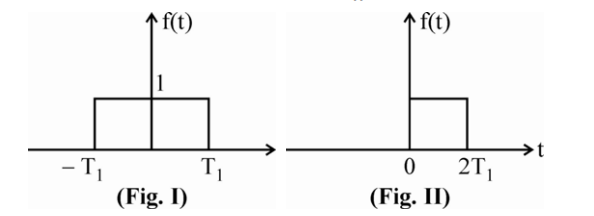
Which one of the following is the Fourier transform of the signal given in Fig. II, if the Fourier transform of the signal in Fig. I is \(=2\dfrac{\sin\omega T_1}{\omega}\) ?
The Hilbert transform of cos ω1t + sin ω2t is


