The figure shows two identical parallel plate capacitors A and B of capacitances C connected to a battery. The key K is initially closed. The switch is now opened and the free spaces between the plates of the capacitors are filled with a dielectric constant 3. Then which of the following statement(s) is/are true ?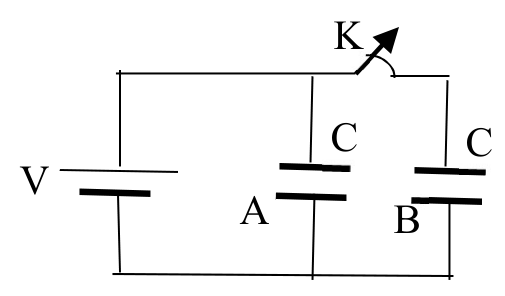
A capacitor that stays connected to a battery keeps its potential difference fixed, while an isolated capacitor keeps its charge fixed. Filling the gap with a dielectric of constant 3 multiplies the capacitance by 3. In the circuit, A is permanently across the battery and the switch K joins B in parallel with it.
Step 1 — With K closed both capacitors have voltage V, so \(U=2\times\dfrac{1}{2}CV^{2}=CV^{2}\).
Step 2 — When K is opened, B is cut off carrying charge CV, and A remains on the battery at voltage V. Both are then filled with the dielectric, so each capacitance becomes 3C.
Step 3 — For A (voltage fixed): \(U_{A}=\dfrac{1}{2}(3C)V^{2}=\dfrac{3}{2}CV^{2}\).
Step 4 — For B (charge fixed): \(U_{B}=\dfrac{(CV)^{2}}{2(3C)}=\dfrac{1}{6}CV^{2}\).
Step 5 — Total energy after opening: \(U=\dfrac{3}{2}CV^{2}+\dfrac{1}{6}CV^{2}=\dfrac{5}{3}CV^{2}\).
The statement that B stores no charge is wrong, since B keeps the charge CV it had when K was opened. The value 3/2 CV2 is the energy of A, not of B, which holds only CV2/6. The total of CV2 with K closed and 5/3 CV2 after opening both hold.
When the switch is closed, total energy stored in the two capacitors is CV2. and When the switch is opened, total energy stored in two capacitors is \(\dfrac{5}{3}\) CV2. options are correct.
Similar Questions
A charged particle of charge q and mass m is placed at a distance 2R from the centre of a vertical cylindrical region of radius R where magnetic field varies as \(\vec{B}=(4t^{2}-2t+6)\hat{k}\), where t is time. Then which of the following statement(s) is/are true ?
An amount of charge Q passes through a coil of resistance R. If the current in the coil decreases to zero at a uniform rate during time T, then the amount of heat generated in the coil will be,
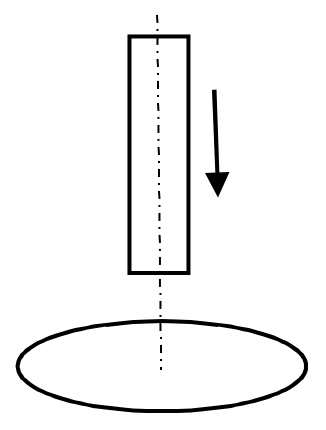
A bar magnet falls from rest under gravity through the centre of a horizontal ring of conducting wire as shown in figure. Which of the following graph best represents the speed (v) vs. time (t) graph of the bar magnet ?
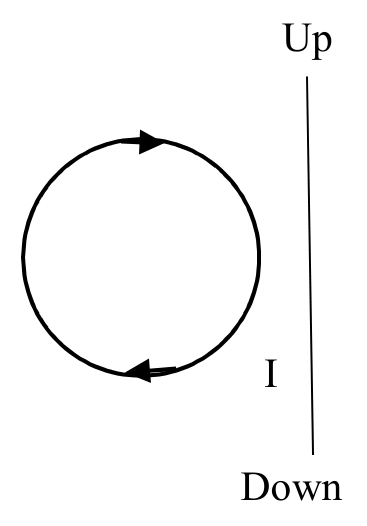
A circular coil is placed near a current carrying conductor, both lying on the plane of the paper. The current is flowing through the conductor in such a way that the induced current in the loop is clockwise as shown in the figure. The current in the wire is,
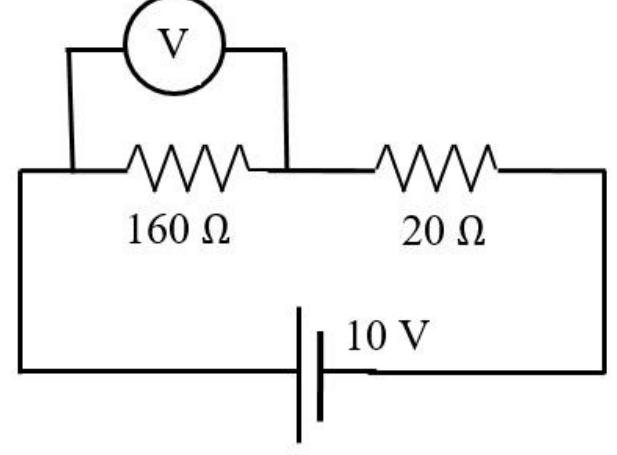
In an experiment on a circuit as shown in the figure, the voltmeter shows 8 V reading. The resistance of the voltmeter is,
A charged particle in a uniform magnetic field \(\vec{B} = B_0\hat{k}\) starts moving from the origin with velocity \(v = 3\hat{i} + 4\hat{k}\) m/s. The trajectory of the particle and the time t at which it reaches 2 m above x-y plane are,
An electric dipole of dipole moment \(\vec{p}\) is placed at the origin of the co-ordinate system along the z-axis. The amount of work required to move a charge ‘q’ from the point (a, 0, 0) to the point (0, 0, a) is,
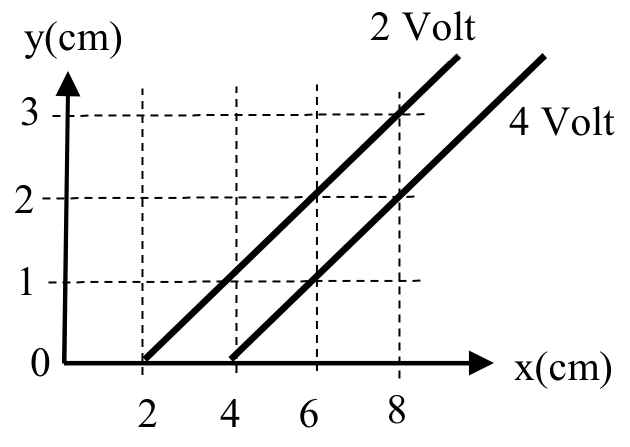
The figure represents two equipotential lines in x-y plane for an electric field. The x-component Ex of the electric field in space between these equipotential lines is,
A wire carrying a steady current I is kept in the x-y plane along the curve \(y = A\sin\left(\dfrac{2\pi}{\lambda}x\right)\).
A magnetic field B exists in the z-direction. The magnitude of the magnetic force in the portion of the wire between x = 0 and x = λ is
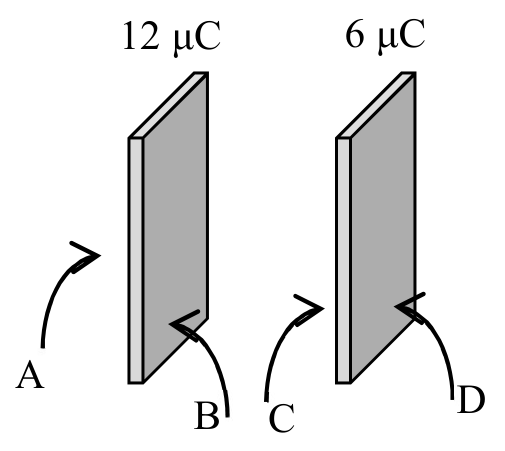
12 μC and 6 μC charges are given to the two conducting plates having same cross-sectional area and placed face to face close to each other as shown in the figure. The resulting charge distribution in μC on surfaces A, B, C and D are respectively,
Important Questions from Electricity and Magnetism
- A short bar magnet placed with its axis at $30^\circ$ with an external field of 800 Gauss, experiences a torque of 0.016 N.m. The work done in moving it from most stable to most unstable position is $\alpha \times 10^{-3} \text{ J}$. The value of $\alpha$ is ______.
- An electromagnetic wave of frequency $100\text{ MHz}$ propagates through a medium of conductivity, $\sigma = 10\text{ mho/m}$. The ratio of maximum conduction current density to maximum displacement current density is __________.
$\left[ \text{Take } \frac{1}{4\pi\varepsilon_0} = 9 \times 10^9\text{ Nm}^2\text{/C}^2 \right]$ - An inductor stores $16\text{ J}$ of magnetic field energy and dissipates $32\text{ W}$ of thermal energy due to its resistance when an a.c. current of $2\text{ A}$ (rms) and frequency $50\text{ Hz}$ flows through it. The ratio of inductive reactance to its resistance is _________. ($\pi = 3.14$)
- A simple pendulum made of mass 10 g and a metallic wire of length 10 cm is suspended vertically in a uniform magnetic field of 2 T. The magnetic field direction is perpendicular to the plane of oscillations of the pendulum. If the pendulum is released from an angle of $60^\circ$ with vertical, then maximum induced EMF between the point of suspension and point of oscillation is ___________ mV. (Take $g = 10\text{ m/s}^2$)
Using a variable frequency a.c. voltage source the maximum current measured in the given LCR circuit is 50 mA for $V = 5\sin(100t)$ The values of L and R are shown in the figure. The capacitance of the capacitor (C) used is ___________ $\mu\text{F}$.