
The error detector element in a control system gives
The difference of the reference signal and the feedback signal
The error detector — the summing junction at the input of every closed loop — subtracts the feedback signal from the reference :
\(E(s)=R(s)-B(s)\qquad\text{where}\qquad B(s)=H(s)\,C(s)\)
which is option 3.
Two details separate the right answer from the near miss.
First, subtraction, not addition. Negative feedback is what makes a closed loop stable and self-correcting: if the output exceeds the reference, the error goes negative and the controller reduces its drive. Adding the two signals (options 1 and 2) would give positive feedback, and the loop would run away to a limit rather than settle.
Second, the feedback signal, not the output. This is why option 4 is wrong. The feedback path contains the sensor and its conditioning, described by \(H(s)\), so what returns to the junction is \(H(s)C(s)\) and not \(C(s)\) itself. The two coincide only in a unity-feedback system, where \(H=1\) — a special case, not the general one. Physically the distinction matters because the reference and the output are usually different kinds of quantity: a thermostat compares a set-point voltage with a thermocouple voltage, not with a temperature.
The closed-loop transfer function follows directly from that subtraction :
\(C=GE=G\left(R-HC\right)\quad\Rightarrow\quad \dfrac{C}{R}=\dfrac{G}{1+GH}\)
The \(1+GH\) in the denominator — the source of every benefit feedback brings — exists only because the junction subtracts. Had it added, the denominator would be \(1-GH\), which vanishes when \(GH=1\) and gives the Barkhausen condition for an oscillator.
| Signal | Symbol |
|---|---|
| Reference / set point | R(s) |
| Feedback | B(s) = H(s)C(s) |
| Error | E(s) = R(s) − B(s) |
| Output | C(s) |
Practical error detectors take many forms — a potentiometer bridge, a differential amplifier, a synchro pair for shaft angles, or simply a subtraction in software — but all perform the same operation, and the steady-state value of E is what the error constants Kp, Kv and Ka quantify.
Hence, the error detector gives the difference of the reference signal and the feedback signal.
Similar Questions
Three blocks having transfer functions \(G_1(s) = \frac{1}{s+2}\), \(G_2(s) = \frac{1}{s+5}\) and \(G_3(s) = \frac{s+1}{s+3}\) are cascaded. The equivalent transfer function is:
Read the following statements about the transfer function of a system :
(a) The transfer function provides complete insight into the structure of the system.
(b) It offers a symbolic picture about the dynamic characteristics of the system.
(c) It does not give any insight into the structure of the system.
(d) If the transfer functions of individual components of the system are known, the overall characteristics of the system can be determined just by taking their product.
Which of the above statements are correct ?
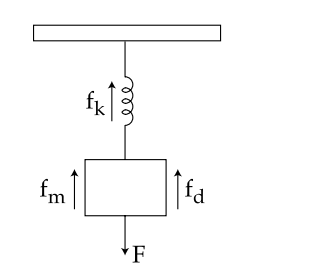
The mass-spring-damper system shown in the following figure represents :
Important Questions from Basics of Control Systems
The term control system means:
Poles are the complex frequencies of a transfer function where the response becomes
Which of the following is the analogous pair under force current analogy?
The electrical capacitance is analog of _________
- Which statement is correct for open loop system?



