
The mass-spring-damper system shown in the following figure represents : 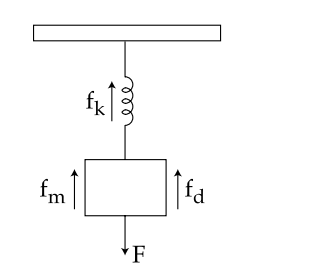
a second-order system
The order of a system is the order of the differential equation that describes it, and for a mechanical system that is set by the number of independent energy stores.
Write the force balance. Newton's second law applied to the mass, with the spring and damper opposing the applied force F, gives
\(M\dfrac{d^{2}x}{dt^{2}}+B\dfrac{dx}{dt}+Kx=F(t)\)
The highest derivative is the second, so this is a second-order system — option 3.
Identify each term with its element :
| Element | Force | Energy stored |
|---|---|---|
| Mass M | \(M\ddot{x}\) | Kinetic, \(\tfrac{1}{2}Mv^{2}\) |
| Damper B | \(B\dot{x}\) | None — it dissipates |
| Spring K | \(Kx\) | Potential, \(\tfrac{1}{2}Kx^{2}\) |
Two energy stores, therefore second order. The damper contributes a first-derivative term but stores nothing, so it does not raise the order — exactly as a resistor does not raise the order of an electrical circuit. That is the point worth carrying away: it is the storage elements that count.
The transfer function and its standard form :
\(\dfrac{X(s)}{F(s)}=\dfrac{1}{Ms^{2}+Bs+K}=\dfrac{1/M}{s^{2}+2\zeta\omega_{n}s+\omega_{n}^{2}}\)
with
\(\omega_{n}=\sqrt{\dfrac{K}{M}}\qquad \zeta=\dfrac{B}{2\sqrt{KM}}\)
— the mass and spring set the natural frequency, and the damper alone sets the damping ratio.
The electrical analogue makes the correspondence exact. A series RLC circuit obeys the identical equation with mass ↔ inductance, damper ↔ resistance and spring compliance ↔ capacitance; force corresponds to voltage and velocity to current. That is why an RLC circuit and a suspension both overshoot and ring in the same way, and why the whole vocabulary of overshoot, settling time and damping ratio transfers between the two domains.
Why the other orders would need different hardware : a zero-order system has no dynamics at all (a plain potentiometer), a first-order one has a single store (a thermometer, an RC circuit), and third order would require a further independent store beyond the two present here.
Hence, the mass-spring-damper is a second-order system.
Similar Questions
Three blocks having transfer functions \(G_1(s) = \frac{1}{s+2}\), \(G_2(s) = \frac{1}{s+5}\) and \(G_3(s) = \frac{s+1}{s+3}\) are cascaded. The equivalent transfer function is:
Read the following statements about the transfer function of a system :
(a) The transfer function provides complete insight into the structure of the system.
(b) It offers a symbolic picture about the dynamic characteristics of the system.
(c) It does not give any insight into the structure of the system.
(d) If the transfer functions of individual components of the system are known, the overall characteristics of the system can be determined just by taking their product.
Which of the above statements are correct ?
The error detector element in a control system gives
Important Questions from Basics of Control Systems
The term control system means:
Poles are the complex frequencies of a transfer function where the response becomes
Which of the following is the analogous pair under force current analogy?
The electrical capacitance is analog of _________
- Which statement is correct for open loop system?



