
Read the following statements about the transfer function of a system : (a) The transfer function provides complete insight into the structure of the system. (b) It offers a symbolic picture about the dynamic characteristics of the system. (c) It does not give any insight into the structure of the system. (d) If the transfer functions of individual components of the system are known, the overall characteristics of the system can be determined just by taking their product. Which of the above statements are correct ?
Only (b) and (c)
Only (b) and (c) — option 2.
What a transfer function is. For a linear time-invariant system it is the ratio of the Laplace transform of the output to that of the input, with all initial conditions zero:
\(G(s)=\dfrac{C(s)}{R(s)}\)
Everything the four statements assert follows from one fact about that definition — it is a description of behaviour, not of construction.
| Statement | Verdict | Reason |
|---|---|---|
| (a) Gives complete insight into the structure | False | Contradicts (c); see below |
| (b) Offers a symbolic picture of the dynamic characteristics | True | Poles, zeros and gain fix the whole dynamic response |
| (c) Gives no insight into the structure | True | The standard statement of the same point |
| (d) Overall characteristics found just by taking the product | False as written | The word “just” ignores loading; see below |
(a) and (c) are direct contradictions, so exactly one of them is true, and the true one is (c). A transfer function is blind to physical realisation: an RC network, a mass-spring-damper and an op-amp filter can share the identical \(\dfrac{1}{s+1}\), and nothing in that expression reveals which is on the bench. This is precisely why analogue simulation works — an electrical circuit can stand in for a mechanical system because the transfer function does not care.
(b) is true because the transfer function does capture the dynamics completely. The poles fix stability and the character of the transient — overdamped, underdamped, oscillatory; the zeros shape it; the DC gain \(G(0)\) fixes the steady-state value. Everything a control engineer needs about behaviour is in \(G(s)\).
Why (d) fails, and this is the subtle half of the question. The cascade rule is genuinely useful:
\(G(s)=G_{1}(s)\,G_{2}(s)\cdots G_{n}(s)\)
but it holds only under conditions the statement omits. The word “just” is what makes it false :
| Required condition | What goes wrong without it |
|---|---|
| No loading between stages | If stage 2 draws current from stage 1, stage 1’s own transfer function changes. Two cascaded RC sections are not the product of two isolated RC transfer functions |
| The connection is a plain cascade | With feedback the rule is \(\dfrac{G}{1+GH}\), not a product; in parallel it is a sum |
In practice the loading problem is solved by inserting buffer amplifiers with high input and low output impedance, and only then does the product rule apply exactly.
The limitations to carry away: the transfer function applies only to linear, time-invariant systems, assumes zero initial conditions, describes only the input-output relation and so says nothing about internal states — which is exactly the gap the state-space representation was developed to fill.
Hence, the answer is Only (b) and (c).
Similar Questions
Three blocks having transfer functions \(G_1(s) = \frac{1}{s+2}\), \(G_2(s) = \frac{1}{s+5}\) and \(G_3(s) = \frac{s+1}{s+3}\) are cascaded. The equivalent transfer function is:
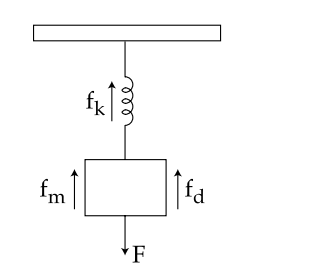
The mass-spring-damper system shown in the following figure represents :
The error detector element in a control system gives
Important Questions from Basics of Control Systems
The term control system means:
Poles are the complex frequencies of a transfer function where the response becomes
Which of the following is the analogous pair under force current analogy?
The electrical capacitance is analog of _________
- Which statement is correct for open loop system?



