
To deal with issues of democracy and authoritarian rules we have to pay particular attention to both the context what can be called development and to the interpretation of democracy, in particular to the respective roles of voting and public reasoning. The assessment of development cannot be divorced from the lives that people can lead and the real freedom that they enjoy. Development can scarcely be seen mere in terms of enhancement of inanimate objects of convenience, such as a rise in GNP or in personal incomes, or industrialization important as they may be as means to the real ends. Their value must depend upon what they do to the lives and freedom of the people involved, which must be central to the idea of development. If development is understood in a broader way with a focus on human lives, then it becomes immediately clear that the relation between development and democracy has to be seen partly in terms of their constitutive connection, rather than only through their external links. Even though the question has often been asked whether political freedom is 'conducive to development', we must not miss the crucial recognition that political liberties and democratic rights are among the constituent components of development. Their relevance for development does not have to be established indirectly through their contribution to the growth of GNP. However, after acknowledging this central connection, we also have to subject democracy to consequential analysis since there are other kinds of freedoms as well, other than political liberties and civil rights, to which attention must be paid. We must be concerned, for example, with economic poverty.
The central theme of the passage is:
Development and freedoms are inter-related.
Throughout the passage, the author (writing in the tradition of Amartya Sen's capability approach) repeatedly links development to the real freedoms and lives of people, argues that political liberties are constituent components of development (not just means to GNP growth), and calls for attention to freedom from poverty alongside political and civil freedoms.
The unifying idea running through all of this is that development and freedoms are inter-related. The passage explicitly rejects treating industrialisation as essential for political freedom, treating development as unlinked to human lives, or treating development as a purely economic proposition — so those three options are the opposite of what the passage argues.
Similar Questions
Subliminal communication is part of.
What is the main focus of this passage?
The passage indicates that one of the responsibilities of a firefighter is to.
The passage states that, compared with people who do not have smoke detectors, persons who live in homes with smoke detectors have a
A smoke detector should not be installed near a window because
A smoke detector must always be placed
The interpretation of democracy depends upon
Development should be comprehensively measured in terms of
The relation between democracy and development can be seen through their
The consequential analysis of democracy as related to development should take into account
Important Questions from Miscellaneous
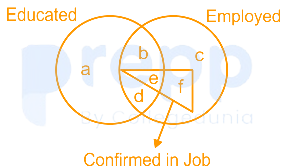
Read the given figure and find the region representing persons who are educated and employed but not confirmed in job.
The magazine in which Mahatma Gandhi mentioned what he wanted the Constitution to do is:
Which gas shields the surface of the earth from ultraviolet radiation from the sun?
Which event is marked as an Intangible Cultural Heritage of Humanity by UNESCO?
Who has been conferred with the rank of the Commander of the Order of the British Empire in 2018?



