
The 6 V zener diode shown in figure has zero zener resistance and a knee current of 5 mA. The minimum value of R so that the voltage across it does not fall below 6 V is :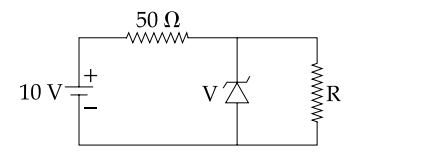
80 Ω
The zener regulates only while it keeps conducting, so the whole problem is a current-budget question.
Step 1 — the series current is fixed. With the zener holding its terminals at 6 V, the drop across the 50 Ω resistor is the same whatever the load does:
\(I_{S}=\dfrac{V_{in}-V_{Z}}{R_{S}}=\dfrac{10-6}{50}=\dfrac{4}{50}=80\ \text{mA}\)
This 80 mA is the total current available, and it must divide between the zener and the load:
\(I_{S}=I_{Z}+I_{L}\)
Step 2 — the zener must keep at least its knee current. Below the knee (5 mA) the device leaves the breakdown region and stops holding 6 V. So
\(I_{L(max)}=I_{S}-I_{Z(min)}=80-5=75\ \text{mA}\)
Step 3 — convert the maximum load current into the minimum load resistance. A smaller R draws a larger current, so the current limit sets a lower bound on R:
\(R_{min}=\dfrac{V_{Z}}{I_{L(max)}}=\dfrac{6}{75\ \text{mA}}=80\ \Omega\)
which is option 2.
| R | IL | IZ = 80 − IL | Regulating? |
|---|---|---|---|
| 1.2 kΩ | 5 mA | 75 mA | Yes, comfortably |
| 80 Ω | 75 mA | 5 mA | Just at the knee |
| 50 Ω | 120 mA | Impossible | No — zener drops out |
What happens if R is made smaller than 80 Ω. The load now wants more than 80 mA, but only 80 mA can flow through the 50 Ω resistor while the output sits at 6 V. The output voltage must therefore fall, the zener stops conducting altogether, and the circuit degenerates into a plain potential divider — regulation is lost. That is exactly the condition the question asks us to avoid.
The complementary design check is the zener's power rating at the other extreme. With the load removed entirely the zener carries the whole 80 mA and dissipates
\(P_{Z}=V_{Z}I_{Z}=6\times0.08=0.48\ \text{W}\)
so a half-watt device would be marginal. A practical shunt regulator has to satisfy both limits at once: enough current to stay above the knee at maximum load, and not so much that the zener overheats at minimum load.
Hence, the minimum value of R is 80 Ω.
Similar Questions
A PIN diode can not be used as
i. Microwave switch
ii. Microwave mixer
iii. Microwave detectorWhich is correct ?
________ diode is not used as a microwave mixer or detector.
Match the given lists :
List – I (Name of the Device) List – II (Application) a. Diode i. Rectification b. Tunnel diode ii. Microwave switching c. Zener diode iii. An oscillator d. PIN diode iv. Voltage regulation Codes :
Varacter diodes have the following properties :
A. Junction capacitance varies with bias voltage
B. Junction capacitance varies with time
C. Non linearity of varacter diodes makes them suitable for frequency multipliers
D. Linearity of varactor diode makes them suitable for frequency multipliers.
Choose the correct answer from the options given below:
In a tunnel diode, the degeneracy on the n-side can be expressed as
The static current voltage characteristics of a tunnel diode consist of
(a) Tunneling current and thermal current
(b) Thermal current and excess current
(c) Tunneling current only
(d) Tunneling current, excess current and thermal current
Out of these which are correct ?
Match the following :
List – I List – II a. Gunn diode i. degenerate silicon b. Tunnel diode ii. n-type Ga As c. BJT iii. Silicon d. Diode (P-N junction) iv. \(I_o\left[\exp\left(\dfrac{qV}{kT}\right)-1\right]\) Choose the correct answer from the codes given below:
A TRAPATT diode has the doping concentration NA = 2 x 10¹⁵/cm3 and a current density of 20 kA/cm2. The value of avalanche zone velocity is given by :
Assertion (A) : The Gunn diode characteristics shows the region of negative resistance.
Reason (R) : The Gunn diode is made of n-type and p-type degenerate semiconductor.
Select your answer using the codes given below.
Which of the following statements are correct for Tunnel Diode ?
(a) 1 impurity atom in 103 atoms
(b) Very high doping in both p and n regions
(c) 1 impurity atom in 108 atoms
(d) used as a voltage controlled devices
Out of the above, the following is the correct answer :
Important Questions from Types of Diode
A PIN diode can not be used as
i. Microwave switch
ii. Microwave mixer
iii. Microwave detectorWhich is correct ?
________ diode is not used as a microwave mixer or detector.
Match the given lists :
List – I (Name of the Device) List – II (Application) a. Diode i. Rectification b. Tunnel diode ii. Microwave switching c. Zener diode iii. An oscillator d. PIN diode iv. Voltage regulation Codes :
Varacter diodes have the following properties :
A. Junction capacitance varies with bias voltage
B. Junction capacitance varies with time
C. Non linearity of varacter diodes makes them suitable for frequency multipliers
D. Linearity of varactor diode makes them suitable for frequency multipliers.
Choose the correct answer from the options given below:
In a tunnel diode, the degeneracy on the n-side can be expressed as



