
Sentences of a paragraph are given below in jumbled order. Arrange the sentences in the correct order to form a meaningful and coherent paragraph. A. He repeated the experiment, increasing the amount until he had weighed up to a thousand pounds. B. During the spring of 1717, the iron foundries in a remote district were often visited by a thin, middle-aged man with a notebook. C. Three cauldrons were next prepared under his directions. D. He would weigh out two pounds of iron, have them heated till they were red-hot and then weigh them again.
BDAC
Understanding Paragraph Cohesion: Arranging Jumbled Sentences
The task is to arrange the given sentences in a logical order to form a coherent and meaningful paragraph. To do this, we look for a sentence that introduces the main topic or character, and then identify how the other sentences follow sequentially, describing actions, events, or details related to the introduction.
Identifying the Topic Sentence
Let's examine each sentence:
- A. He repeated the experiment, increasing the amount until he had weighed up to a thousand pounds. (Refers to a previously mentioned "experiment" and "He")
- B. During the spring of 1717, the iron foundries in a remote district were often visited by a thin, middle-aged man with a notebook. (Introduces a person and setting, providing context. This is a strong candidate for the opening sentence.)
- C. Three cauldrons were next prepared under his directions. (Refers to "his directions" and implies a sequence with "next".)
- D. He would weigh out two pounds of iron, have them heated till they were red-hot and then weigh them again. (Describes an action performed by "He".)
Sentence B clearly introduces the main subject – a man visiting iron foundries. This makes it the most suitable opening sentence for the paragraph.
Establishing the Flow: From Introduction to Action
After introducing the man (B), we need to know what he does at the foundries. Sentence D describes an action he performs: weighing iron, heating it, and weighing it again. This action is likely what he was doing during his visits mentioned in B. So, D logically follows B.
So far, the order is BD.
Developing the Narrative: Repeating the Experiment
Sentence D describes a specific action, which sounds like an experiment or a test involving weighing heated iron. Sentence A explicitly mentions "He repeated the experiment, increasing the amount...". This sentence directly follows the description of the initial experimental action in D, showing the continuation and scaling of his work.
The sequence is now BDA.
Completing the Paragraph: The Next Step
Sentence C states, "Three cauldrons were next prepared under his directions." The word "next" indicates that this action happens after the previous events. While sentences D and A focus on the weighing experiment, sentence C introduces a new activity – preparing cauldrons. This could be the next phase of his work or research after completing his weighing tests. Placing C after A provides a plausible sequence of events related to the man's activities at the foundries.
Thus, the logical sequence is BDAC.
The Arranged Paragraph
Putting the sentences in the order BDAC:
- During the spring of 1717, the iron foundries in a remote district were often visited by a thin, middle-aged man with a notebook.
- He would weigh out two pounds of iron, have them heated till they were red-hot and then weigh them again.
- He repeated the experiment, increasing the amount until he had weighed up to a thousand pounds.
- Three cauldrons were next prepared under his directions.
This arrangement forms a coherent paragraph that introduces the man, describes his initial experiment, details the extent of his repeated experiments, and then mentions the next step in his activities.
| Sentence | Content | Role in Paragraph |
|---|---|---|
| B | Man visits foundries in 1717 | Introduction of subject and setting |
| D | He weighs and heats iron | Describes initial action/experiment |
| A | He repeats/scales the experiment | Shows continuation of the action |
| C | Cauldrons prepared next | Describes subsequent action |
The order BDAC establishes a clear narrative flow, starting with the introduction, moving to the core activity, detailing its scale, and concluding with a subsequent action.
Revision Table: Checking the Flow
Let's quickly review how the sentences connect in the BDAC order:
- B to D: B introduces the man visiting the foundries. D explains what he does there - an experiment with iron. The connection is logical; the visit is for the purpose described in D.
- D to A: D describes the initial experiment. A describes repeating this experiment on a larger scale. This is a direct continuation of the action described in D.
- A to C: A concludes the description of the weighing experiments. C introduces a new action, preparing cauldrons, as the "next" step. While less directly linked than B-D and D-A, it logically follows as something he directs after his weighing work.
The overall flow in BDAC is cohesive and meaningful.
Additional Information: Tips for Sentence Rearrangement
Here are some helpful tips for arranging jumbled sentences to form a coherent paragraph:
- Look for the introductory sentence: This sentence usually introduces the main topic, person, or event and provides context. It often stands alone without referring to previous sentences using pronouns like 'he', 'she', 'it', 'they', or conjunctions like 'but', 'so', 'therefore'.
- Identify connecting ideas: Look for sentences that logically follow the introductory sentence. These might describe the next event, provide details, or explain the purpose.
- Find pronoun references: Sentences using pronouns (he, she, it, they) or demonstratives (this, that, these, those) usually follow sentences that introduce the noun or idea they refer to.
- Look for sequence markers: Words like 'first', 'next', 'then', 'finally', 'after this', 'before that' indicate the chronological order of events.
- Identify cause and effect: Some sentences explain the reason for an action (cause), while others describe the result (effect). Arrange them accordingly.
- Recognize concluding sentences: A sentence that summarizes the main point, provides a conclusion, or describes the final outcome might be the last sentence of the paragraph.
- Read the rearranged paragraph: After arranging the sentences, read the entire paragraph aloud to check for smooth transitions and logical flow. Does it make sense as a whole?
Practicing with various examples helps improve your ability to identify these connections and arrange sentences correctly.
Similar Questions
Select the grammatically correct sentence.
Select the most appropriate synonym of the given word.
Zealous
Select the most appropriate option that can substitute the underlined word in the given sentence.
She had an ability to persuade others.
Select the most appropriate option that can substitute the underlined segment in the given sentence.
We must remember that what we teach our children is what we inculcate in them.
Select the option that expresses the given sentence in passive voice.
He won’t receive any better choice than this from anywhere.
Select the most appropriate synonym of the given word.
Feeble
Select the correct spelling of the underline word.
They denied having any associasion with the terrorists.
Select the most appropriate meaning of the underlined idiom in the given sentence.
Pooja tried to explain the problem, but soon she tied herself up in knots.
Sentences of a paragraph are given below in jumbled order. Arrange the sentences in the correct order to form a meaningful and coherent paragraph.
A. In Bihar and Central India, in particular, every district had smelters that used local deposits of ore to produce iron which was widely used for the manufacture of implements and tools of daily use.
B. The smelting was done by men while women worked on the bellows, pumping air that kept the charcoal burning.
C. But iron smelting in India was extremely common till the end of the nineteenth century.
D. Production of Wootz steel required a highly specialised technique of refining iron.
Select the most appropriate option to fill in the blank.
She is _________ a peacock in the blue satin saree.
Important Questions from Miscellaneous
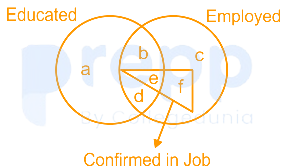
Read the given figure and find the region representing persons who are educated and employed but not confirmed in job.
The magazine in which Mahatma Gandhi mentioned what he wanted the Constitution to do is:
Which gas shields the surface of the earth from ultraviolet radiation from the sun?
Which event is marked as an Intangible Cultural Heritage of Humanity by UNESCO?
Who has been conferred with the rank of the Commander of the Order of the British Empire in 2018?



