
Select the option that expresses the given sentence in passive voice. He won’t receive any better choice than this from anywhere.
Any better choice won’t be received by him than this from anywhere.
Understanding Voice Change: Active to Passive
Voice change involves transforming a sentence from active voice to passive voice or vice versa. The active voice emphasizes the subject performing the action, while the passive voice emphasizes the action itself or the object receiving the action.
In the given question, we need to convert the sentence "He won’t receive any better choice than this from anywhere" from active voice to passive voice.
Analyzing the Active Sentence
Let's break down the structure of the active sentence:
- Subject: He
- Verb Phrase: won’t receive (This indicates Simple Future Tense, negative form)
- Object: any better choice than this from anywhere
The sentence is in the Simple Future Tense (will/won't + base form of the verb).
Rules for Converting Simple Future Active to Passive
The general structure for converting a Simple Future active sentence (Subject + will/won't + Verb + Object) to passive voice is:
Object + will/won't + be + Past Participle of the Verb + by + Subject (optional, if the subject is not important or unknown).
Step-by-Step Conversion
Let's apply the rules to our sentence "He won’t receive any better choice than this from anywhere":
- Identify the object: "any better choice than this from anywhere". This becomes the subject of the passive sentence.
- Identify the verb and tense: "won’t receive" is Simple Future negative. The passive structure will be "won’t be" followed by the past participle.
- Determine the past participle of the main verb "receive": The past participle is "received".
- Identify the original subject: "He". In the passive voice, this becomes "by him".
Putting it all together, the passive sentence structure becomes:
Any better choice than this from anywhere + won’t be + received + by him.
Rearranging slightly for better flow, we get: "Any better choice won’t be received by him than this from anywhere."
Evaluating the Options
Now, let's compare our derived passive sentence with the given options:
| Option | Sentence | Analysis |
|---|---|---|
| 1 | Any better choice won’t be received by him than this from anywhere. | Matches the passive structure for Simple Future tense (Object + won’t be + Past Participle + by + Subject). Correct. |
| 2 | Any better choice wouldn’t have received by him than this from anywhere. | Uses "wouldn’t have received", which is incorrect for Simple Future passive. The structure "have received by him" is also grammatically incorrect for passive voice; it should be "have been received". |
| 3 | Any better choice shouldn’t be received by him than this from anywhere. | Uses the modal verb "shouldn’t", which changes the meaning from the original sentence which uses "won’t". The structure itself ("shouldn't be received") is passive, but the modality is wrong. |
| 4 | Any better choice won’t have been be received by him than this from anywhere. | Uses "won’t have been received", which is the future perfect passive tense, not the simple future passive. It also has an extra "be". Incorrect tense and structure. |
Conclusion on Passive Voice Transformation
Based on the analysis, Option 1 correctly transforms the active voice sentence "He won’t receive any better choice than this from anywhere" into passive voice following the rules for the Simple Future Tense.
Revision Table: Key Tense Conversions (Active to Passive)
| Tense | Active Voice Structure | Passive Voice Structure |
|---|---|---|
| Simple Present | Subject + Verb(s)/Verb + Object | Object + is/am/are + Past Participle + by + Subject |
| Simple Past | Subject + Verb(ed) + Object | Object + was/were + Past Participle + by + Subject |
| Simple Future | Subject + will/won’t + Verb + Object | Object + will/won’t + be + Past Participle + by + Subject |
| Present Continuous | Subject + is/am/are + Verb(ing) + Object | Object + is/am/are + being + Past Participle + by + Subject |
| Past Continuous | Subject + was/were + Verb(ing) + Object | Object + was/were + being + Past Participle + by + Subject |
| Present Perfect | Subject + has/have + Past Participle + Object | Object + has/have + been + Past Participle + by + Subject |
| Past Perfect | Subject + had + Past Participle + Object | Object + had + been + Past Participle + by + Subject |
| Future Perfect | Subject + will/won’t + have + Past Participle + Object | Object + will/won’t + have + been + Past Participle + by + Subject |
Additional Information on Active and Passive Voice
Active voice is generally preferred for clear and direct communication. Passive voice is used when:
- The doer of the action is unknown or unimportant.
- The focus is on the action or the receiver of the action rather than the doer.
- You want to sound more formal or objective (e.g., in scientific writing).
- You want to avoid mentioning the doer.
Changing voice does not change the tense of the sentence. It only changes the structure using the auxiliary verb 'to be' and the past participle.
Similar Questions
Select the grammatically correct sentence.
Select the most appropriate synonym of the given word.
Zealous
Select the most appropriate option that can substitute the underlined word in the given sentence.
She had an ability to persuade others.
Select the most appropriate option that can substitute the underlined segment in the given sentence.
We must remember that what we teach our children is what we inculcate in them.
Select the most appropriate synonym of the given word.
Feeble
Select the correct spelling of the underline word.
They denied having any associasion with the terrorists.
Select the most appropriate meaning of the underlined idiom in the given sentence.
Pooja tried to explain the problem, but soon she tied herself up in knots.
Sentences of a paragraph are given below in jumbled order. Arrange the sentences in the correct order to form a meaningful and coherent paragraph.
A. In Bihar and Central India, in particular, every district had smelters that used local deposits of ore to produce iron which was widely used for the manufacture of implements and tools of daily use.
B. The smelting was done by men while women worked on the bellows, pumping air that kept the charcoal burning.
C. But iron smelting in India was extremely common till the end of the nineteenth century.
D. Production of Wootz steel required a highly specialised technique of refining iron.
Sentences of a paragraph are given below in jumbled order. Arrange the sentences in the correct order to form a meaningful and coherent paragraph.
A. He repeated the experiment, increasing the amount until he had weighed up to a thousand pounds.
B. During the spring of 1717, the iron foundries in a remote district were often visited by a thin, middle-aged man with a notebook.
C. Three cauldrons were next prepared under his directions.
D. He would weigh out two pounds of iron, have them heated till they were red-hot and then weigh them again.
Select the most appropriate option to fill in the blank.
She is _________ a peacock in the blue satin saree.
Important Questions from Miscellaneous
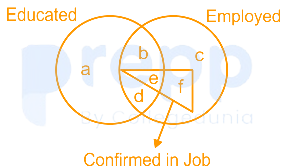
Read the given figure and find the region representing persons who are educated and employed but not confirmed in job.
The magazine in which Mahatma Gandhi mentioned what he wanted the Constitution to do is:
Which gas shields the surface of the earth from ultraviolet radiation from the sun?
Which event is marked as an Intangible Cultural Heritage of Humanity by UNESCO?
Who has been conferred with the rank of the Commander of the Order of the British Empire in 2018?



