
Sentences of a paragraph are given below in jumbled order. Arrange the sentences in the correct order to form a meaningful and coherent paragraph. A. In Bihar and Central India, in particular, every district had smelters that used local deposits of ore to produce iron which was widely used for the manufacture of implements and tools of daily use. B. The smelting was done by men while women worked on the bellows, pumping air that kept the charcoal burning. C. But iron smelting in India was extremely common till the end of the nineteenth century. D. Production of Wootz steel required a highly specialised technique of refining iron.
DCAB
Understanding Sentence Arrangement for a Coherent Paragraph
The task requires arranging the given jumbled sentences to form a meaningful and coherent paragraph. To do this, we need to read each sentence carefully and identify the main idea of the paragraph, the possible starting sentence, connecting ideas between sentences, and the concluding sentence.
Here are the jumbled sentences:
- A. In Bihar and Central India, in particular, every district had smelters that used local deposits of ore to produce iron which was widely used for the manufacture of implements and tools of daily use.
- B. The smelting was done by men while women worked on the bellows, pumping air that kept the charcoal burning.
- C. But iron smelting in India was extremely common till the end of the nineteenth century.
- D. Production of Wootz steel required a highly specialised technique of refining iron.
Let's analyze the sentences to find the logical flow:
- Sentence D introduces the topic of "Wootz steel" and highlights that its production was a "highly specialised technique of refining iron". This seems like a good starting point as it introduces a specific type of metal production related to iron.
- Sentence C talks about "iron smelting in India" being "extremely common till the end of the nineteenth century". The word "But" at the beginning of sentence C suggests a contrast with the previous statement. If D comes before C, then C could be contrasting the specialized technique for Wootz steel (mentioned in D) with the more common practice of general iron smelting. This contrast makes sense.
- Sentence A provides specific examples of "smelters" and "produce iron" in "Bihar and Central India". This gives geographical detail about the "common iron smelting" mentioned in sentence C. Therefore, A logically follows C.
- Sentence B describes the process of "smelting" ("done by men while women worked on the bellows"). This sentence details how the common iron smelting mentioned in A and C was performed. B naturally follows A, providing a description of the activity happening in the smelters mentioned in A.
Based on this analysis, the most logical order for the sentences is D-C-A-B.
- D: Introduces the specific, specialized technique of Wootz steel production.
- C: Contrasts the specialized Wootz technique with the widespread, common practice of iron smelting across India ("But... iron smelting in India was extremely common...").
- A: Provides specific geographical examples and details about this widespread, common iron smelting (location, presence in every district, use of local ore, purpose of iron).
- B: Describes the specific tasks involved in the process of this common smelting activity (roles of men and women, use of bellows).
Let's read the paragraph in the DCAB order:
Production of Wootz steel required a highly specialised technique of refining iron. But iron smelting in India was extremely common till the end of the nineteenth century. In Bihar and Central India, in particular, every district had smelters that used local deposits of ore to produce iron which was widely used for the manufacture of implements and tools of daily use. The smelting was done by men while women worked on the bellows, pumping air that kept the charcoal burning.
This sequence forms a cohesive and meaningful paragraph, starting with a specific point about Wootz steel, contrasting it with general iron smelting, giving examples of the common practice, and finally describing the process.
Revision Table: Analyzing Sentence Connectors
| Sentence | Potential Clues/Keywords | Connection |
|---|---|---|
| D | Wootz steel, highly specialised technique, refining iron | Introduces a specific type of iron processing. Often a good starting point or follows a broader statement about iron/steel. |
| C | But, iron smelting, extremely common, till the end of the nineteenth century | "But" indicates contrast. "Extremely common" contrasts with "highly specialised" in D. Provides a general historical context for common iron production. |
| A | In Bihar and Central India, every district, smelters, produce iron, daily use | Gives specific examples ("In particular") related to the "iron smelting" and its widespread nature ("every district") mentioned in C. Mentions "smelters" where smelting happens. |
| B | The smelting, men, women, bellows, pumping air, charcoal burning | Describes the process ("The smelting") that takes place in the "smelters" mentioned in A. Follows descriptions of smelting activity. |
Additional Information on Iron Smelting in India
Iron smelting has a long history in India. Archaeological evidence suggests that iron was used in the Indian subcontinent as early as the second millennium BCE. Indian ironworkers were known for their skill in producing high-quality iron and steel.
- Wootz Steel: This was a high-carbon steel developed in India, known for its strength and sharpness. It was famous across the ancient world and was used to make swords, including the legendary Damascus blades. The technique involved controlled heating and cooling of iron in a crucible with carbonaceous material.
- Common Iron Smelting: Apart from specialized techniques like Wootz, basic iron smelting from locally available ore was a widespread rural industry in many parts of India for centuries. This process typically involved reducing iron ore in small furnaces using charcoal as fuel, often with the help of bellows to provide air. The iron produced was used for agricultural tools, household implements, weapons, and construction.
- Decline: The traditional iron smelting industry in India faced decline during the colonial period, partly due to competition from imported iron and steel produced using industrial methods, and also due to forest regulations that restricted access to charcoal wood.
Understanding the context of iron and steel production in India helps in appreciating the historical significance of the activities described in the jumbled sentences.
Similar Questions
Select the grammatically correct sentence.
Select the most appropriate synonym of the given word.
Zealous
Select the most appropriate option that can substitute the underlined word in the given sentence.
She had an ability to persuade others.
Select the most appropriate option that can substitute the underlined segment in the given sentence.
We must remember that what we teach our children is what we inculcate in them.
Select the option that expresses the given sentence in passive voice.
He won’t receive any better choice than this from anywhere.
Select the most appropriate synonym of the given word.
Feeble
Select the correct spelling of the underline word.
They denied having any associasion with the terrorists.
Select the most appropriate meaning of the underlined idiom in the given sentence.
Pooja tried to explain the problem, but soon she tied herself up in knots.
Sentences of a paragraph are given below in jumbled order. Arrange the sentences in the correct order to form a meaningful and coherent paragraph.
A. He repeated the experiment, increasing the amount until he had weighed up to a thousand pounds.
B. During the spring of 1717, the iron foundries in a remote district were often visited by a thin, middle-aged man with a notebook.
C. Three cauldrons were next prepared under his directions.
D. He would weigh out two pounds of iron, have them heated till they were red-hot and then weigh them again.
Select the most appropriate option to fill in the blank.
She is _________ a peacock in the blue satin saree.
Important Questions from Miscellaneous
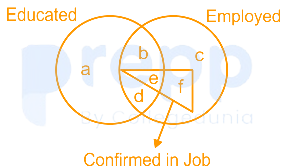
Read the given figure and find the region representing persons who are educated and employed but not confirmed in job.
The magazine in which Mahatma Gandhi mentioned what he wanted the Constitution to do is:
Which gas shields the surface of the earth from ultraviolet radiation from the sun?
Which event is marked as an Intangible Cultural Heritage of Humanity by UNESCO?
Who has been conferred with the rank of the Commander of the Order of the British Empire in 2018?



